Sheffield has recently been voted as the UK’s most sustainable city, and with Leeds also featuring in the UK’s top ten, there is a lot to celebrate about the green revolution sweeping Yorkshire. Kwasi Kwarteng, secretary of state for business, energy and industrial strategy, recently described Yorkshire as a “climate conscious county, leading by example”.
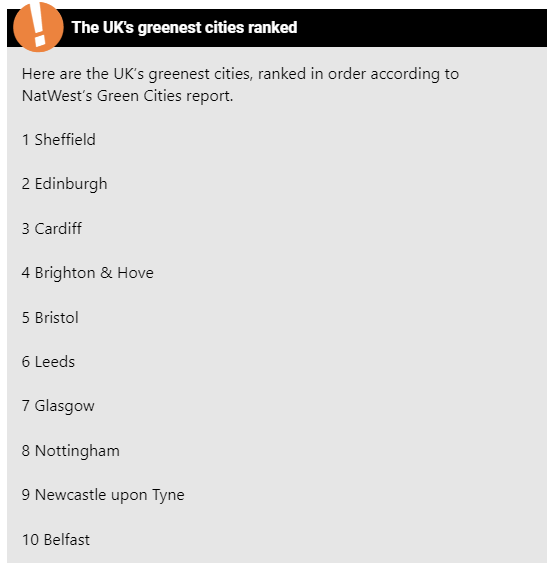
Sustainable Sheffield
It is difficult to think of Sheffield without thinking of the opening sequence of The Full Monty, where Sheffield is described as “a city on the move”. In stark contrast to its industrial powerhouse heritage, Sheffield is now a beacon of sustainability where economic growth can go hand in hand with environmental growth. Kwasi Kwarteng also praised local companies and projects, such as Siemens Gamesa, the Leeds District Heat Network, and the biomass company Drax, which have all recognised this economic opportunity.
“These local firms recognise that taking action on climate change isn’t a cost on business – it helps companies grow, seize new opportunities, create new jobs, all while lowering running costs and attracting new customers.”
The ‘green cities report’ ranked areas using a range of environmental data including pollution levels, renewable energy production, car use and green space.
Responding to this report, Douglas Johnson, Sheffield City Council’s Green Party cabinet member for climate change, said, “It’s nice to be recognised but, as a city, we now need to go further and faster to reach net zero by 2030. We need to get away from the internal combustion engine.” One key priority for the city is to promote a significant investment in cycling and walking routes to encourage a modal shift away from polluting vehicles.
Other pioneering approaches: Yorkshire’s own climate change summit
On Wednesday 10 November, the Yorkshire and Humber climate commission launches its climate action plan for the Yorkshire and Humber area. The combined Yorkshire Post and Yorkshire and Humber climate commission’s climate change summit will feature this plan as it brings together a range of politicians, business leaders, academics and media. The summit is set to be progressive in its approach, and will have the global agenda outlined by local climate expert Professor Piers Forster. Forster is an IPCC lead author and member of the UK committee on climate change.
Andy Gouldson, director of the Yorkshire and Humber climate summit and professor of environmental policy at the University of Leeds, will set out the commission’s report in an hour-long session with other commissioners. Prof Gouldson said:
“As a commission we have brought together climate leaders from all sorts of organisations and groups, and we have worked extensively with stakeholders from across the region to develop this plan. It’s been a mammoth undertaking, but it’s hugely important that people are involved in the process and we are very happy with the outcome.”
“We now have to start the really hard work, which for us as a commission is to tackle a set of specific actions over the next two and a half years. We’re playing our part, but we need the region as a whole to step up and get behind the delivery of the plan.”
In a joint supporting statement, Yorkshire leaders board co-chairs Cllr Carl Les, leader of North Yorkshire County Council, and Cllr Sir Stephen Houghton, leader of Barnsley Metropolitan Borough Council, said:
“Climate change is not a remote or distant issue. Many of our communities have already experienced extreme weather in recent years. In time, every corner of Yorkshire and Humber will be directly or indirectly impacted by the changing environment to some degree. The commission’s recommendations on how our region can adapt are therefore an extremely important contribution.”
The commission’s climate action plan outlines 50 actions that are aimed at helping the region to meet its 2038 net-zero target, as well as building resilience to climate change.
Yorkshire: an early victim of UK climate change?
Although transformatively proactive in multiple climate solutions, Yorkshire also significantly suffers from the current impact of climate change. Air pollution in the region, flooding, coastal erosion, and even biodiversity loss from multiple moorland fires for grouse driving have all impacted Yorkshire.
There is momentum to create a clean air zone in Sheffield to be introduced by 2022. This would involve an inner ring road daily charge for buses, coaches, taxis and HGV drivers, with private drivers being exempt.
Tom Finnegan-Smith, head of strategic transport at Sheffield Council, said, “In Sheffield air pollution contributes to the early deaths of around 500 people every year and particularly affects the long-term health of young people and those with existing health conditions”.
Mr Finnegan-Smith added, “Multiple places across our road network are in breach of legal limits for air quality with vehicles, particularly diesel vehicles, exposing communities to invisible but harmful concentrations of nitrogen dioxide. The primary goal is to encourage and support the removal of the most polluting vehicles from the city’s roads in order to make our air cleaner and safer to breathe”.

Coastal erosion
Away from the cities climate change still impacts Yorkshire. In the East Riding, parts of the coast are retreating by up to four metres a year, with some areas even exceeding that rate. On the Yorkshire coast, Skipsea has been one of the places hardest hit. It has lost “about 1.4 metre of cliffs every year on average since 1989, a total of almost 45 metres in all”. Whether residents will begin to internally migrate or not remains to be seen, but with more extreme weather attributed to the changing climate the decision may be taken out of their hands.
Flooding
Flooding is well known to residents of Yorkshire and it seems that every town and village has its own stories: from Boroughbridge to York, Doncaster to Leeds, East Cowick to the Yorkshire Dales, and many others besides. We are perhaps becoming numb to the television and social media images of flooded streets and homes, but for each there is an individual story, a loss of belongings and livelihoods, with rising insurance costs attached. For some repeated flood victims, they can become trapped in their own homes, unable to sell properties that are situated on flood plains.
According to projections from Climate Central, areas marked in red on the map below will be underneath annual flood levels by 2050 if sea level rise and annual flooding follow current trajectories. This has the potential to put just under 30,000 additional properties in East Yorkshire at risk of flooding by 2050 according to information from the intelligence provider Gamma.

Although Yorkshire towns and cities have much to celebrate with their ‘green’ credentials, as well as their positions on the environmental league table, the mitigation and adaption to the challenges of the climate crisis is an ongoing process. The Yorkshire climate change summit will be the first of its kind, exploring how the Yorkshire and Humber area can be both proactive and reactive to climate change.