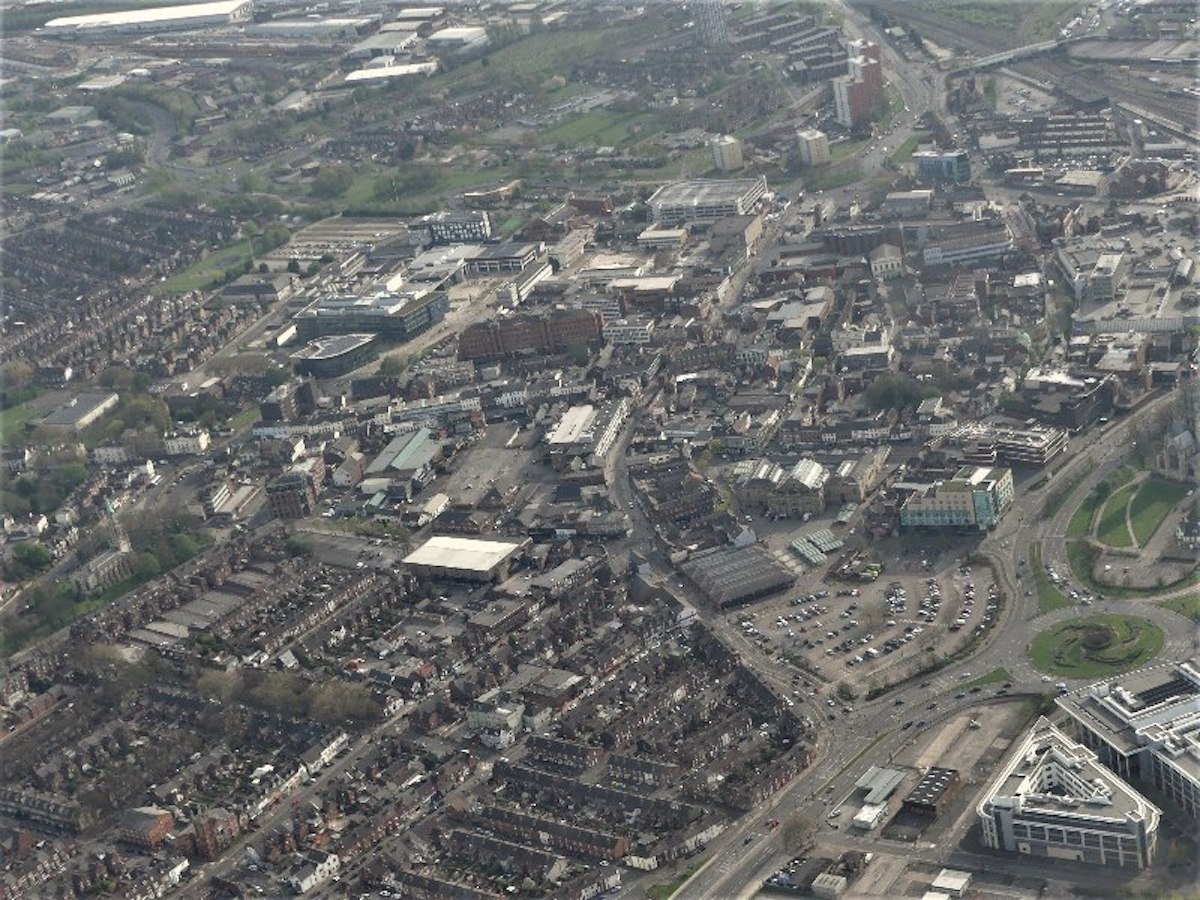
For those who missed it, Doncaster is set to be the eye of the storm next year as Reform pledges to target the city in the 2025 elections. Nigel Farage MP, leader of Reform UK Ltd, recently said: “The one we’re going to focus on will be Doncaster next year when the whole of that district is up.”
It’s not the first time the right has focused on Doncaster, as both the UK Independence Party (UKIP) and Reform have held conferences there in the last few years. At the 2014 UKIP gathering in the city, Farage said: “It’s no coincidence that we’re holding our conference here. We are now parking our tanks on the Labour Party’s lawn.”
Why Doncaster? #1 – Apathy and low voter turnout
At first glance Doncaster is not the most obvious place to park your political tanks.
A recent map from the Independent shows the Reform vote concentrated around East Anglia and the Midlands. Or look at this map from a briefing note by the House of Commons library.

The House of Commons paper shows that Reform UK Ltd came second place in 98 constituencies of which 89 were second place to Labour. Some 60 of these were in the north of England and 13 were in Wales. So why choose Doncaster?
There are other factors that Reform is tapping into.
The first and most obvious is voter apathy. Look at the correlation between turnout and the rise of the Reform vote and you can see a distinct pattern. A House of Commons briefing paper captures the regional variation, showing the highest turnout (64.9%) in the South West of England and the lowest turnout (55.7%) in Yorkshire and the Humber.
Break this down by constituency and as the paper shows: “Seventeen of the 20 constituencies with the lowest turnout were seats held by Labour and three quarters of these seats were in the North West, Yorkshire and the Humber or the West Midlands.” Go to seats with the highest turnout and there is scant evidence of any Reform inroads.
Overlay all three maps and you can begin to see a distinct pattern of where Reform is targeting. With an anti-establishment message they tap into a general sense of distrust and apathy for the main political parties. Throw in some false claims on immigration and a healthy dose of anger and you have the classic anti-party party talking to disaffected voters!
Why Doncaster? #2 – Inequality and the failure of “levelling up”
There are of course other characteristics that mark out Reform territory. Most notably are those communities promised so much with levelling up but who in fact have seen disparities grow and who have seen their own circumstances and life chances diminish. They are not just the ‘red wall’ seats, or former coal mining seats, but the ‘sea wall’ seats and places where rural poverty is evident.
Liam Byrne MP, chair of the Commons business and trade committee, has recently commissioned research for an updated version of his book The Inequality of Wealth: Why It Matters and How to Fix It, suggesting, as the Guardian puts it, “a strong correlation between wealth inequality and the popularity of Reform at the election”.
The Guardian article goes further, saying the research shows that “the Reform vote is lower in areas where house prices are higher, while property prices are about a third lower than the national average in constituencies with the top 20 highest Reform votes. About 8% more of the people in those constituencies are living in deprivation compared with the national average”.
So, for Byrne, the way to address the rise of the populist right is to address inequalities sooner rather than later – and the obvious way to do that sooner is through a wealth tax. But the causes of inequality are deep rooted and there’s no quick fix – certainly not one that will halt Reform in its tracks between now and next May.
All of these factors – inequality, house prices, turnout, and so on – make Doncaster a target for Reform. But perhaps the biggest factor is that Doncaster is the only metropolitan borough that will have both local and mayoral elections taking place in 2025, when there will be elections in the 21 country councils and nine unitary authorities in England.
Yorkshire has also been firmly on Reform’s radar since 4 July. The party finished in second place in ten Yorkshire seats and Farage claims that his party is “forming branches rapidly right across Yorkshire”. On 23 September, Reform UK Ltd launched its Doncaster branch.

Maybe NOT Doncaster? Riots and the short-term attraction of “whinge” politics
There is, however, one small problem for Reform. This summer saw the worst elements of the extremist right involved in violent disorder and rioting. One of the most serious incidents took place at the Holiday Inn Express hotel in Manvers, just 11 miles from Doncaster city centre. The problem for Farage is that, according to a poll published by Savanta a week after the riots, at least half of voters thought Farage was responsible for the riots.
Voters won’t forget that easily. And as we know Farage has little control over his candidates, never mind his party members. How he holds all this together over the coming year will be interesting.
The Tory leadership race also raises the stakes on where membership for Reform will come from. The choice between Robert Jenrick or Kemi Badenoch has moved the party of opposition to the right, parking its tanks firmly on Reform’s territory rather than Labour’s. The battle for members, never mind voters, will be interesting and could see some intriguing turf wars. But it could push Reform further towards something more akin to the British National Party and marginalise it further.
This raises the question of what exactly we are dealing with. The rise of the populist right, both here and abroad, is well documented. But it is chameleon-like. Leaving the EU may have been the driver for UKIP’s rise from 2013 onwards (you can plot the rise here) but, following the 2016 referendum, the populist right had to find something else to give it political currency. Their vote is also very volatile.
The Reform vote share (14.3%) in the recent 2024 general election is not too far wide of the UKIP vote share (12.6%) in the 2015 general election, when they came second in 120 constituencies. In between, they had little traction.
No room for complacency
The collapse of the Tory vote this year was a gift to Reform. And the sluggish growth and failure to regenerate many communities helped to give Reform places to go and shout their empty rhetoric. But they now have their place at the table and they will have to do more than just whinge in those constituencies where Reform has MPs.
But we cannot be complacent. Reform UK Ltd has found electoral success and buoyed by this result is now definitely coming for Labour. And as the Guardian succinctly put it in 2014, “Nigel Farage, however, is no fool when it comes to sniffing out a neglected electorate”. And after 14 years of Tory mismanagement of the economy there’s any number of communities for Farage to go after.
As Best for Britain said in a recent blog: “Naivety surrounding Reform would be misplaced, a lesson from our European counterparts is that the rise of these new populist right parties can happen quickly boosted by the political adrenaline of that first step into the halls of power, that first taste of legitimacy.”
More from Jane Thomas

CLICK HERE TO DONATE TO OUR CROWDFUNDER
HELP US BECOME STRONGER SO THAT WE CAN CONTINUE TO DELIVER POWERFUL CITIZEN JOURNALISM!