• Contact
  • About
  • ISSN 3049-9720
  • Authors and editors
NEWSLETTER SIGN UP
Yorkshire Bylines
Advertisement
  • Home
  • News
    • Brexit
    • Culture
    • Education
    • Environment
    • Home Affairs
    • Transport
    • World
  • Politics
  • Opinion
  • Society
    • Food
    • Music
    • Poetry
    • Sport
  • Business
    • Economy
    • Science and Technology
    • Trade
  • Region
No Result
View All Result
Yorkshire Bylines
Home Opinion

Norky’s ramblings: Huddersfield, the town that bought itself

Norky reveals how Huddersfield slew off its feudal past by way of Sir John Betjemen and a curious statistic featuring Rolls Royces

Peter Norcliffe by Peter Norcliffe
17-09-2022 08:46
in Opinion, Region
Reading Time: 6 mins read
A A
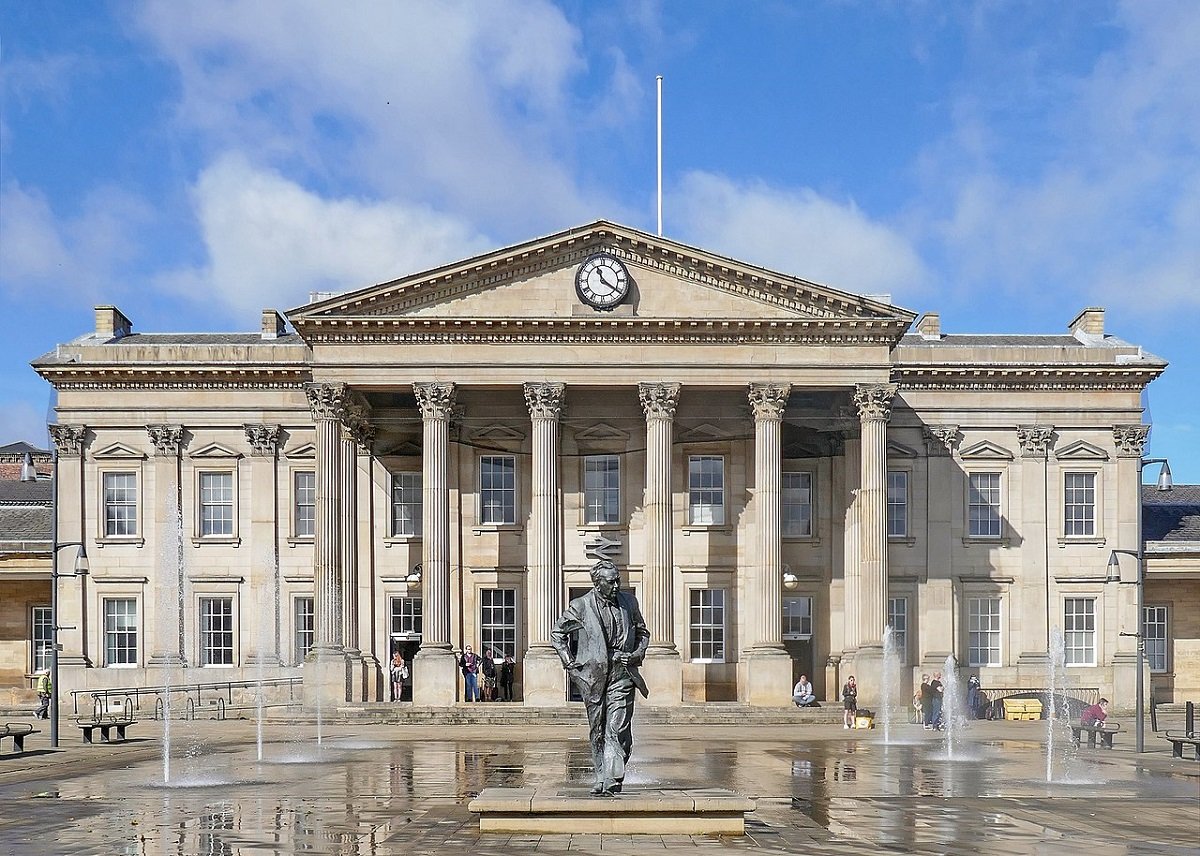
Huddersfield Station

Huddersfield Station https://www.flickr.com/photos/atoach/51493513431/ Image credit: Tim Green

Share on Bluesky

The town that bought itself, on the face of it, sounds odd. And if odd means original then it certainly was odd, and I suppose odder than just the ‘face of it’, as this had never been done before. ‘Nothing ventured nothing gained’, ‘grasping the bull by the horns’, and more clichés that the then town council could muster. And so it was written that Huddersfield did just that, on the 29 September 1920.

There was once a chap called Huder (probably an immigrant from Scandinavia), who holds a small place in history for he owned a field mentioned in the Domesday Book of 1086 that went by the name of Huderfelt. Over the following centuries, place names, as with surnames, had subtle changes in spelling, probably depending on how they were spoken at the time and written phonetically. So over time, Huderfelt became known as Oderesfelt and Hudresfelt, and in a charter of 1297 it became Huderesfield which is but a small step to the Huddersfield as we now know and love.

John, son of William, son of John, son of William

The Ramsden’s rode into town in or around 1542, the town was then a hamlet, and either John or his brother William bought property belonging to their in-laws in Longley. The Ramsden’s quickly began to acquire neighbouring land greatly helped by the dissolution of the monasteries whereby vast amounts of land came on the market. The Ramsdens were never mill owners or industrialists, their wealth came from rents from their land.

Over the coming centuries they became very powerful and influential, becoming sirs and lords of the manor, it was always John succeeded by his son William, or his son John, or William succeeded by his son William or his son John. There was one heir in the late 1800s whose parents really pushed the imaginative boat out and named their son John William. To commemorate this momentous moment of imagination there is a street named John William Street in the centre of Huddersfield.

By this time the town of Huddersfield was not big enough for the Huders and the Ramsdens and as the Magnificent Seven were busy in the wild west, Huder had thought it prudent to move on some time earlier, leaving the Ramsdens to buy nearly all of Huddersfield. At one time they owned land the size of 2,150 kickerball pitches, or more appropriately, as Huddersfield is the birthplace of rugby league, 2,150 rugby pitches.
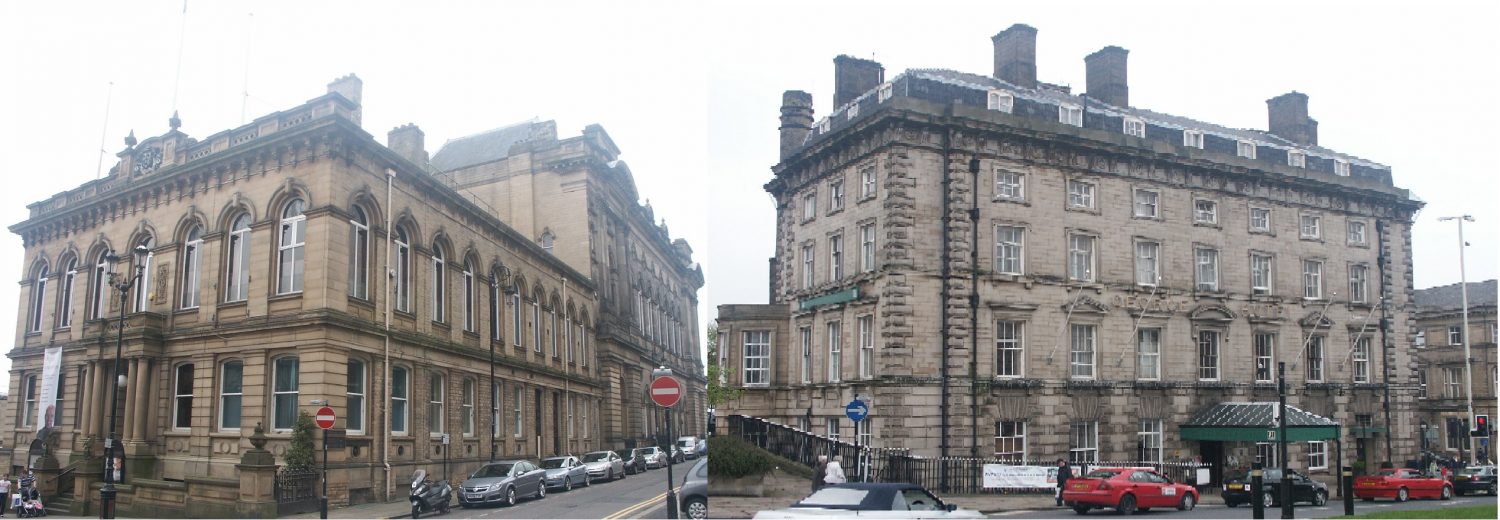
Huddersfield Town Hall and the George Hotel, the birthplace of rugby league

The most splendid railway station in England

Contrary to popular local belief, they did not own all of it, not even the town centre, but enough to persuade parliament to grant Huddersfield market town status, which in turn brought first the canal, then the railway and as it is geographically central to the north of England. Having natural resources such as coal and water nearby, it became the world’s centre for woollen production, and as a result became very wealthy. It has been said that Huddersfield had, at one time, more Rolls Royce motor cars per capita than anywhere in the world.
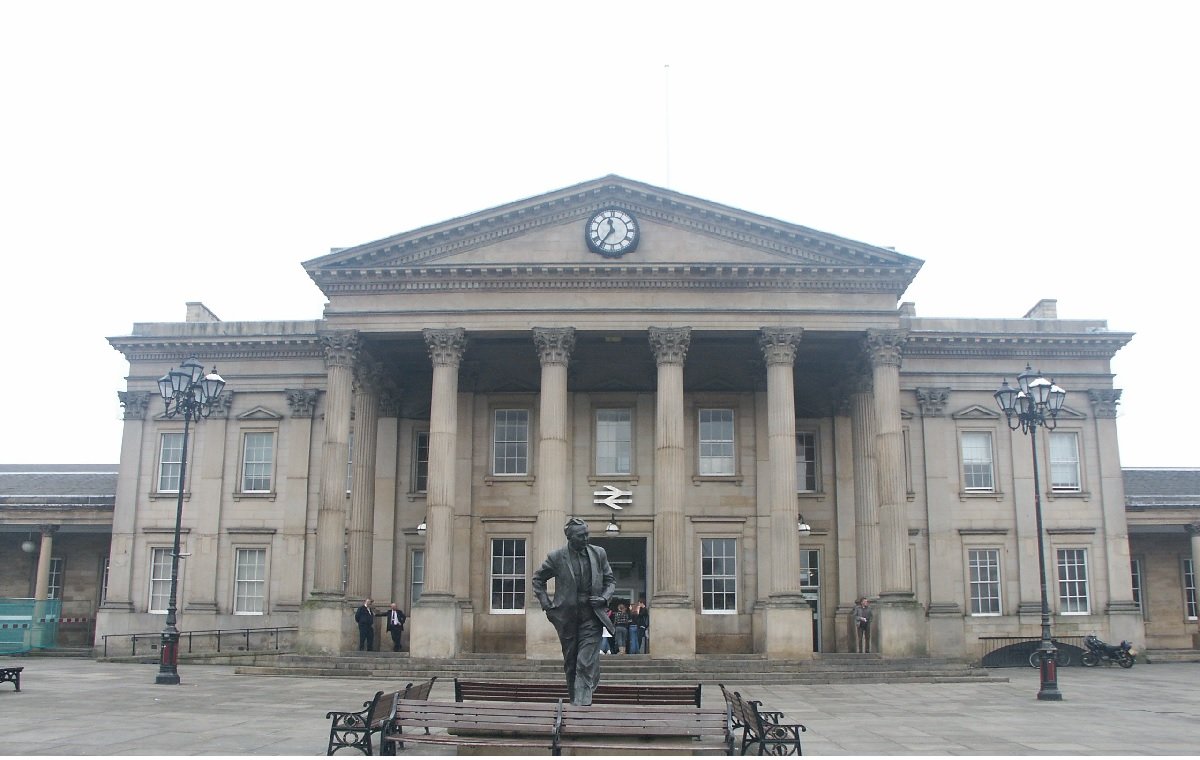
Huddersfield railway station with the statue of Wilson in front
‘The most splendid in England’ is how Sir John Betjeman described Huddersfield railway station. The statue of Harold Wilson, one of our two prime ministers who were closely associated with the town is now proudly striding across St. Georges Square and into Huddersfield town centre.  Harold Wilson in office from 1964 to 1970, then again from 1974 to 1976 was born in Huddersfield, and Herbert Asquith in office from 1908 to 1916 was partly educated at Huddersfield Collage and later also had business connections in the town. 

As did many local influential families of the time, the Ramsdens as did the Norcliffes, moved to north Yorkshire in the 17th or 18th century. York was at that time the power and influential hub of northern Britain. The Ramsdens had left the management of the Huddersfield estate to agents who in turn developed the town and constructed many magnificent Victorian buildings that are still proudly marking our history.

merlin engine
Region

Norky’s ramblings: engineering a legend – the magic of the Merlin

by Peter Norcliffe
20 August 2022 - Updated on 18 November 2022

Handing over the keys to the city

It was Wilfred Dawson a local Newsome councillor who came up with the bright idea of buying the Ramsden estate for the people of Huddersfield so they could dictate their own future rather than rely on the unpredictable will of the lord of the manor.
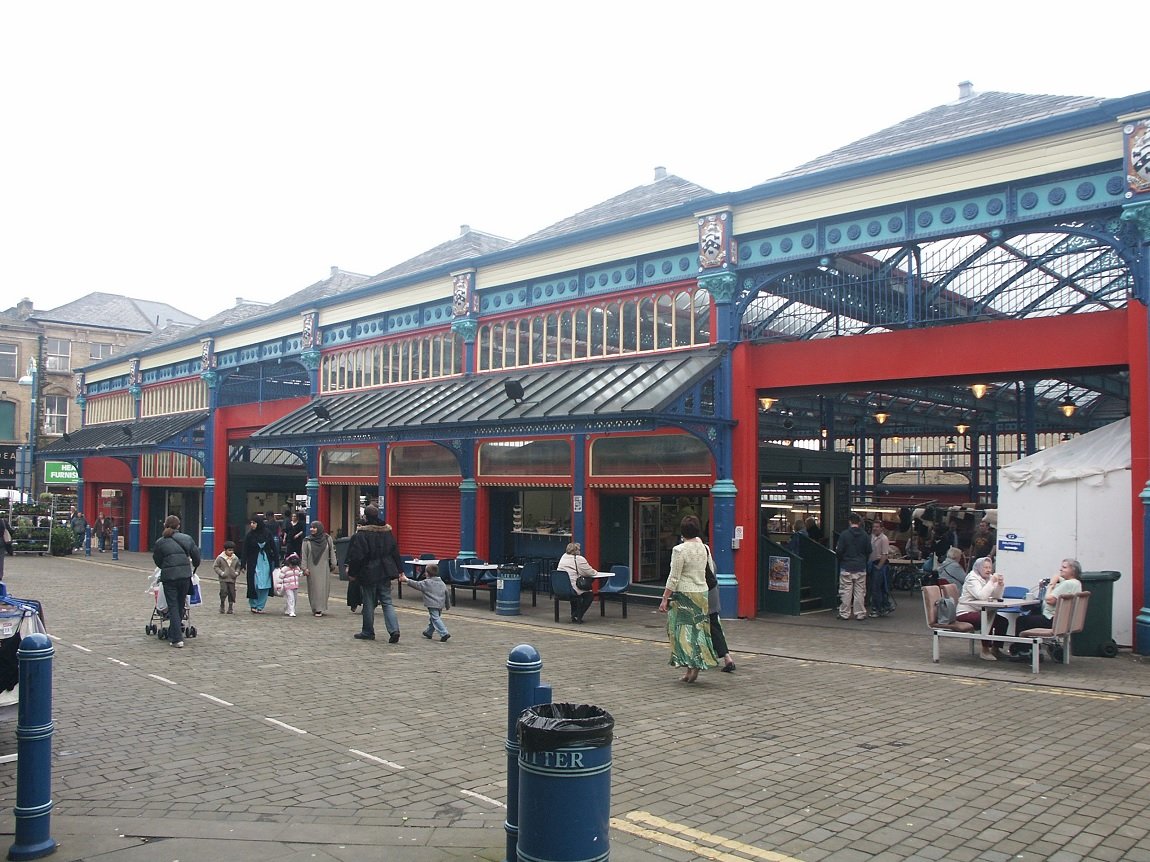
Huddersfield Market, 2008

The asking price was 1.3 million pounds and as the council could not find that sort of money immediately a friend of Wilfred Dawson called Sam Copley stepped in with the money until the council could pay him back. And they did, but I bet it was a worrying moment or two.

The sale to Huddersfield council was agreed by The 3rd Baronet Sir John Ramsden, the son of The second Baronet Sir John William Ramsden in 1920. The price was the equivalent to over nine million pounds in today’s money. I wonder how many of our rate payers would agree to spending that amount of money on something that they probably thought was theirs already or could see no benefit from the acquisition, they would still have a landlord who could kick them out on their ear.

I suppose it would eliminate the droit du siegneur (Lord’s Right) whereby the lord of the manor could first take a subordinate’s wife on her wedding night. Even after extensive research I have found no evidence that councillor Wilfred Dawson or his mate Sam Copley, nor indeed the baronets John or William or John William were into that sort of thing.

I suspect there was little truth in this ‘Lord’s rights’ story anyway. In my humble opinion it’s probably mostly another Hollywood myth.


Tags: History

Sign up for the Yorkshire Bylines newsletter

* indicates required

Consent for having Bylines Network store my submitted information

You can unsubscribe at any time by clicking the link in the footer of our emails. For information about our privacy practices, please visit our website.

We use Mailchimp as our marketing platform. By clicking below to subscribe, you acknowledge that your information will be transferred to Mailchimp for processing. Learn more about Mailchimp's privacy practices.

Peter Norcliffe

Peter Norcliffe

Peter Norcliffe is a proud Yorkshireman, born on 21 June 1947, when the family lived at Scapegoat Hill a small farming village overlooking the Colne Valley to the west of Huddersfield. His parents Clifford and Mary Norcliffe were hard working textile workers, an industry that Peter himself took an apprenticeship in when he left school at 15 years old. Married at 19 to his childhood sweetheart Moira in 1966 they have one daughter Rachel. Much of Peter’s life can be found in the two books he has published to date. Norky's Ramblings and Norky is Still Rambling On.

Related Posts

The Tricolor team standing outside their storefront on Church Street
Economy

Is York’s flagship business incubator still working?

by Gabriel Macarthur
7 November 2026
Architect's imagining of the new Dewsbury Market development.
Region

Dewsbury Market: a place where the town has always come together

by John Heywood
5 November 2026
A flock of sheep in front of a night sky lit up with many fireworks
Culture

A bang too far: isn’t it high time we rethought fireworks?

by Kay Johnstone
4 November 2026
Todmorden Book Festival Logo
Culture

Todmorden Book Festival welcomes literary heavyweights

by Kay Johnstone
4 November 2026
The Milner York's The Garden Room
Food

Review: A Night at The Milner York Hotel

by Graham Clark
3 November 2026
Next Post
dragonfly

Ten for nature: dance troupe takes to the air

PLEASE SUPPORT OUR CROWDFUNDER

BROWSE BY TAGS

Art Books Boris Johnson Bradford Charity Climate Change Cost of Living Covid-19 Creative Industries Crime Democracy Devolution Donald Trump Environment Equality Experience Farming Festival Gaza Conflict General Election History Human Rights Immigration Iran Journalism Keir Starmer Labour Leeds Media Mental Health NHS Northern Ireland Protocol Pollution Poverty Recipe Refugees and Asylum Seekers Restaurants Retained EU Law Review Rishi Sunak Sheffield Theatre Travel Ukraine USA
Yorkshire Bylines

We are a not-for-profit citizen journalism publication. Our aim is to publish well-written, fact-based articles and opinion pieces on subjects that are of interest to people in Yorkshire and beyond.

Yorkshire Bylines is a trading brand of Bylines Networks Limited which is separate to, but allied with, Byline Times.

Learn more about us

No Result
View All Result
  • About
  • Authors and editors
  • Complaints
  • Contact
  • Donate
  • Letters
  • Privacy
  • Network Map
  • Network RSS Feeds
  • Submission Guidelines
  • Download the Bylines Network App

© 2020-2026 Yorkshire Bylines. Powerful Citizen Journalism. ISSN 3049-9720

No Result
View All Result
  • News
    • Brexit
    • Education
    • Environment
    • Health
    • Home Affairs
    • Transport
    • World
  • Politics
  • Opinion
  • Society
    • Culture
    • Dance
    • Food
    • Music
    • Poetry
    • Recipes
    • Sport
  • Business
    • Economy
    • Science and Technology
    • Trade
  • Region
  • The Davis Downside Dossier
  • The Digby Jones Index
  • Cartoons by Stan
  • Authors and editors

Newsletter sign up

CROWDFUNDER

© 2020-2026 Yorkshire Bylines. Powerful Citizen Journalism. ISSN 3049-9720