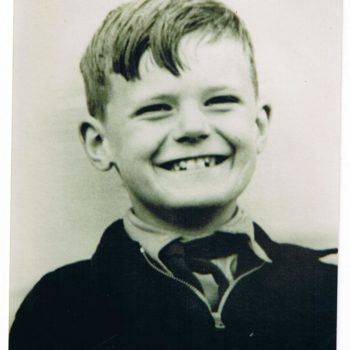

I was born two years after WW2. There were still many very recent memories and stories told about the war when I was old enough to take notice. My father, two of his brothers and their sister, and Mum’s brother were either fighting with the armed forces or working in munitions, and I became engrossed in their stories of daring do.
Mum’s brother, Uncle Frank, was in the RAF Bomber Command ground crew, two of Dad’s brothers were in the army, Dad was in the navy and their sister Margaret was working in the Rolls-Royce aero engine test bays at Barnoldswick, which was then in the West Riding of Yorkshire, but now in Lancashire. I’m saying nothing, just now anyway, but I certainly do sometimes. Many details of Mum and Dad’s siblings are in the ramble ‘Uncles in the war’.
Rolls Royce sets the wartime aviation standard
Most, if not all of the Rolls-Royce engines being tested at Barnoldswick at that time would have been the iconic Merlin and Griffon engines. Both were 12-cylinder liquid-cooled piston engines. The Merlin first ran in 1933 and the Griffon in 1939 as a supercharged variant of the Merlin – eventually, both were fitted with superchargers.
Many very influential aircraft were fitted with the Merlin: the Lancaster and Halifax heavy bombers, the Beaufighter and Mosquito fighter bombers, the Spitfire and Hurricane fighters – and half a dozen other aircraft. Arguably the best and certainly one of the most successful fighters in WW2 was the McDonnell Douglas P51B, developed in the US and named the Mustang by the British. The US military did not support the development of the Mustang, but after fitting it with Merlin engines in 1942, and fuel drop tanks to give it a longer range, it became an ideal support aircraft for the British Bomber Command and Allied air forces flying over Germany.
The Avro Lancaster spreads its wings
The most famous of the British heavy bombers must be the Avro Lancaster, designed by Roy Chadwick, Avro’s chief designer. The Lancaster was developed from the Avro Manchester, which only having two engines was too slow and vulnerable, so Roy Chadwick extended the wings, put two more engines on it, and ‘Bob’s your uncle’. It was of course much more involved but that was the very basic process.
Of the nearly 7,400 Lancasters that were built, only two are flying now. However, there is a group of engineers at the Lincolnshire Aviation Heritage Centre who are five years into a ten-year programme to get Lancaster NX 611 ‘Just Jane’ up to airworthiness.
The British Lancaster and Halifax heavy bombers and the American B17 Flying Fortress were the main offensive Allied aircraft in the bombardment of Germany. Some 50% of 18 major German cities were destroyed, including 75% of Hamburg, Mainzand Bochum. In comparison, we are allowed to believe that London suffered the most destruction in Britain, when in fact more of Coventry and Hull was left in ruins; Hull having had 95% of its housing stock destroyed.

Darkening skies over Europe
Following hostilities, it was decided that Bomber Command under the leadership of Sir Arthur ‘Bomber’ Harris should not be awarded a campaign medal because some saw the concentrated destruction of German cities towards the end of the war as unnecessary terror or vengeful attacks. Seeing a thousand bomber raid flying over your country would certainly be terrifying. If the nine aircraft of the Red Arrows display team seem to fill the sky, just try to Imagine what 111 times that number would look like – all of them hell-bent on dropping a bomb on your house.
One of the reasons that there were so many civilian casualties on both sides was the poor accuracy of their aim. Only one in three Allied aircraft got within five miles of their target and this was the reason ‘carpet bombing’ was introduced. Just throw a carpet of bombers and bombs somewhere near a target and hope for the best.
I have always thought that not giving the very brave men of Bomber Command their own campaign medal was wrong. After all, it wasn’t those aircrews who had devised the tactics. Out of 125,000, 55,573 were killed (44%). A further 8,403 were wounded and 9,838 taken prisoner. It wasn’t until June of 2012 that they were given their own memorial, but what a fantastic memorial it is. It’s in Green Park, opposite the RAF club on Piccadilly, London.
Enough of this death and destruction, I will try to lighten up a tad and write about a trophy and a couple of Dad’s humorous wartime stories.
The Schneider air race trophy comes home!
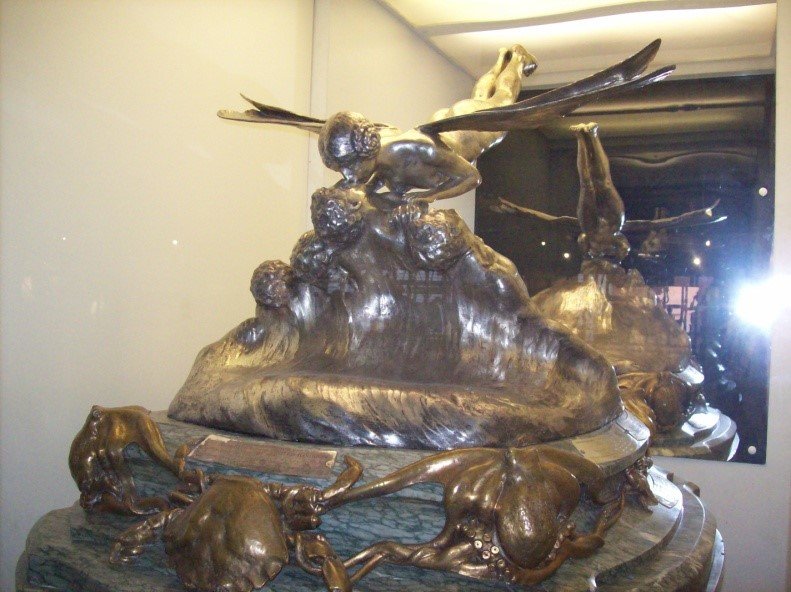
In my humble opinion, the most beautiful trophy ever designed is the Schneider trophy, now on permanent display at the Science Museum, London. It was awarded from 1913 for the fastest seaplane to navigate a distance of 170, then later, 220 miles on a triangular course. In 1931 the British were awarded it permanently after managing the rules better than the others, and of course, developing a faster plane – but we are British, so it must be alright init.
The victorious seaplane was a Vickers Supermarine S.6B designed by Vickers chief designer R.J. Mitchell and powered by a Rolls-Royce R type engine. This aircraft was the forerunner of the iconic Spitfire, which was then powered by the legendary Rolls-Royce Merlin engine.
The trophy is of silver and bronze and depicts a naked winged human kissing the face of Zephyrus, the god of the west winds, emerging from the waves. Beautiful stuff.
A hairy-string-raising encounter in the Pacific
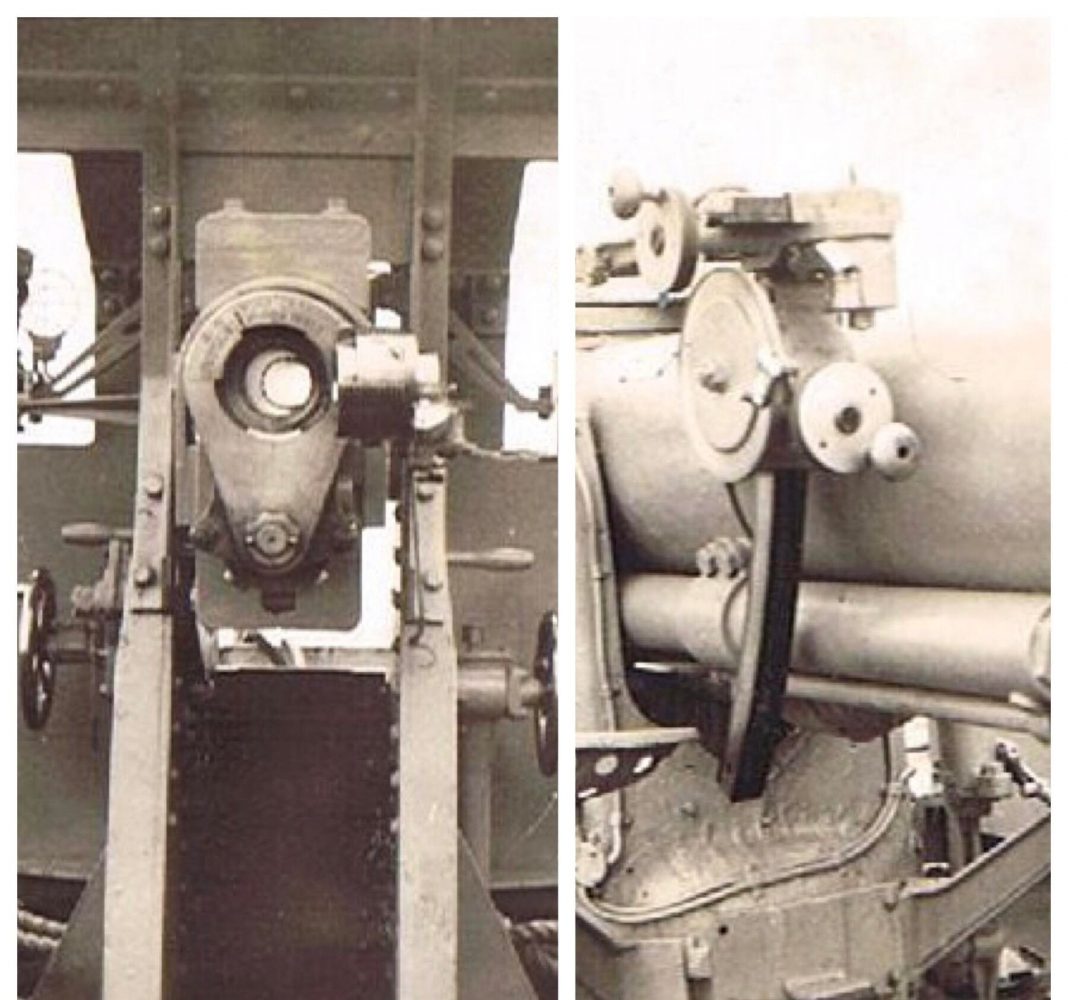
As I have described previously, Dad was in a unit called the DEMS (Defence Equipped Merchant Ships). In the early days of the war these merchant ships were provided with very little defence equipment. One idea was a grenade fastened to a length of hairy string (probably thin wire of course) using a rifle adapted grenade launcher. The idea was to propel the grenade in front of an enemy dive bomber (first ensuring it was, in fact, the enemy), then hoping the wire and its grenade get entangled around the wing. Unfortunately, the other end of the hairy string is fastened to the deck of the ship, their concerns about where this grenade would end up had it not become entangled around the enemy aircraft meant that these things were accidentally lost at sea.
They could still use the rifle but that wasn’t much good out at sea. However, they did eventually get proper three and four-inch guns to play with. The photos below show a couple of examples of Dad’s wartime toys.
Another story Dad told me occurred while his ship was just leaving an island in the Pacific. Much of the onboard life for the DEMS was tedious and routine, their only responsibility was to keep themselves, their uniforms and equipment in good nick. The ship Dad was on at that time would have probably been either SS Samkansa, or MV Durham. SS meaning ‘steam ship’ or ‘screw steamer’. I had always thought MV meant ‘merchant vessel’, but it appears to be a throwback to the days of sail and means ‘motor vessel’. I could easily be wrong and I’m sure someone will put me right.
Anyway, Dad was on watch that day. All cleaning, polishing and ironing carried out, he was idly leaning on the guard rail looking out to sea allowing his mind to wander, when he noticed a speck in the distance. Knowing that the island was in Allied hands and that there were a number of proper fighting ships on the other side, Dad assumed that this speck was an aircraft preparing to land on the airfield. Imagine his surprise when he saw THIS fly past at deck height, no more than a hundred feet away:
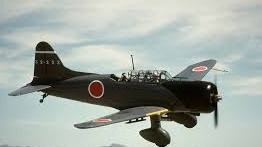
Dad later speculated that it was probably a Japanese reconnaissance aircraft and luckily not there to course damage. He didn’t take this picture of course, he only had time to stand up, never mind get his camera, nor a grenade on a length of hairy string.