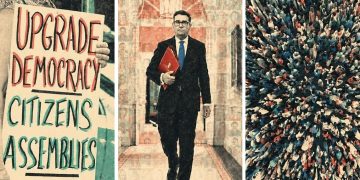
Nick Palmer is a man on a mission, aiming to challenge the status quo of British politics. As part of Yorkshire Bylines series of candidate profiles, I had the pleasure of interviewing Nick, one of the Independent candidates in the by-election for the Selby and Ainsty constituency, triggered when local MP Nigel Adams stepped down.
Palmer was born in Harrogate and grew up in Bramham, just south of Wetherby. His love for Yorkshire is evident in every word he speaks, and it’s clear that this is not just his home, but his passion. “I just like Yorkshire. People are good and the countryside – the mix of urban and rural. It’s got a lot to offer”, he says.
His promise to represent the ‘politically homeless’ caught my attention. As a resident of the constituency and a father of young children, Palmer believes he can bring a fresh perspective to the political landscape, untainted by the so-called ‘Westminster bubble’.
The motivation to stand
When asked about his motivation to stand as an Independent candidate, Palmer’s response was simple and forthright. He feels that he is representing the disillusioned millions in the UK who are fed up with the current political conduct and processes. He told me, “Sadly there is no option on the ballot paper for the politically homeless, so I thought I’d create one”.
Palmer’s decision to stand in the by-election comes at a unique time in his career. As a contractor, the timing was impeccable. It allowed him to step forward and fill what he perceives as a void in the political representation of his constituency.
Palmer is firm in his belief that a vote for him is a vote for protest. He explains that this by-election won’t change the balance of power in Westminster, making it a prime opportunity to elect someone not driven by party politics. He emphasised, “A vote for me is a vote for protest. Because this by-election won’t change the balance of power in Westminster, I see it as an opportunity to elect someone who isn’t driven by party politics”.
Advocating for change
When discussing national issues, Palmer lays out a few areas he is especially passionate about: planning, education, and the conduct of politics. He’s interested in promoting mature conversations about the realities and costs of ‘perfect’ systems, whether it’s healthcare or education. He argues that understanding these costs is crucial to having informed, realistic debates about what is achievable. He elaborated:
“We all need to do better to engage, understand and be realistic about so many topics. As a trend, I can’t help noticing that we never talk about what a perfect health service would cost to run, we only talk in terms of ‘investment’ and ‘cuts’… no wonder we never reach a satisfactory conclusion”.
From his experience in the constituency and polling data, he advocates for several changes, including reducing allowances for political advertising in by-elections and conducting an urgent review into voter disaffection and the flaws of the political party system. He specifically mentioned, “requiring government to publish annual analysis of total cost requirements for each government department” and “voter referenda on critical issues, such as migration”.
With a healthy dose of realism he focuses his ambition on advocating for change as “sadly, the victor of this by-election won’t be able to implement change before the 2024 general election”.

Breaking the ‘Westminster bubble’
Palmer’s plan to break the ‘Westminster bubble’ is a challenge to the system. He aims to scrutinise Westminster and call out behaviours that negatively affect citizens. He stated, “I intend to use my influence as an MP to scrutinise Westminster life and call out behaviour that negatively affects citizens”.
Regarding voter engagement, Palmer plans to use his skillset from the business world (largely influenced by systems thinking) to structure a review process, including “collection of feedback from the voters, civil servants and politicians who are involved in the delivery of politics and democracy”.
With a background in setting up businesses to help people prepare for employment, Palmer has a vested interest in improving the relationship between education and employment. He previously proposed an hour of ring-fenced time each week for career planning in schools and remains passionate about better preparing people for the workplace. He emphasised, “there’s always more that can be done to prepare people for the workplace. One essential requirement, which remains outstanding, is to help job applicants better understand the commercial pressures facing any hiring manager”.
A voice for the disaffected
If elected, Palmer promises to operate independently, free from the influence of the whip system. His intent is to be both collaborative and, if necessary, awkward. He’s determined to provide a different perspective.
Palmer’s candidacy represents a departure from traditional party politics. He aims to be a voice for the politically homeless, the disaffected, and those yearning for a change in the democratic processes. “If we can measure and prove voter disaffection [via my vote], then we can build on that in the 12 months until the next election”.
During his campaign, Palmer has encountered a significant number of voters who are disillusioned and frustrated with the current state of politics:
“Well, there’s a lot of people who are fed up. That’s the consistent message. I have spoken to people who are certain of their vote. But I’m not sure I’ve spoken to many people who are delighted with the democratic process we have currently. I don’t yet know what a better solution might be, but the overwhelming sentiment from the people I’ve spoken to in the last two or three weeks is – this isn’t good enough. And I’m a candidate for those people.”
The by-election in Selby and Ainsty presents an opportunity for voters to send a clear signal of their disaffection and desire for change. Nick Palmer is offering himself as a vehicle for this message, promising to be a committed, diligent MP who will represent the interests of the local people and work towards a revitalization of British politics. Whether or not he secures a victory in this by-election, his campaign serves as a steppingstone for future candidates and reformers to build upon, driving the necessary change to reshape and restore trust in the democratic processes that shape our society.
Addendum – Independent candidates standing in the Selby and Ainsty by-election have issued the following joint statement:
“Predictably, coverage of the Selby and Ainsty by-election has been mired in BBC bias. Independent candidates, Councillor Tyler Wilson-Kerr, Nick Palmer and Andrew Gray, have been marginalised. Whilst non-state-owned media have been fairer, it is a disservice to voters that Independent candidates face such inequalities in timing and extent of coverage.
“Independents are a vital voice in British democracy, not beholden to the party whips – an archaic system which crushes democracy.
“Tyler, Nick and Andrew all bring valuable experience to this election. The habit of mainstream media to treat elections as a largely binary choice is both insulting to Yorkshire voters and damaging to democracy. Tyler is both the youngest candidate this election, and the youngest parish councillor in the country. Recognisable youth representation is vital for the future development of British Politics and the BBC’s refusal to cover the Independent candidates is harmful to our democracy.
“In Selby’s 2022 May local elections, Independents came third. With so many candidates, the likely margin of victory is likely to be small. The state broadcaster’s position could sway this election.”
Councillor Tyler Wilson-Kerr, Nick Palmer and Andrew Gray