For at least a year now almost every opinion poll has pointed to a huge defeat for the government at the next election. Things may not, however, be that simple. Because there are three big potential errors in every sample of national opinion.
Opinion polls
The first unavoidable problem is that pollsters can only ask for the opinion of those who are prepared to talk to them. They can’t know anything about the views of those who don’t wish to be stopped in the street or won’t respond to phone calls. No amount of trying to select a sample that properly reflects the variety of voters can correct that gap in the knowledge.
The proportion of people who won’t talk to anyone with a clipboard has been increasing steadily for decades and it is highly likely that those who won’t give their opinion include a high percentage of people who hold to views that they think are socially unacceptable. This may mean that polls will significantly underestimate the numbers of people who hold views from the far right. A lot more people may be deserting the Conservatives in favour of parties that are even more extreme than many of us would like to think.
Who will turn up to vote?
Another great unknown is who will actually turn out and vote. Pollsters know that there are big divergencies between the views that are expressed by people of different ages, genders and ethnic origin. What they don’t know is what proportion of young black women will vote and how many elderly white men will choose to stay at home and not vote. One of the main reasons that pollsters are currently producing significantly different results is that they have to apply a judgement based on what has happened in the past.
Most polls assume fewer young people will vote and the elderly will be very inclined to turn out. Those assumptions might be proven wrong. In an election where the government has inflicted so much pain on young working people much depends on how many of them get out and vote and how many disillusioned pensioners don’t vote. It is impossible to know this until we get to a real election because the numbers voting in by elections is always lower than in a general election. What we do know is that this government has tried hard to find ways of suppressing the vote of the young by insisting on voter identification.

Sampling errors
The final significant error in all polls is both the biggest one and the most promising one for those of us on the left. Samplers try to build a model of the views of an entire nation on the basis of only a couple of thousand of people who are selected to represent the differing views of different areas. This ignores the fact that there are significant regional and local variations which are highly likely to produce results that strongly diverge from a simple projection of a national swing onto the national results last time round.
If you just look at the Labour vote and the Conservative vote, the lead of the Labour Party has varied but has been dramatically high at around 20% for months. If you add up the votes of all the parties that are to the left of the current government then the number is even larger. Some 30% more people are telling pollsters that they intend to vote left of centre than for the right. As I write, a recent poll of polls shows the following:
Labour: 44.3%
Conservative: 25.2%
Lib Dem: 11.0%
Reform UK 8.0%
Green 6.2%
SNP: 3.3%
That means 64.8% voting left of centre and 33.2% to the right with the remaining 2% including more left leaning parties like Plaid Cymru or the SDLP. Anyone who has campaigned on the doorstep will tell you that a high proportion of voters calculate very carefully which local candidate they think is most likely to win and who they want to represent them in their particular seat. It is reasonable to expect some very significant regional variations and a lot of bunching of votes.
Bad news for the Conservatives
That is very bad news for the Conservatives. In a marginal red wall seat in the North it is highly likely that votes will line up behind the Labour Party and they could have a crushing majority. Particularly if Reform UK stand in those seats, as they say they will.
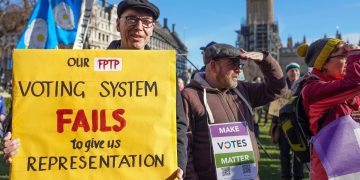
In former blue wall seats in well-off areas, there may well turn out to be a remarkably high number of constituencies where the Liberal Democrats can convince voters that they have the best chance of winning and they take seats few pollsters expect them to win. That is likely to significantly increase the size of the Conservative defeat. Under first past the post if your vote drops below 30% and is spread out fairly evenly across the country you get badly punished and win very few seats. If there is no major shift in opinion the Conservatives could secure a third of the votes and win fewer than 100 seats.
Then there are very local factors. Labour may well get punished for its refusal to call for a cease fire in Gaza in seats with a large Muslim community and those votes could easily produce surprise victories for independents or the Greens. Similarly, there will be places where small parties have worked hard for years and built enough of a local base to become serious challengers. That is likely to enable the Greens to take seats in places like Bristol from Labour, and in Suffolk from the Conservatives.
General election prediction
All of which leaves us looking at a very interesting picture. I predict the following things:
- The total Conservative vote will be higher than the polls suggest
- The Conservative seat loss will be much worse for them than predicted
- There will be a big majority for left-of-centre parties
- The number of seats won by smaller parties will be higher than predicted and may result in a hung parliament
People will have different views on the merits of such an outcome. My own is that if it results in no overall control or a small majority for Labour then it will be no bad thing. I fear what Keir Starmer will do with a hugely secure majority and think he will swivel even further to the right. I am, however, hopeful that he may have to govern in consultation with other parties and be kept on his toes by voters who have sent a variety of progressive voices to Westminster.
Given the impossibility of knowing what all the voters think and what they will do on the day in each locality, there is lot of uncertainty out there and much still to work for. First past the post is about to provide us with one of the strangest and most unpredictable elections of modern times.