The United Kingdom has a reputation for being a democratic country, yet, upon closer examination, this perception proves to be misleading.
The disenfranchisement of a significant portion of the electorate. A worrying decline in democracy. These are the fault lines of an antiquated electoral system, perpetuated by the unwillingness of controlling parties to enact meaningful change. They have given rise to disproportionate outcomes, leaving many voices unheard and the legitimacy of governance in question.
The disenfranchisement epidemic
This reluctance to change highlights the structural issues within the electoral system and the role of controlling parties in perpetuating these issues by resisting reforms. It underscores the broader systemic challenges that have eroded democratic principles and the credibility of governance.
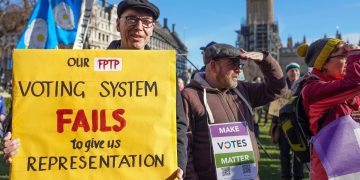
At the heart of this issue lies the ‘first-past-the-post’ (FPTP) electoral system that has favoured the two dominant powers – Labour and the Conservatives. Under this system, parties can seize absolute power with less than 40% of the popular vote, leaving swathes of the electorate unrepresented and their voices marginalised. The 2005 general election serves as a stark reminder of the inherent flaws within the FPTP system. Despite securing a minority, the Labour Party clinched an overwhelming majority of parliamentary seats, illustrating a democracy teetering on the edge of legitimacy. The disproportionate representation of smaller parties highlights the systemic injustices embedded within the current electoral framework.
The FPTP conundrum: disproportionate outcomes
Delving deeper into the numbers paints an even bleaker picture. Securing only modest support among voters in this 2005 election. Labour led by Tony Blair to represent the electorate was staggeringly low, with only 21.6% of eligible voters. This statistic underscores a troubling trend of public disengagement from the political process.
Exacerbating these issues are concerns about the erosion of democratic norms and institutions. Accusations of undermining parliamentary sovereignty, judicial independence, media freedom, and individual rights have raised alarms about the fragility of British democracy. The government’s manoeuvres, including the controversial prorogation of Parliament and the suppression of reports on alleged Russian interference, underscore the urgent need for safeguarding democratic principles.
Politicians presenting the news: an indisputable conflict of interest
Government politicians such as Jacob Rees-Mogg, Philip Davies, and Esther McVey involve themselves in presenting TV news shows, which poses a risk that their biases, affiliations, and agendas may shape the way information is presented. Ofcom’s findings show Rees-Mogg, Davies, and McVey breached rules over broadcasters’ requirement to provide an impartial stance when showing news. As a result, viewers perceive such news sources as less trustworthy and reliable because of the perceived lack of neutrality.
This revision not only underscores the general risk associated with politicians presenting news but also provides a concrete example of how such involvement can lead to breaches of regulatory standards and subsequent erosion of trust in the credibility of all news sources. Politicians have vested interests in shaping public opinion to advance their own political goals or agendas. When they’re involved in news presentations, there is a potential conflict of interest between their political objectives and the duty to deliver unbiased information to the public. There is a significant risk to the integrity and credibility of regulated broadcast news.

Voter identification laws lead to inequities in access
In the ongoing discourse surrounding electoral integrity, one contentious issue continues to draw significant attention: voter identification laws. Advocates argue that such laws are essential for preventing fraud and maintaining the integrity of the electoral process.
However, a closer examination reveals a troubling reality: these laws often disproportionately disenfranchise already marginalised groups, exacerbating existing inequalities in democratic participation.
Recent observations, backed by research, underscore the profound inequities embedded within strict voter ID requirements, particularly in countries like the United States and the United Kingdom. This is contrary to the situation in much of mainland Europe, where mandatory national ID cards ensure widespread identification access. The absence of such systems in the UK and the USA accentuates the disparities in ID possession. The correlation between socioeconomic status and ID possession is stark – the wealthier a person is, the more likely they are to possess a valid form of identification.
Privilege and access
At the heart of this issue lies the intersection of privilege and access. Those who lack the means to travel abroad often do not possess passports, while individuals who do not drive are unlikely to have driver’s licenses. Consequently, it is the most economically disadvantaged segments of society who find themselves disproportionately burdened by stringent voter ID laws.
Compounding this injustice, government-commissioned research has shed light on the reality that certain vulnerable demographics are even less likely to possess valid forms of identification. Individuals with severe disabilities, the unemployed, those without formal qualifications, and first-time voters are among those disproportionately affected, further marginalising those already on the fringes of society. This research has revealed that approximately 2% of the population lacks any form of photo ID, while 4% do not possess recognisable identification. This translates to roughly 2.1 million people being effectively disenfranchised by the imposition of mandatory voter ID requirements – a staggering figure that underscores the magnitude of the barrier to democratic participation.
Urgent need for fair access to voting
It is crucial to recognise that the fundamental right to vote should not be contingent upon one’s socioeconomic status or ability to navigate bureaucratic hurdles. By erecting barriers to voting under the guise of preventing fraud, policymakers perpetuate systemic inequalities and undermine the very essence of democracy. In light of these observations, policymakers must re-evaluate the efficacy and fairness of voter ID laws. Rather than perpetuating inequities, electoral systems should prioritise inclusivity and accessibility, ensuring that every eligible citizen has the opportunity to exercise their democratic rights without undue hindrance. Initiatives aimed at expanding access to identification, particularly among marginalised communities, must be pursued with urgency.
In conclusion, the evidence is unequivocal: strict voter ID laws disproportionately disadvantage already marginalised groups, hindering rather than safeguarding the democratic process. As advocates for fairness and equality, it is incumbent upon us to confront and dismantle these barriers, fostering a more inclusive and equitable electoral system for all.
Reaffirming the commitment to democracy
Faced with these challenges, electoral reform emerges as a critical imperative. Transitioning to a proportional representation (PR) system offers a promising path towards a more inclusive and representative democracy. By allocating parliamentary seats based on the proportion of votes each party receives, PR ensures that all voices are reflected in the halls of power, fostering a more robust and resilient democratic ecosystem.
However, electoral reform cannot exist in isolation. It must be accompanied by a broader commitment to upholding democratic values and principles. Transparency, accountability, and respect for the rule of law are indispensable pillars upon which a thriving democracy stands. As citizens, we must demand a democracy that truly works for all. The time has come for the United Kingdom to embark on a new era of democratic renewal – one where the voices of every citizen are heard, and the power of governance is derived from a genuine mandate representing the will of the majority. In the pursuit of this vision, electoral reform serves as a beacon of hope, signalling a commitment to fairness, equality, and justice.
The Yorkshire Party believes that we should seize this opportunity to reaffirm our collective commitment to democracy and ensure that the promise of a government “of the people, by the people, and for the people” endures for generations to come.