In 2024, 54 western democracies went to the polls. In 40 of these, the incumbent government was dismissed. Fortune Magazine suggests that this might be “a kind of electoral long Covid”; populations dissatisfied with slow economic recovery and a surge in migration in the immediate post-Covid period.
In particular, the election of Donald Trump as US president has created global shockwaves. Why did the culturally similar UK electorate vote very differently, despite their Conservative Party offering broadly similar policies? Might these apparently disparate results be signaling a much deeper malaise across the democratic world?
MAGA and Project 2025
Project 2025 is a document produced by the US Heritage Foundation, founded in 1973 in the US. Published in 2022, it states its aims as follows:
- Rescue our kids.
- Reclaim our culture.
- Revive our economy.
- Defeat the American left at home and abroad.
- Restore the family and protect children.
- Dismantle the administrative state and return “self-governance”.
- Defend US sovereignty, borders and bounty against global threats.
- Secure “God given rights to live freely”.
While President-elect Trump has denied his Make America Great Again (MAGA) campaign was rooted in the Project 2025 blueprint, it is clear that there are many overlaps between the policies it outlines and those that he set out during his campaign.
The NatCons and the New Social Covenant Unit
In the UK, in 2021, NatCon Conservative MPs Miriam Cates and Danny Kruger founded the New Social Covenant Unit.
The unit’s website outlines 12 proposals for governance, several of which closely resemble the Project 2025 points listed above, for example:
- The purpose of politics is to create the conditions for “virtue”.
- The state should safeguard the customs of the country.
- A leaner, more capable state, and greater security in food, energy and technology.
- A deal between Left and Right to reduce mass migration into Europe.
- The household is an economic institution, sustained by a better work-life balance.
- Marriage is a public institution and essential to society.
- A new principle of “community power” to let people “take back control” of their neighbourhoods.
Similarities between Project 2025 and the NatCons…
The overall policy similarities from these new right conservatives on both sides of the Atlantic are as follows:
- In the US, children are to be placed into an education system which punishes educators who don’t teach ideology espoused by the government. It can be argued that this has already effectively happened in England under the Department of Education policies initiated by Michael Gove and expanded by his successors.
- In the US young people from impoverished backgrounds are to experience unequal access to higher education based on ability to pay. While in the UK, NatCons talk of “too many young people attending university” and a “precariat class of over-qualified, underpaid, insecure workers… at risk of further regress” – a hint that such individuals do not come from the more economically privileged echelons.
- In the US, support for ‘the family’ is to be limited to the traditional family structure; non-traditionally constructed families are to be penalised, regardless of relative functionality. The NatCons are less frank, but the similarities are implicit in the New Social Covenant’s avocation of “marriage as a public institution” and the concept of “maternal feminism”.
- In both the UK and US, women’s choices to control their own fertility have been put under threat in pursuit of re-establishing such traditional families, and increasing the birthrate.
- In the US, the indications are that MAGA claims of increasing freedom to determine one’s own health care will be limited by the individual’s ability to pay. Again, NatCons in the UK have been less open about their ambitions, but some of their rhetoric suggests that their preference would be to put the UK on a similar pathway.
There is also a unifying theme that underpins both sets of policies. This is most explicitly voiced in the slogan ‘Make America Great Again’ – a harking back to a more culturally homogenous society, traditional families with adults in traditional gender roles, and more authority for incumbent governments to direct a less-diverse and discursive political and administrative arena.

…and differences between Project 2025 and the NatCons
The most obvious difference is that while the MAGA-led Republican campaign won the American presidency and both houses of government by a significant margin in November 2024, the British Conservative Party suffered an overwhelming defeat in the UK election in July. Overall, only 120 Tory MPs were elected to parliament, the lowest number in history. While not led by ‘NatCons’ at that time, several of the policy orientations shared with MAGA were present within the campaign manifesto.
The US and UK share many cultural similarities, and much of the same media. There is a considerable overlap between the organisations involved in funding and organising NatCon and MAGA initiatives in each nation and both broadly espouse new right conservatism. So why did the populations vote so very differently? Opinions vary.
In the UK, during the 2019–2024 Conservative administration, a public furor erupted over various scandals. Most notable of these were Partygate, in which pandemic lockdown laws were flouted within the innermost circles of government, and the Covid contracts scandal in which it was alleged that many had been awarded through a ‘chumocracy’.
When Prime Minister Boris Johnson was forced to stand down, the situation was further exacerbated. The ill-judged budget that his short-lived replacement Liz Truss delivered, enriched the wealthy while sharply increasing the cost of living for ordinary people. Then her successor Rishi Sunak’s profligate use of public funds and closeness to wealthy Tory donors caused ongoing irritation.
There were no such scandals in the US, leading US politics expert David Smith to state a seemingly logical, unconnected reason for the US election result:
“The fact is that a lot of Americans’ perception and experience of the economy is that it is in dire shape, and they are dealing with the biggest price shocks since the 1970s… and they took it out on [incumbent Vice President] Harris.”
So, a disillusioned population in both nations, but for different reasons, seems on the surface a reasonable proposition. Or is there something more seismic going on?
The death throes of world democracy?
Looking beyond the US and the UK a ballot box result that went against the incumbent government was repeated again and again in the 54 elections that took place in western democracies across the world in 2024. In 40 of these countries, the electorate voted for a change of government, taking several governments, including France and Germany, sharply to the right, following a similar shift in Italy’s government in 2022.
The main theme, however, was the rejection of incumbents. This was especially visible within the UK. As the right-wing Conservative government was ousted in England and Wales, the incumbent left-wing Scottish National Party were simultaneously routed, after scandal tainted their previously popular leader.
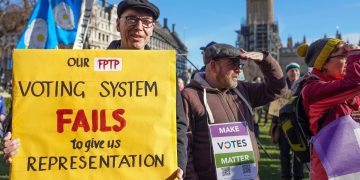
Alarmingly, earlier this year, 59% of voters across 24 democratic countries told the Pew Research Centre that they were dissatisfied with the system of democracy itself. They viewed politicians in general as an elite who did not represent their views. This message came across very clearly in voter rhetoric during the British election campaign. The day after the Labour election victory, Politico prophetically added:
“The tidal wave that swept away the Conservative Party on Thursday night is not so different to the anti-establishment wave currently enveloping Emmanuel Macron in France, and perhaps soon Joe Biden in America…”
Former Labour Home Secretary David Blunkett commented “The major challenge is absolute disillusionment … Starmer must work ferociously to head this off”.
Post-election, British Conservatives have elected Kemi Badenoch, a leader with NatCon views, to revive their party between now and the next general election. Meanwhile, Nigel Farage, leader of the rival Reform UK Party Ltd and enthusiastic MAGA supporter, was elected as an MP in the 2024 election, and waits in the wings to challenge her for the opportunity to lead a unified right-wing opposition into the next general election.
Perilous times
Of course, the ultimate liberty is for national populations to collectively vote for the policies they wish their governments to pursue. However, ‘liberationist’ rhetoric from those who seek to enslave them is often beguiling, particularly during times when international events have negatively affected day-to-day lives.
It’s a perennial responsibility to educate each successive generation to be wary of those who make claims to be their ‘protectors’ from opponents who challenge the ‘right’ ways they espouse. The power of the populist demagogue is as old as humanity itself.
In January, the US will start on a new path. Under its constitution, in November 2028 they will have the opportunity to choose whether to continue, or take an alternative direction. Unless of course, in the meantime, there is a successful attempt to amend those rules.
The fact that so many people in western democracies report discontent with the system itself indicates that this is not as remote a possibility as we might like to believe.
It is therefore imperative that western democracies pay close attention to mass voter disillusionment. Otherwise economic malaise, global warming, the threat of a globally encroaching war and the increase in migration that is emergent from all of these factors, will put the world on a slippery path to increasingly perilous times.

CLICK HERE TO DONATE TO OUR CROWDFUNDER
HELP US BECOME STRONGER SO THAT WE CAN CONTINUE TO DELIVER POWERFUL CITIZEN JOURNALISM!