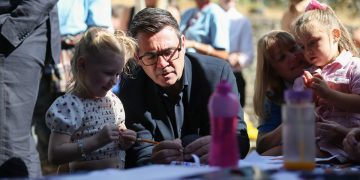




The British Psychological Society (BPS) has raised concerns that the Department for Education (DfE) has ignored their advice when it comes to providing children with sufficient time for unstructured play. Specifically, they have said that the DfE’s post-lockdown catch-up programme does not go far enough to prioritise children’s mental health and wellbeing in schools. Perhaps revived interest in a creative process that took place over 50 years ago might help us to contemplate mistakes ministers have made in creating recent policy for children.
Catching up on play
The BPS’s comments particularly relate to the fact that the committee did not hear evidence from experts in the relevant field, despite the BPS writing to the chair of the education select committee. The lack of play time is an overarching issue that has been raised many times in different contexts with the current government.
In particular, a lack of unstructured play, most recently raised by the BPS in their ‘Time to Play’ campaign, is pinpointed as a problem. Unstructured free play was the topic of my own PhD, over 20 years ago. My research was based on regular observations of a group of children freely playing in their school playground between the ages of four and six.
Learning through play
While all young mammals play at chasing and catching, only children make up stories to go along with what they are doing, and this was the focus of my research. Chasing and catching play is an activity that has been observed in all human societies, from hunter-gatherer societies in the Khalahari Desert to children playing in concrete playgrounds in the largest cities on earth.
Generations of British children have known this game as ‘he’, ‘tig’ or ‘tag’, depending on regional origin. It is called ‘El Dimoni’ in Spain and ‘Oni’ in Japan, both translating to ‘devil’ or ‘demon’, which immediately indicates the archetypal narrative of good vs evil that children typically attach to the activity.
The children I observed told many different ‘chasing’ stories that drew on universal human concepts and the culture of the time, filtering ideas about fear, heroic activity and salvation into play that drew upon Beyblades, Robot Wars, Batman, Disney Princesses, and even David Beckham. The conclusion that I came to, which is echoed in the recent BPS campaign, is that children are doing a lot more than simply burning off energy when they engage in chasing and catching.
Disappearing play
Up to the last quarter of the 20th century, children had significant out-of-school time and space around their homes to engage in collaborative free play. But due to traffic concerns, ‘stranger danger’ worries and longer hours away from home that reflect changing adult working patterns, both time and space for children to play independently in local spaces have reduced.
Schools themselves have also restricted time and space to play, with playing fields sold off, and a condensed school day in which the afternoon break has disappeared and the lunch break has been greatly curtailed. Some schools have even reconstructed the lunch break to make it entirely adult-directed.
Obvious issues arise relating to physical fitness. But the psychological damage is far more insidious.

What happens when children don’t get sufficient opportunities for free play?
In 2014, I published an article with three colleagues examining the likely sociological and psychological fall out from disappearing free play. The main conclusion we came to was that psychological damage is emergent from a lack of childhood opportunities to independently collaborate, cooperate and compete with peers, because these are core primate skills that socially competent adults must be able to independently deploy. In human society, we draw on these skills in all social situations where negotiation occurs, from parish councils to international negotiations.
We predicted that psychological fragility would increase if children did not get the opportunity to develop these skills in the ways that human beings naturally develop them, even long before we became the current human species. We also predicted that sociological issues would arise if human populations began to lack the ability to amicably work out disagreements between themselves. Evidence is now emerging of this result, although social media has also had its role to play, which I have recently discussed elsewhere.
Creativity and play
Beyond building psychological robustness, what else does unstructured play contribute to the development of adult skills? This can be illustrated with examples drawn from the recently released Get Back documentary, which explores archival tapes of The Beatles putting together their final collaborative project. In this, we can observe how a group of talented young adults engage in complex collaboration, competition and cooperation towards a specific creative end.
We first have to remember that John Lennon, Paul McCartney, George Harrison and Ringo Starr were state-school educated, had no university education and very little formal musical training. An earlier BBC documentary looking back on their work on Sergeant Pepper revealed that in writing their songs, they frequently drew directly from endless hours of independent outdoor play and creative activities recalled from childhood; this is most explicit in Strawberry Fields.
The thought of them engaging with the customary SMART targets that now seem indispensable to education and business practice is laughable. Instead, their mode of creative production was open-ended debate and collaborative experimentation – the very skills that I had observed children building in their school playground.
An alternative timeline…
So, what might have happened if those four young men had been born into the 21st first century? Would 14 years of being drilled by Ofsted-harassed teachers ‘delivering’ material to be accurately recalled and continually tested create an environment in which creativity could have thrived in this way?
What if they had been required to spend even more time in pressure-cooker classrooms in order to engage in post-lockdown ‘catch up’? What if they had never been able to independently mess around with their friends in Strawberry Fields?
Would a 21st-century Lennon have had the time during childhood to engage in the depth of independent, abstract thought that underpinned his later contemplation that in ‘Strawberry Fields… nothing is real [and therefore] nothing to get hung about’? Or would that have passed him by, so he would instead turn to posting selfies on Instagram and getting ‘hung about’ the number of resulting ‘likes’?
Would a 21st-century teenage Lennon and McCartney have had sufficient time to play around with their music, away from the direct adult gaze? And would a 21st-century version of Lennon’s conscientious Aunt Mimi have felt compelled by the prevailing culture to ‘enhance’ his (inevitable) UCAS application by sending him to be formally coached in music? And if so, how long would it have been before he told the teacher to f**k off, and never touched a musical instrument again?
A misunderstanding of human nature
One of Lennon and McCartney’s biggest hits was Lucy in the Sky with Diamonds, famously based on a picture drawn by Lennon’s son Julian, six years old in 1969, at the time the ‘Get Back’ films were shot. I was also in primary school in 1969, and remember being influenced by The Beatles’ creativity, for example in the cartoon film Yellow Submarine, a perennial classic that still evokes the cultural environment that surrounded a 1960s childhood.
It is sobering to compare these memories to contemporary children’s experience of the current early years curriculum, with its focus on children memorising and regurgitating adult instruction; for example the emphasis upon ‘retelling’ stories, rather than creating stories of their own.
It is, in the final analysis, impossible to know what a removal of opportunities for children to play and innovate will have on adult human beings until we are presented with the results. But I completely agree with the BPS that such dramatic changes in the way that we raise children over one generation, particularly without resort to expert advice, is a very risky strategy.
And like Lennon and McCartney, I frequently contemplate that ‘living is easy with eyes closed, misunderstanding all you see’, experiencing deep concern that since 2010, our government has rebuilt England’s national curriculum on such a flawed foundation.