




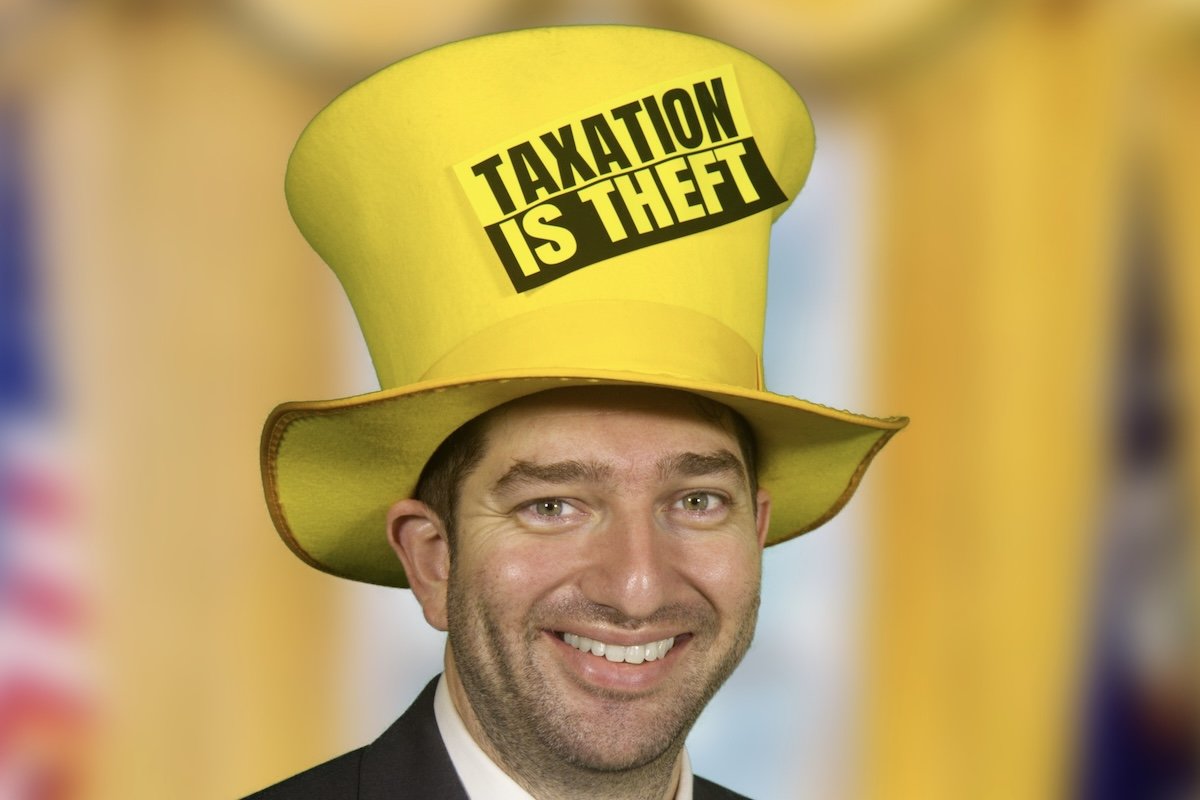
Taxes and death. Both are inevitable. Both are surrounded by myths, lack of comprehension, and lies. Unlike death, however, which none of us will ever truly ‘know’, there are certain truths about taxation which are incontrovertible, and certain lies which are definitely just that – lies.
Taxes are constantly in the news – whether it’s winter fuel allowances, inheritance tax on farms, wealth taxes, or VAT on private schools. But not everything we see is true, complete or clear. This article lays down ten basic truths about taxation to cut through the smoke-screening and deception that cloud many discussions. I will suggest some ways that taxation could be fairer, but this is not an attempt to rewrite tax law – simply to highlight how taxes on the rich can prevent attacks on the poor.
1. Tax is not compulsory
The word ‘compulsory’ implies an absence of choice. But tax is not compulsory, in the sense that we live in a democracy and could vote in a government that abolished taxes. However, we collectively understand the necessity of collecting taxes and so we never have and likely never will. But laws evolve. For instance, marital rape was made illegal and homosexuality decriminalised. These moves were not ‘compulsory’ – they were democratically agreed.
Protest is an extra-parliamentary means to show opposition to laws, including tax laws. Protest ended the poll tax. However, those with power and wealth don’t need to take to the streets. They use lobbying and their media influence to shape public opinion.
2. Tax money is not ‘taxpayers’ money’
Once collected, tax money belongs to the government. Lobby groups such as the Taxpayers’ Alliance, claim “You know how to spend your money better than the government”. This is dangerously misleading. It’s like saying “You know how to live in your neighbour’s house better than your neighbour”. Your neighbour’s house belongs to your neighbour. Tax receipts belong to the government.
3. Anything can be taxed – or not
Tax is more than just ‘income tax’, which only accounts for just over a quarter of UK tax revenue. Historically, we’ve taxed windows, wallpaper and bricks. The sugar tax and the bedroom tax are newer innovations. Today, we tax income, goods, services, business profits, oil and gas revenues, fuel, tobacco, alcohol, capital gains, inheritances, residential and commercial properties and more.
However, we do not effectively tax multinational tech companies, profits hidden in in tax havens, wealth, or windfall profits. If properly taxed, these would generate billions for public services. We could also more effectively target specific types of financial transactions associated with market speculation and the huge gambling sector itself, which would also reduce the harm that gambling spawns.
4. Income is income but it’s not all taxed equally
Earnings above the personal allowance of £12,570 per annum are taxed at a rate of 20%, rising to 40% above £50,270, and 45% above £125,140. National insurance is also levied on all earnings above the personal allowance at 8%. However, earnings above £50,270 are taxed at only 2%. Pensioners – even wealthy ones – pay no national insurance.
Beyond payment for employment, there are many other forms of income: rental earnings, inheritance, savings interest, dividend payments, capital gains, royalties, limited partner involvement, pensions, crypto trading and more. Yet these are often taxed more leniently than employment income. This disproportionally benefits the wealthier.
5. Local taxation reflects regional wealth disparities
Local government funding comes from a mix of council tax, business rates and central government grants. The latter helped poorer areas, where service demand is higher.
However, austerity measures of the previous Conservative government slashed central grants by 40% in real terms from 2009/10 to 2019/20. Councils were left with three options:
- cut services (which has happened)
- borrow more or potentially go bust (both have happened)
- increase council tax and business rates (which has also happened).
Raising council tax does not increase funding equally across regions. Wealthier areas, with more high-value properties, raise more money than poorer areas, an inequality deepened by poorer areas’ greater call on services than richer boroughs. As certain services are mandated by law, it is the non-compulsory, quality-of-life services (libraries, youth work, culture) that get cut.
Furthermore, council tax is regressive. Band H properties (worth £1,714,114 today) pay less than three times the tax of a band A property (worth £214,264), despite being worth eight times as much. This lack of scaling is a political choice, not an economic necessity.

6. Tax and allowances can be powerful behavioural tools
Taxes and allowances can influence behaviour. The congestion charge reduced asthma and average journey time. The sugar tax improved diets. Zero VAT on books encourages literacy. Corporation tax breaks can foster job creation and investment. Gift aid boosts charity donations.
But we can go further – incentives could support heat pump and solar panel installation, regenerative agriculture, cycle-to-school schemes, apprenticeships and physical activity initiatives. Targeted tax measures could also boost employment in bricks and mortar retail and reduce fresh food deserts. Conversely, taxation could be used to deter online hate, exploitative zero-hours contracts, short car journeys, discharge of sewage by water companies and gambling harm.
Tax incentives work best when they are universal. Means-testing a benefit is a foolproof way to ensure that many that need support miss out. Instead, universal benefits can be balanced by progressive taxation, with wealthier earners contributing more. Working-age taxpayers could be covered by a ‘workers’ allowance’, equal in value to the tax hike for the post-retirement benefits that they don’t (yet) receive.
Anything is possible (see point 8).
7. Negative taxation is a thing
Research shows that financial security improves health outcomes and employment prospects and reduces crime, delivering huge savings to the Treasury in the process. Universal Basic Income (UBI), funded by higher tax rates on the wealthy, could benefit all and provide this security.
However, mainstream media fixates on “benefit scroungers” and the feckless. The truth is, a well-designed negative taxation system could create a more stable and more equitable society.
8. Computers can do wonderful things
The current taxation system has evolved over time and contains archaic and mutually contradictory elements. Much of the system was developed in an age of hand-written ledgers. Current income tax bands – 0%, 20%, 40% and 45% – create sudden, sharp tax jumps. A person earning £12,570 pays no tax. But every pound they earn above this leads to a loss of 20p in the pound. At this wage level, the loss is significant. Modern computing power could allow a smoother, incremental tax system – 1%, 2%, 3% etc – with the income brackets much more closely spaced. It could be structured so that anyone on a median wage or lower would benefit and higher earners would pay more tax. The steps could be extended well beyond current income levels to deal with enormously bloated pay packets.
Other forms of income (as outlined in section 4 above) would be treated in exactly the same way – but with carefully introduced allowances to promote positive societal inputs such as employment and investment.
National insurance could be merged with income tax and extended to all age groups.
9. Tax can be more – or less – fair
In 1989, the government introduced the ‘community charge’ to pay for local services. It was a flat tax, where everyone paid the same amount – the charge did not depend on the value of their house, or on their earnings. Renamed ‘the poll tax’, it was immediately branded as unfair, and sparked protests and riots. It was abolished and the government fell.
Flat taxes, such as the TV licence and vehicle registration and utility charges (where people pay for services that they must have e.g., gas, water, electricity, public transport) are effectively poll taxes. Flat taxes are generally seen as unfair.
Proportional taxes – where everyone pays the same rate of tax – appear fairer, since everyone pays at the same rate. VAT is a good example. However, poorer people spend a larger share of their income on taxed goods, meaning that VAT is actually regressive. The poor subsidise the rich.
Progressive taxation – where higher earnings attract higher rates of tax – is fairer. Beyond earnings, a comparable, progressive approach could be applied to utility use and public transport with the first tranche of usage not charged for.
More tax fairness could be achieved by treating all forms of income equally and extending tax rates for the super rich.
10. Tax does not have to be hypothecated
Some taxes are misleadingly linked to specific expenditures (hypothecation) – like national insurance for your state pension or vehicle excise duty for roads. In reality, tax is not legally tied to identifiable spending and all ends up in the same pot. So, for instance, there is no reason why wealthy pensioners should not be required to continue paying national insurance (their ‘stamps’).
Council tax could be replaced with an income-based local tax, pooled nationally and re-distributed to local authorities according to local needs. This would solve the underfunding of local authorities, the inequities of council tax, and the problem of regional wealth inequality, simultaneously.
In conclusion
David Graeber, in his book The Utopia of Rules, wrote: “The ultimate hidden truth of the world is that it is something we make. And could just as easily make differently.”
We should apply this to the UK taxation system. Does the current system work? Are we missing something? Are there negative side effects? Can we do it better? More fairly? We should then apply the same maxim to many other aspects of UK life.
I am indebted to Richard Murphy’s The Joy of Tax, which first showed me that there is more to tax than meets the eye – particularly with regard to points 1 and 2 above, and to Ha-Joon Chang’s 23 Things They Don’t Tell You About Capitalism which inspired the approach that this article takes. Both are recommended reads.
I am not a tax expert. I won’t have got everything right. Hopefully, though, I have provided some food for thought.



