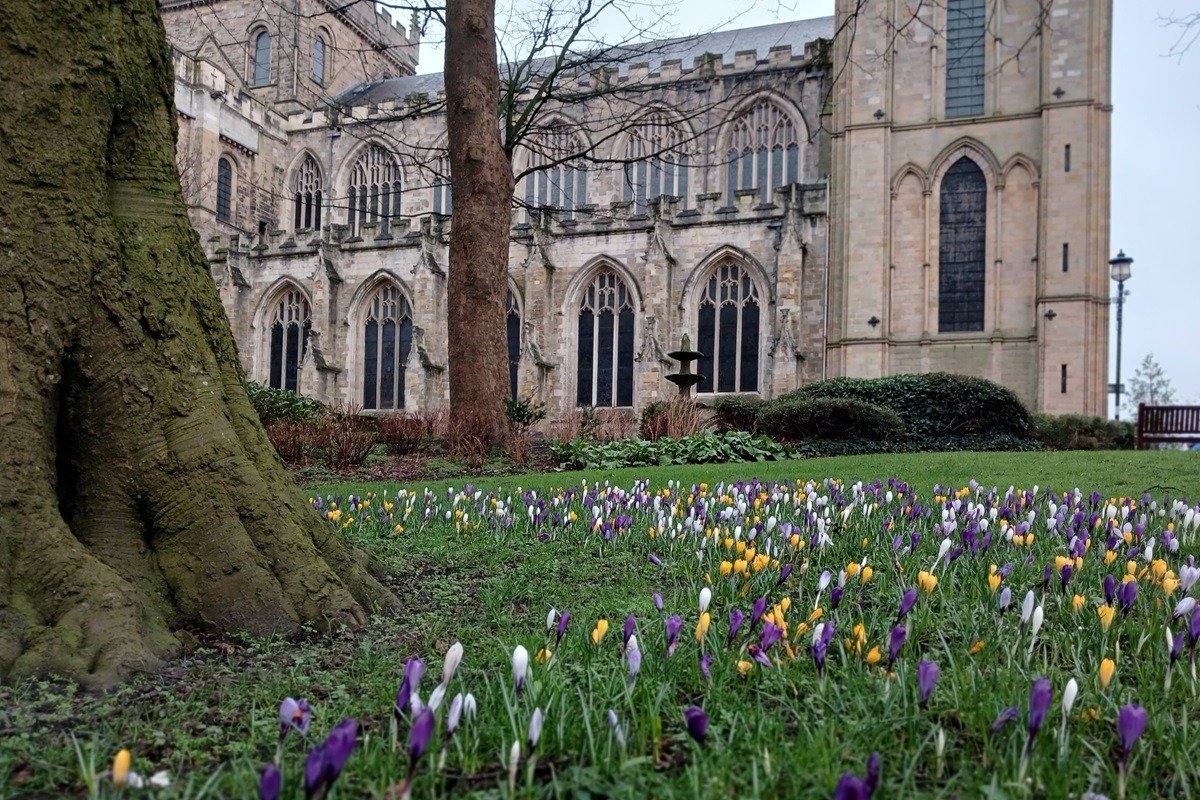
Ripon Cathedral’s £8mn annexe plans continue to cause frustration for environmental campaigners, as they accuse the Cathedral of acting in an empty and cynical fashion, by offering no new plan to save the 11 threatened trees, but instead pushing ahead with the plans submitted in December 2022.
Ripon Cathedral launched its ‘consultation’ into a north side development for their annexe earlier this month, after originally calling a ‘pause’ to their submission plans in January. This new consultation consists of:
- a new leaflet;
- new slides on a PowerPoint presentation, which only lists the supporting organisations and does not give the impartial information by listing all objecting organisations;
- an online feedback form which has been criticised for its emotive and leading questions, as well as the omission of any mention of the impact to the trees.
This online feedback form can be completed multiple times by the same person, clearly invalidating any responses which are given, as it can be manipulated. Additionally, there are now a number of drop-in sessions at the cathedral, staffed by members who cannot provide answers to the questions from the public.
Campaigners emphasise that this consultation launch only serves to highlight the fact that there has been no public consultation on these north side plans – which would have been a major failing on the part of the applicant and could have seen the proposal refused. Had a consultation been done in a timely manner, this issue could have been presented to the planning committee long ago.
Ripon Cathedral: a consultation for appearances’ sake
Of the 22 drop-in sessions, all but one of them is held within the cathedral, or 95% of sessions. Some 16 of the 22 sessions, or 73% overall, are scheduled during the times of 9am–5pm, meaning that a significant majority of people cannot attend. For those who do attend, questions cannot be answered by staff, and the public are invited to email in their questions, which often go unanswered. There are limited records kept of discussions with the public at these sessions, as few staff carry a notebook to record them.
All this leaves campaigners frustrated that this newly launched consultation is for appearances’ sake, rather than a meaningful and genuine attempt to engage in good faith with the public.
A recent public comment on the council planning portal bluntly stated:
“I attended the Cathedral display and was horrified to only experience continued ‘indoctrination’ and no sign of any creative lateral thinking ‘consultation’: clearly the application’s ‘on hold’ period is just a blatant excuse for the Cathedral to attempt to muster cooked up figures to try and prove the above applications have any support from the people.”
Failure to engage with the public
Additionally, Ripon Cathedral and Chapter did not send any representative to a recent public meeting, where the aim of the meeting was to arrange a community consultation event to help rebuild relationships between the Cathedral and the community. This will be the second open public event that the Cathedral has been invited to, after ignoring the first overture from the public. By sending no representatives to the recent meeting, the Cathedral is positioning itself as not being prepared to engage.
How big will the Ripon Cathedral annexe be?
In figures revealed to Yorkshire Bylines only last week – over 14 months from the original submission of the plans – the dimensions of the annexe finally became clear. The Cathedral has made no effort to make these details public, nor can they be found on the planning portal.
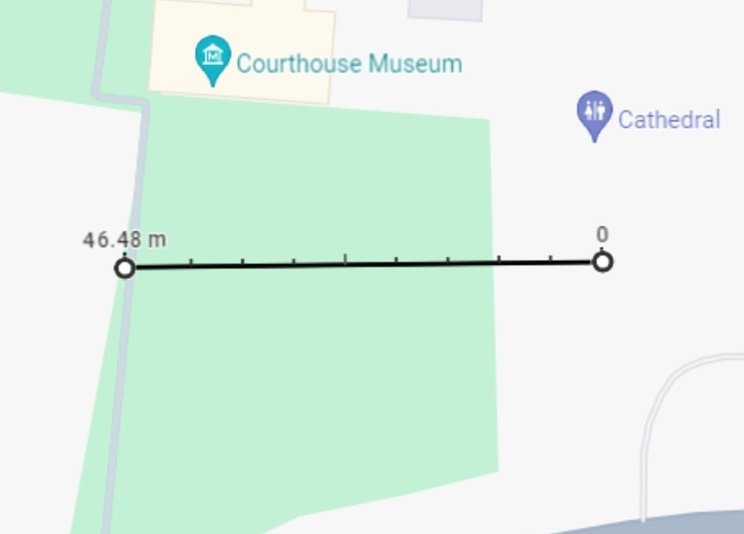
The length of the annexe will be 41.8m, or 137.9 feet long, with a width of 24.7m, or 81.5 feet. The plain issue is that the width of the Minster Gardens from the east boundary wall to the west boundary wall is only 46.5m wide, so the width of the annexe is more than half of the council-owned Minster Gardens, or Kirkgate Park, one of the historic names for this area as recently revealed by Ripon Civic Society.
Scheduled monument consent needed
As Ripon Civic Society noted on an application by the Cathedral to demolish boundary walls in order to ‘fit in’ their new annexe, consent is needed for this action:
“The application by Ripon Cathedral involves partial demolition and rebuilding of the Grade II* curtilage listed Old Deanery wall and ‘adaption’ and partial demolition of wall C1/3 (Grade II* listed with the Courthouse), which connects the Courthouse with the workshop in the stone yard.”
Ripon Civic Society has recently published a leaflet, entitled ‘Ripon’s Kirkgate Park – An Appreciation’, which outlines the historical significance of this area through the centuries, and highlights that the park lies within a scheduled ancient monument and therefore needs scheduled monument consent from the secretary of state for any works.
Fears of gypsum dissolution
North Yorkshire Council’s own Lead Local Flood Authority submitted comments on the planning portal and drew attention to the dangers of gypsum dissolution in the area – an issue that campaigners have long stressed. In comments dated 23 February, the council noted, “Due to risk of gypsum dissolution, disposal via infiltration has been discounted”.
Campaigners have also emphasised recent development cases in the proximity of the Cathedral, which were initially objected to, owing to concerns over gypsum and potential impact to the Cathedral:
“A high risk of ground dissolution within the gypsum-rich bedrock underlying the site is recorded in the area, and ground dissolution is a known, and well recorded hazard, in the Ripon area as a whole.”
Only four years ago, an application to build townhouses behind Kirkgate met with objection from Historic England, who stated:
“The application site is located in the core of Ripon Conservation Area, close to several listed buildings and adjacent to (within 17 meters) the scheduled area of Ripon Minster. The archaeological potential of the scheduled area is extremely high, with stratified deposits surviving from the 7th century AD, much of which includes burials and evidence for early ecclesiastical organisation and related structures.”
Campaigners, then, remain perplexed as to the rationale behind Historic England’s support for the annexe project, when the organisation has indicated that it is mindful of development in a location farther away than the annexe building. Campaigners argue that the risks must be increased by a closer proximity, especially when the western Grade II listed boundary wall is already showing signs of having structural issues and walls in close proximity have been ‘pinned’ before to help with stability.

Repeated failure to respond to press enquiries
Written questions to the Cathedral continue to go unanswered and although asked for a comment on the current process, Ripon Cathedral offered no response.
Sadly, this has now become their repeated response to press enquiries, from this publication and others. They simply ignore them and continue to bulldoze ahead with their unchanged plans. How this approach can be viewed as one which unites a divided city is a baffling viewpoint.