
Labour’s Council of Skills Advisers, commissioned by Lord Blunkett, has produced a report which begins “If there is one thing that would transform the British economy, generating growth and accelerating productivity, it would be a transformational change in the investment – public and private – in the skills of the British people”.
This is not the key issue. The key issue, aside from government policy, is management. The UK workforce today is intrinsically no better or worse than that of any other Western country. But the UK has possibly the most pitifully inadequate management in the West. This report has managed to dump on the workers – again.
UK productivity
Report after report on UK productivity finger the workers or technology. This is wrong! Workers’ productivity is a function of an organisation’s management system as designed by its leaders. This has long been the fatal flaw, exacerbated by bad government policies, and has constrained public sector productivity even more than in the private sector.
The report has 16 key recommendations and over 150 references. There was a strong focus on post-school education and investment by companies. But not one of these recommendations refers to the importance of good management. Labour has thus spent a lot of time and money looking in the wrong place for economic growth. The great Dr W Edwards Deming, who turned the Japanese industry around in the 1950s by improving product quality, would always put the responsibility on management.

Management or the workers?
Organisational experts who go as far back as W Edwards Deming, Joseph Juran and Peter Drucker focused on management. In fact, in his ground-breaking book Out of the Crisis (1982), Deming stated: “Only transformation of the American style of management, and of governmental relations with industry, can halt the decline.”
Forty years later, Tom Brown, a retired UK top executive in the engineering sector, agreed. In his book Tragedy and Challenge (2017) he stated categorically that the decline in UK engineering lies with its poor leadership, the detrimental effects of government economic policy, and the destructive influence of the City.
In 1951/52, Deming met with the heads of Japan’s 21 most important companies, representing over 75% of that country’s corporate wealth. They came to learn. He trained, as did Juran, over 500 top managers in quality improvement. The managers took ownership of quality. They did not employ outside consultants. By 1975, Americans rated Japanese cars as better than the USA models and a million were exported globally. At the same time, the UK’s biggest car manufacturer, British Leyland, was nationalised to save it from bankruptcy.
Unrewarding work and low pay
How bad is it for Britain today? An important indicator of something being really wrong is that, for the first time on record, there are as many posts vacant as there are unemployed workers looking for a job. However, many of the jobs available are, to quote the late, much-lamented, David Graeber “bullshit jobs”, such as those offered by Amazon, Boohoo and their ilk. Who devised these jobs? The top management of the corporations concerned. Others may finger the command-and-control mentality behind unrewarding work for low pay. Either way, it all comes down to management.
Renewal of the management of industry and the economy must be the priority. Since 2015, GDP has grown by 24% in Germany, 18% in France and just 10% in the UK. That leaves the UK economy 70% the size of Germany’s, against 90% in 2015. GDP in the UK is set to shrink by 0.4 per cent in 2023, the Organisation for Economic Co-operation and Development has forecast, and growth is below every other substantial nation except sanctions-hit Russia, so the gap can only widen.
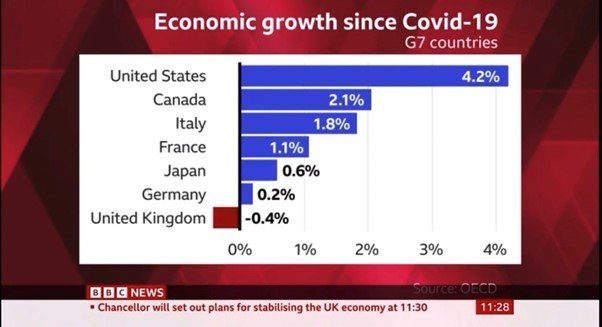
In the three years after Brexit, the UK, traditionally ranked in the world’s top five exporters, sank from 5th to 11th place, where it resides below Mexico and just above Belgium. The UK is home to nine of northern Europe’s ten poorest regions. Its poorest people are now 20% worse off than their equivalents in Germany and France. By 2024 the average Slovenian household will be better off than its UK counterpart. The UK, the so-called fifth richest country in the world, has the lowest GDP per capita in northern Europe; but UK bosses get some of the biggest bonuses!
Britain’s ongoing poor productivity performance
Britain’s productivity record has long been on a downward path, particularly since the Great Financial Crash in 2008. UK workers are 13% less productive than their G7 counterparts, and the gap is getting wider. This low productivity is the main reason for the grim reality that the average British worker, unlike almost every other, is worse off than a decade ago in real terms.
They are losing money at this most demanding time. This is not the fault of the workers. A fish rots from the head down and it is correct to look at leadership at every level. Today there are major disputes in seven key areas of the economy. Not one is, at its most basic, about pay. It is about sheer bad management and greedy top managers.
Take Royal Mail. It paid out £400mn in dividends last year, but the average wage is still below the national average at £23,000. The CEO’s pay was £753,000, including a £142,000 bonus, even though it failed to meet its delivery targets. It is ever thus – the customer/user is never put first and the worker is always where the pinch is. Trade union leaders know far more about how their organisations work, and should work, than the bosses. They also know how companies financial policies serve the shareholders, not the people within the businesses, with the connivance of the government.
Management needs fixing, not the workers
So, it is clear that it is management that needs fixing, not the workforce. What is strange is that both the extreme right wing of the Conservatives and Labour focus on the workers, while the elephant in the room is management. Where does this come from?
The easy answer for the Conservatives is the influence of neoliberal think tanks as captured in the infantile book, Britannia Unchained, put together by Kwarteng, Truss, Raab, Patel and Skidmore – all members of the Free Enterprise Group of MPs. Not one of them has run an organisation or even held down a worker’s job. They are a bunch of ideologues, brainwashed by Tufton Street think tanks without an original thought between them when it comes to real economics.
Out of this badly researched well of ignorance come contemptuous statements about the workforce, suggesting that the British people are “among the worst idlers in the world”, too many of whom “prefer a lie-in to hard work”. This is unresearched schoolboy thinking. Academic MP, Jon Cruddas’ review in The Guardian (2012) marked it as a fail!
Labour is more of a puzzle. Did the party provide too restricted a brief? The key aim stated was “Critically, to put education and training back at the centre of government thinking, and prioritisation.” This was a preconceived solution to the challenge of economic growth and it is the wrong one. Did any of the team consider the successes of Nissan and Toyota in the UK, and of John Lewis, that were brought about management systems and style that made it easy for the workforce to do a good job? They need to put that right if Labour are to really help the workers grow the economy.