
Liz Truss’s recently leaked comments about workers in this country needing to apply a “bit more graft” reveals far more about her ignorance of Britain’s long standing productivity problem than it does about the effort and industrial practices inside British factories.
If, as now seems almost certain, she becomes prime minister on 5 September, we will soon be pursuing another strategy that is bound to fail. Simply exhorting workers to graft more will never work.
There can be little surprise that we have been unable to solve the great productivity conundrum, when we are looking in the wrong place. The answer – eventually – will be found not on the shop floor at all but in the boardroom and in the offices of the hedge funds and institutional shareholders. In other words, the very people who fund for the Conservative Party and support Truss.
She had told civil servants:
“Basically, British workers…..I once wrote a book about this which got mischaracterised, but British workers produce less per hour than…and that’s a combination of kind of skill and application… and they, they, there’s a ….and it’s very…. if you look at productivity, it’s very, very different in London from the rest of the country.”
She said that this lack of productivity had been a historical fact for decades and, “Essentially it’s partly an attitude and mindset thing I think”. She added, that it was somehow related to “a fundamental issue of British working culture.” The clip is below:
A bit more …“graft” is her answer
Britain wants “easy answers” Truss said, and seemingly without noticing the glaring irony, immediately followed this up with – an easy answer. Workers simply need to work harder:
“Essentially, if we are to be a richer country and a more prosperous country that needs to change but I don’t think people are that keen to change that. So, I think there’s a slight thing in Britain about wanting the easy answers. And I think that’s, you know, that’s my reflection on the election and what’s gone before it … and the referendum it’s like we say it’s all Europe that’s causing all these problems … it’s all migrants that’s causing problems, but actually what needs to happen is … you know, a bit more … [prompt] … graft [laughter], it’s not a popular message.”
She is, I’m afraid, completely wrong, as the workers at Nissan in Sunderland have shown consistently over the last 36 years.
A text book example of how wrong Truss is
To see how mistaken she is, we need look no further than a report by the Boston Consulting Group (BCG), commissioned by the Labour government and submitted to Eric Varley, secretary of state for industry, in July 1975. It set out precisely the productivity issue she now identifies but in the context of the terminal problems facing the UK motor cycle industry at the time.
Post-war UK had perhaps 20 or more motorcycle manufacturers and a booming market. After BSA purchased Triumph Motorcycles in 1951 it claimed to be the world’s largest manufacturer. Eight years later in 1959 that crown had been usurped by Honda, a Japanese company that then went on to virtually wipe out Britain’s entire motorcycle industry singlehanded over the next decade.
The BCG report is a sorry tale of how it happened, with productivity right at the very heart of it. But you would find it impossible to conclude the reasons were down to workers not grafting. BCG certainly didn’t.
In 1975, Norton-Villiers-Triumph – effectively all that was left at the time of a once-thriving industry in Britain – produced 56,500 bikes, an average of just 14 for each of the 4,000 workers. In contrast, Honda alone was producing two million bikes – close to 36 times as many – each year in Japan. Workers at the Suzuka factory managed 350 bikes per person/year. Overall Honda workers contributed on average 106 bikes in addition to 21 cars each per year. Another manufacturer, Yamaha, hit a million, at 200 bikes per worker/year; Suzuki 800,000 at 114 per worker/year; and Kawasaki 300,000 at 159 per worker/year.
The figures are in exhibit 21 on page 53 of the report:
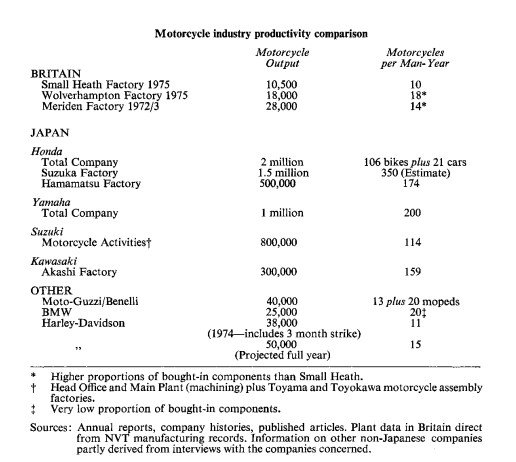
This was Britain’s productivity problem writ large (very large), but a lack of what Truss calls ‘graft’ played no part in it then and still doesn’t. We appear to have learned nothing in the last 50 years.
How did Japan do it?
Honda first built up domestic manufacturing capacity by satisfying growing demand in Japan for small, reliable lightweight machines, before branching out overseas into the lucrative export markets of North America and Europe.
There are claims that Honda sold machines at a loss in order to capture or hold market share and this was partly true. The primary strategy was always to grow sales volume at the expense of profitability. Between 1963 and 1970, because of market development, Honda was not profitable in the UK but by 1974, holding 54% of the market, it was easily the dominant supplier.
And BCG found that at Honda: “Manufacturing policy is based on the concept that high volumes per model provide the potential for high productivity. This potential is realised in practice by using capital intensive and highly automated techniques” [added emphasis].
More than that, Japanese bikes were designed from the outset with low-cost automated mass-production in mind, while British manufacturers focused on pure design using simple hand-assembly methods.
The report adds, “The Japanese now have large factories specialised by model, component and/or function. Their focus on volume-based cost reduction results in extensive use being made of advanced techniques such as: automated high pressure die casting of large engine components; forging and sintering to reduce machining and material waste; rotary index and in-line transfer machines, largely made in-house; and conveyorised assembly lines” [added emphasis].
British plants on the other hand contained, “mostly old, general purpose, fairly labour-intensive equipment which is not capable of high volume low cost production and is not ideal for producing parts to the close tolerances required for a reliable final product”.

Far more fixed investment
Despite having about five times the number of employees, each Honda worker still had access to £5,000 worth of fixed investments compared to just £1,300 at British plants.
Honda, Yamaha and Suzuki each employed between 800 and 1,300 people in research and development alone. Yet, because of the sales volumes achieved, as a percentage of the selling price this added less cost per machine than the 100 R&D employees in the UK industry.
Honda, in a separate division (Honda Engineering), employed 1,400 people just building automated machine tools which they designed themselves to manufacture sub-assemblies and complete bikes. This was over a third of the entire workforce of the entire UK industry at the time in one Japanese company.
The Japanese assembly line worker probably ‘grafted’ less than their counterpart in this country because he or she had access to more, more modern and more automated equipment that produced better, more reliable products at lower unit cost and they were better rewarded for doing so. Honda workers received average pay of £296 per month, about 45% more than the £203 per month earned by the average NVT employee.
How is a worker supposed to influence this sort of strategy with a bit more graft?
Graft, I’m afraid, doesn’t enter into it and any amount of improvement to attitudes, skills, application, mindsets and working culture isn’t going to affect productivity without a massive change in investment thinking which can only come from the boardrooms of Britain’s manufacturers.
What happened to the British motorcycle industry since 1975?
Triumph Engineering went into receivership in 1983, and the name and manufacturing rights purchased from the official receiver by John Bloor, who slowly began making motorcycles again. The company has achieved modest success. In February 2020 it was announced that production would be moving to their factories in Thailand. Customs handling and the R&D department with prototype manufacturing remain in the UK.
Last year, total global sales of Triumph motorcycles reached 78,365. The company made a small loss of £7mn on sales of £500mn.
Honda in 2021 sold a little under 17 million machines (motorcycles, scooter and powersport vehicles) worldwide, less than the record 20.7 million figure seen in 2018 but still enough to retain their position as the largest manufacturer. And now over 200 times as many as Triumph.
No Mrs Truss, a bit more graft is not the answer. It’s not even an easy one.