• Contact
  • About
  • ISSN 3049-9720
  • Authors and editors
NEWSLETTER SIGN UP
Yorkshire Bylines
Advertisement
  • Home
  • News
    • Brexit
    • Culture
    • Education
    • Environment
    • Home Affairs
    • Transport
    • World
  • Politics
  • Opinion
  • Society
    • Food
    • Music
    • Poetry
    • Sport
  • Business
    • Economy
    • Science and Technology
    • Trade
  • Region
No Result
View All Result
Yorkshire Bylines
Home News Brexit

Gibraltar vs Northern Ireland: the Brexit flashpoints

Gibraltar and Northern Ireland were both predicted to be Brexit flashpoints but so far only one of them has been

David Henig by David Henig
14-06-2021 19:15 - Updated on 07-10-2024 16:49
in Brexit, Politics
Reading Time: 4 mins read
A A
Northern Ireland Gibraltar

Photo by Eliška Motisová on Unsplash

Share on Bluesky

With tensions continuing to mount between the UK and EU over the Northern Ireland protocol, it’s worth taking a look at how differently Brexit is playing out at another border between Britain and the EU – Gibraltar. Both areas were widely predicted to be Brexit flashpoints, but so far, only one of them has been. Why is that?

The reasons, I believe, come down to confidence and leadership, more than history.

Gibraltar and Northern Ireland and the reality of Brexit

There are similarities and differences between Gibraltar and Northern Ireland, of course. Northern Ireland has the legacy of the troubles, while Gibraltar is more singular in views about being British. Both have sensitive borders with the EU: right now both require more checks coming from Great Britain, while having more open borders to the EU. So there’s enough to make the comparison.

And what’s immediately apparent is that the difference in the extent to which Gibraltar and Northern Ireland have accepted the reality of Brexit. Because Gibraltar appears to be happy, whereas Northern Ireland isn’t. Why?

Separating the British identity from post-Brexit trading relationships

It’s not that Gibraltar has become less British or more Spanish, although raising such a question feels like a key point. Gibraltar’s leadership (more on them later) were able to separate British identity from post-Brexit trading relations. This didn’t happen in Northern Ireland.

The UK government negotiates on behalf of Gibraltar in the same way that it does for Northern Ireland. But as these negotiations have played out, it’s felt as though the UK (rather than Northern Ireland) has set the objectives for Northern Ireland, whereas it’s been Gibraltar setting them for Gibraltar. They were more involved, particularly in the internal negotiation as to objectives which precedes the external negotiation and is often more important.

The Gibraltar government always had the twin objectives of protecting economy and identity, and saw these as separate. I then saw them in action a couple of times negotiating with the UK, rather effectively. “We can be British and be open to the EU”, was the message.

In comparison, the UK government never distinguished between the political and economic objectives with regard to Northern Ireland. It didn’t accept, as the Gibraltar government did, that Northern Ireland could be treated differently from Great Britain yet still be British. And in so doing, the UK government found its objectives unclear, economy and identity tangled

Equally, the political parties in Northern Ireland couldn’t reach a common position as could be seen in Gibraltar – or at least, the position they reached was a weak one in relation to UK government plans. The differing identities in Northern Ireland were more of an obstacle, though that didn’t have to be insurmountable.

Leadership and strong negotiation

The final point is to be able to carry out the strategy. In Fabian Picardo, I believe Gibraltar had the outstanding negotiator on the whole UK side during Brexit. Clear in overall objectives. Determined in using each meeting in pursuit of those objectives. Friendly, but tough. A great communicator.

Through observing both negotiations, I have learned that in Northern Ireland they needed a clearer, more agreed cross-community objective. While some in the Northern Ireland political system understand that, this has not been enough. This was not something that should have been left to a distant government. The need for clear cross-community objectives is still apparent.

Confidence and leadership from Gibraltar

On the Gibraltar model, you can be British while still having more checks to arrivals from the UK compared to the EU. It is a confidence that is delivered by leadership, which we simply haven’t seen enough of from anyone with regard to Northern Ireland.

Finally, if the UK government had wanted to give itself a better chance in EU negotiations it would have done everything to get Picardo to play a leading role. It is no accident that Gibraltar has not become a Brexit flashpoint. London should be learning from that.

Learn from Gibraltar that the resolution of issues with regard to Northern Ireland is not about sausage regulations or the nationality of passport checkers, but the extent to which identities and trade rules can be separated. Gibraltar and Northern Ireland may have a different constitutional status, but the lessons in negotiation still hold.


Sign up for the Yorkshire Bylines newsletter

* indicates required

Consent for having Bylines Network store my submitted information

You can unsubscribe at any time by clicking the link in the footer of our emails. For information about our privacy practices, please visit our website.

We use Mailchimp as our marketing platform. By clicking below to subscribe, you acknowledge that your information will be transferred to Mailchimp for processing. Learn more about Mailchimp's privacy practices.

David Henig

David Henig

David is director of the UK Trade Policy Project at ECIPE, co-founder of UK Trade Forum and a columnist for the European trade news service Borderlex. Until 2018 he was a UK government official specialising in trade policy including spending three years working on the proposed TTIP deal between US and EU, and helping establish the Department for International Trade. Follow him on BlueSky

Related Posts

Wooden blocks painted with the European Union EU flag placed on a Europe map, symbolizing European unity, integration, politics, and economy
Politics

Embracing EU free movement should hold no terrors for the UK

by Richard Corbett
6 November 2026
Chelmsford, Essex, United Kingdom - May 08th 2026: Reform UK Leader Nigel Farage speaks at Chelmsford Race Track after sweeping local election victories for his party. Credit: Will Colebourne
Home Affairs

‘Reforming’ Britain? A window to the past

by Dr Pam Jarvis
30 October 2026
Flag of county Yorkshire, UK at cloudy sky background on sunset, panoramic view. County of United kingdom of Great Britain and Northern Ireland, England.
Opinion

Who scrutinises Yorkshire-wide decisions?

by John Hall
29 October 2026
Barack Obama and Donald Trump face one another at the US Capitol during the presidential handover in January 2017. Obama rests his hands on Trump's arms as the two men exchange words.
Opinion

J’Accuse: how Obama’s triumph helped fuel Trump’s rise

by J 'Masharubu' Strauss
26 October 2026
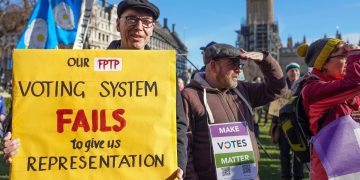
Make Votes Matter protest at Westminster. One activist holds a banner that says, "Our FPTP voting system fails to give us representation in govt".
Constitutional Affairs

On the urgency of reforming our electoral system

by John Cole
23 October 2026
Next Post
Dido Harding, cartoon by Stan

Outsourcing morality: Dido Harding wants the top job at the NHS

PLEASE SUPPORT OUR CROWDFUNDER

BROWSE BY TAGS

Art Books Boris Johnson Bradford Charity Climate Change Cost of Living Covid-19 Creative Industries Crime Democracy Devolution Donald Trump Environment Equality Experience Farming Festival Gaza Conflict General Election History Human Rights Immigration Iran Journalism Keir Starmer Labour Leeds Media Mental Health NHS Northern Ireland Protocol Pollution Poverty Recipe Refugees and Asylum Seekers Restaurants Retained EU Law Review Rishi Sunak Sheffield Theatre Travel Ukraine USA
Yorkshire Bylines

We are a not-for-profit citizen journalism publication. Our aim is to publish well-written, fact-based articles and opinion pieces on subjects that are of interest to people in Yorkshire and beyond.

Yorkshire Bylines is a trading brand of Bylines Networks Limited which is separate to, but allied with, Byline Times.

Learn more about us

No Result
View All Result
  • About
  • Authors and editors
  • Complaints
  • Contact
  • Donate
  • Letters
  • Privacy
  • Network Map
  • Network RSS Feeds
  • Submission Guidelines
  • Download the Bylines Network App

© 2020-2026 Yorkshire Bylines. Powerful Citizen Journalism. ISSN 3049-9720

No Result
View All Result
  • News
    • Brexit
    • Education
    • Environment
    • Health
    • Home Affairs
    • Transport
    • World
  • Politics
  • Opinion
  • Society
    • Culture
    • Dance
    • Food
    • Music
    • Poetry
    • Recipes
    • Sport
  • Business
    • Economy
    • Science and Technology
    • Trade
  • Region
  • The Davis Downside Dossier
  • The Digby Jones Index
  • Cartoons by Stan
  • Authors and editors

Newsletter sign up

CROWDFUNDER

© 2020-2026 Yorkshire Bylines. Powerful Citizen Journalism. ISSN 3049-9720