• Contact
  • About
  • ISSN 3049-9720
  • Authors and editors
NEWSLETTER SIGN UP
Yorkshire Bylines
Advertisement
  • Home
  • News
    • Brexit
    • Culture
    • Education
    • Environment
    • Home Affairs
    • Transport
    • World
  • Politics
  • Opinion
  • Society
    • Food
    • Music
    • Poetry
    • Sport
  • Business
    • Economy
    • Science and Technology
    • Trade
  • Region
No Result
View All Result
Yorkshire Bylines
Home News Brexit

Almost 100 days into Brexit, and the deal is still only provisional

Almost 100 days into Brexit, and the deal which we're operating under is still only provisional. Will we end up with no deal at all?

Richard Corbett by Richard Corbett
04-04-2021 08:01 - Updated on 27-09-2024 17:45
in Brexit, Politics
Reading Time: 3 mins read
A A
Brexit deal provisional

Image is licensed under CC BY

Share on Bluesky

We’re approaching the first 100 days of Brexit and, remarkably, have not yet seen the final ratification of the government’s deal (the trade and cooperation agreement) with the EU. This leaves considerable uncertainty for all those relying on its provisions, not least our exporters and those whose supply chains come from the EU.

Once signed on Christmas Eve, the agreement needed parliamentary approval by both sides. While the UK parliament nodded it through in one day, the EU took this more seriously: after all, the 1,246 pages of dense legal text will govern relationships on all kinds of matters for years to come. The EU therefore agreed only on “provisional application” until the European parliament approves the deal.

Europe is scrutinising the Brexit deal more than Britain

Unlike Westminster, the European parliament is doing a thorough job.

Each of its parliamentary committees (on trade, fishing, transport and so on) has looked in detail at the effects of this deal. They have noted and listed areas that will require more detailed work and they have secured commitments about how parts of it will be implemented. The parliament’s research department has published this handy analysis of the agreement.

Ultimately, however, the parliament’s approval has hit a snag: trust. Many MEPs are arguing that the EU should not approve the trade and cooperation agreement while the UK is threatening to tear up the previous agreement – the withdrawal agreement and in particular its protocol on Northern Ireland.

They argue that, if a country cannot be trusted to implement an agreement and openly breaks international law, what is the point of reaching any new agreement with it?

Will this trigger a no-deal Brexit?

Indeed, the announcement by Lord Frost – without even the courtesy of informing the EU in advance or discussing it in the joint committee set up for sorting out problems – that the UK government will unilaterally disapply provisions it had previously agreed to, caused shock and consternation in the EU (and beyond).

After all, the arrangements for Northern Ireland, which are intended to attenuate some of the problems caused by Brexit, were negotiated, signed and ratified by the UK only months ago, on the basis of changes that Johnson wanted to make to what Theresa May had sought.

It is unlikely that the European Parliament will, at least at this stage, reject the deal outright, triggering a ‘no-deal Brexit’. But it could simply postpone its vote, and announce that it will put the item on its agenda only when the UK government backs down from its threat to break international law.

Unless the UK government walked away, this would force a decision to extend the period of provisional application of the deal. That in turn means prolonged uncertainty for businesses and citizens alike. 

But where the blame lies is clear: Downing Street.

Tags: Boris Johnson

Sign up for the Yorkshire Bylines newsletter

* indicates required

Consent for having Bylines Network store my submitted information

You can unsubscribe at any time by clicking the link in the footer of our emails. For information about our privacy practices, please visit our website.

We use Mailchimp as our marketing platform. By clicking below to subscribe, you acknowledge that your information will be transferred to Mailchimp for processing. Learn more about Mailchimp's privacy practices.

Richard Corbett

Richard Corbett

Richard Corbett is a former Labour MEP for Yorkshire and Humber who served as leader of the Labour MEPs between 2017 and 2020, and is the former Labour leader in the European parliament Follow him on BlueSky

Related Posts

Wooden blocks painted with the European Union EU flag placed on a Europe map, symbolizing European unity, integration, politics, and economy
Politics

Embracing EU free movement should hold no terrors for the UK

by Richard Corbett
6 November 2026
Chelmsford, Essex, United Kingdom - May 08th 2026: Reform UK Leader Nigel Farage speaks at Chelmsford Race Track after sweeping local election victories for his party. Credit: Will Colebourne
Home Affairs

‘Reforming’ Britain? A window to the past

by Dr Pam Jarvis
30 October 2026
Flag of county Yorkshire, UK at cloudy sky background on sunset, panoramic view. County of United kingdom of Great Britain and Northern Ireland, England.
Opinion

Who scrutinises Yorkshire-wide decisions?

by John Hall
29 October 2026
Barack Obama and Donald Trump face one another at the US Capitol during the presidential handover in January 2017. Obama rests his hands on Trump's arms as the two men exchange words.
Opinion

J’Accuse: how Obama’s triumph helped fuel Trump’s rise

by J 'Masharubu' Strauss
26 October 2026
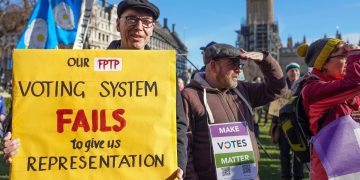
Make Votes Matter protest at Westminster. One activist holds a banner that says, "Our FPTP voting system fails to give us representation in govt".
Constitutional Affairs

On the urgency of reforming our electoral system

by John Cole
23 October 2026
Next Post
civil society

Is the BBC the answer to the collapse of civil society?

PLEASE SUPPORT OUR CROWDFUNDER

BROWSE BY TAGS

Art Books Boris Johnson Bradford Charity Climate Change Cost of Living Covid-19 Creative Industries Crime Democracy Devolution Donald Trump Environment Equality Experience Farming Festival Gaza Conflict General Election History Human Rights Immigration Iran Journalism Keir Starmer Labour Leeds Media Mental Health NHS Northern Ireland Protocol Pollution Poverty Recipe Refugees and Asylum Seekers Restaurants Retained EU Law Review Rishi Sunak Sheffield Theatre Travel Ukraine USA
Yorkshire Bylines

We are a not-for-profit citizen journalism publication. Our aim is to publish well-written, fact-based articles and opinion pieces on subjects that are of interest to people in Yorkshire and beyond.

Yorkshire Bylines is a trading brand of Bylines Networks Limited which is separate to, but allied with, Byline Times.

Learn more about us

No Result
View All Result
  • About
  • Authors and editors
  • Complaints
  • Contact
  • Donate
  • Letters
  • Privacy
  • Network Map
  • Network RSS Feeds
  • Submission Guidelines
  • Download the Bylines Network App

© 2020-2026 Yorkshire Bylines. Powerful Citizen Journalism. ISSN 3049-9720

No Result
View All Result
  • News
    • Brexit
    • Education
    • Environment
    • Health
    • Home Affairs
    • Transport
    • World
  • Politics
  • Opinion
  • Society
    • Culture
    • Dance
    • Food
    • Music
    • Poetry
    • Recipes
    • Sport
  • Business
    • Economy
    • Science and Technology
    • Trade
  • Region
  • The Davis Downside Dossier
  • The Digby Jones Index
  • Cartoons by Stan
  • Authors and editors

Newsletter sign up

CROWDFUNDER

© 2020-2026 Yorkshire Bylines. Powerful Citizen Journalism. ISSN 3049-9720