• Contact
  • About
  • ISSN 3049-9720
  • Authors and editors
NEWSLETTER SIGN UP
Yorkshire Bylines
Advertisement
  • Home
  • News
    • Brexit
    • Culture
    • Education
    • Environment
    • Home Affairs
    • Transport
    • World
  • Politics
  • Opinion
  • Society
    • Food
    • Music
    • Poetry
    • Sport
  • Business
    • Economy
    • Science and Technology
    • Trade
  • Region
No Result
View All Result
Yorkshire Bylines
Home News Brexit

Eurocrat smack down misses the point: the political situation in Northern Ireland is not just a diplomatic spat

To depict this as the EU being ‘nasty’ and pretend this is just about vaccines is to miss the point completely

Professor Juliet Lodge by Professor Juliet Lodge
05-02-2021 11:24 - Updated on 23-09-2024 14:59
in Brexit, Politics
Reading Time: 6 mins read
A A
Ben Kerckx via Pixabay

Ben Kerckx via Pixabay

Share on Bluesky

Last weekend, the UK government was quick to smack down the EU over its threat to use Article 16 of the Northern Irish protocol to deter vaccines from being sent via Northern Ireland to Great Britain. The EU Commission president quickly admitted the error and withdrew the idea within five hours.

The problem centres on what is required to allow any covid vaccines to leave the EU for ‘third countries’. Having left the EU, the UK is a ‘third country’. Therefore authorisation is needed for any vaccines (or other products) leaving the EU and going to the UK. Now for the complicated bit. Ireland is an EU member, so no such authorisations are needed. Northern Ireland is not an EU member. But the protocol allows it to be treated as though it is.

So why did the Commission threaten to use Article 16? Was there a problem? Possibly. Because of the NI Protocol, no export authorisations would have been required for goods (vaccines) shipped from Belgium (or anywhere else in the EU) to Northern Ireland.

This was seen as a potential risk and to close the loophole the Commission reached for the only tool available – Article 16 – and proposed to use it in a draft regulation published on Friday. There was an outcry and within hours it was swiftly withdrawn. A new draft minus the offending section is now in force.

However, it is important to remember that even if the regulation had been unchanged, the practical effect would simply have been that vaccines destined for NI would have needed an export authorisation before they left the EU factory. That is all, nothing in the regulation would have required a land border as some people who should know better are now suggesting.

The situation has been inflamed because of growing problems in implementing the new Irish Sea border, and customs delays at the ports have been politicised as they worsened through January. Last week, food checks at Larne and Belfast ports were stopped. These are required under the Irish protocol.

Worse, EU customs and veterinary officials working alongside their Northern Irish counterparts at the ports in Northern Ireland have been threatened by unionist groups and were told to stay at home for their own safety. The EU sought reassurances from the UK. More worrying are fears of sectarian issues breaking out and endangering peace in Northern Ireland. Sectarian concerns over Brexit’s implications for UK unity and for future trade pre-date, but fed, the row over vaccine exports. Northern Ireland’s ministers have demanded that the protocol be ditched.

This week, First Minister Arlene Foster, her deputy and Michael Gove had a short video conference with Commission Vice President Maroš Šefčovič after which they issued a statement agreeing to cooperate to solve the problems. Mr Gove then sent him a letter demanding sweeping changes to the protocol on Northern Ireland. As reported by Tony Connelly in the Irish Times, its bullying tone has been interpreted as an ultimatum to the EU.

3/ EU sources have said the letter resembled an ultimatum to the EU, as tensions mount in Northern Ireland over the impact of the Protocol, which has meant customs and food safety formalities on goods moving from Great Britain to Northern Ireland.

— Tony Connelly (@tconnellyRTE) February 3, 2021

The tone is unhelpful to say the least. It ignores the fact that the Trade and Cooperation Agreement that came into effect at 11pm on 31 December 2020 UK time, has extensive mechanisms for arbitration in the event of disputes. A timely informal chat could have averted everything escalating into a very public political row fanned by sectarian resentments.

Moreover, to depict this as the EU being ‘nasty’ and pretend this is just about vaccines is to miss the point completely. As every politician or civil servant who has worked in the EU over the past 40+ years know, informal cooperation is how ‘constructive cooperation’ gets done – on the island of Ireland and in the EU.

And the UK has not done what it agreed to do under the protocol to ensure that customs and food safety formalities can be completed. It has not facilitated EU access to either the HMRC’s data system nor to its customs IT system to enable EU officials to monitor the flow of goods across the Irish sea in real time. The EU agreed in return to facilitate a trusted trader scheme and simplify customs formalities and both sides were committed to providing what was needed as part of the so-called ‘exit summary declarations’ normally needed when goods leave the EU’s customs union. Note, Great Britain is no longer part of the customs union. Becoming part of it again would certainly minimise some of these problems.

In fact, that is more or less what Mr Gove wants but will not say. Instead, he calls for major changes to the protocol to exempt food consignments from EU food safety controls, at least until 1 January 2023.

Whatever happens next, the situation is precarious. Boris Johnson adopted his characteristically bullish tone in prime minister’s questions this week in threatening to tear up the protocol; and in the EU and UK, Mr Gove’s stance and criticisms of the peace process in 2000 have not been forgotten. It is not surprising that commentators are saying that for Northern Ireland, Brexit is neither forgotten nor done.

Northern Ireland was a concern during the Brexit negotiations. It’s a concern now Brexit has happened. This is why. In under 5 minutes. Produced @brysonandy pic.twitter.com/KKsegLmndl

— Ros Atkins (@BBCRosAtkins) February 3, 2021

So the current spat highlights the continuing relevance of historical issues that membership of the EU had helped to resolve. Pretending that this is not the case does us all a disservice. Pretending that any extension of arrangements can be provisional to solve problems which are endemic rather than teething problems, will make matters worse. Will Gove come clean or attempt another sleight of hand as the UK becomes increasingly disunited?


Sign up for the Yorkshire Bylines newsletter

* indicates required

Consent for having Bylines Network store my submitted information

You can unsubscribe at any time by clicking the link in the footer of our emails. For information about our privacy practices, please visit our website.

We use Mailchimp as our marketing platform. By clicking below to subscribe, you acknowledge that your information will be transferred to Mailchimp for processing. Learn more about Mailchimp's privacy practices.

Professor Juliet Lodge

Professor Juliet Lodge

Juliet has worked as professor of European integration and EU politics in universities in New Zealand, the EU and UK – including in Yorkshire. Her research spans biometrics, AI and EU affairs, on which she has given expert evidence to many parliaments and to the EU. Juliet is the AI ethics lead in the EU Horizon project 'AI 4 Trust' which is building a hybrid system where machines cooperate with humans to counter advanced disinformation techniques. She was elected EU woman of Europe for her voluntary work with communities, and supports freedom of movement and EU reform. Follow her on Bluesky

Related Posts

Wooden blocks painted with the European Union EU flag placed on a Europe map, symbolizing European unity, integration, politics, and economy
Politics

Embracing EU free movement should hold no terrors for the UK

by Richard Corbett
6 November 2026
Chelmsford, Essex, United Kingdom - May 08th 2026: Reform UK Leader Nigel Farage speaks at Chelmsford Race Track after sweeping local election victories for his party. Credit: Will Colebourne
Home Affairs

‘Reforming’ Britain? A window to the past

by Dr Pam Jarvis
30 October 2026
Flag of county Yorkshire, UK at cloudy sky background on sunset, panoramic view. County of United kingdom of Great Britain and Northern Ireland, England.
Opinion

Who scrutinises Yorkshire-wide decisions?

by John Hall
29 October 2026
Barack Obama and Donald Trump face one another at the US Capitol during the presidential handover in January 2017. Obama rests his hands on Trump's arms as the two men exchange words.
Opinion

J’Accuse: how Obama’s triumph helped fuel Trump’s rise

by J 'Masharubu' Strauss
26 October 2026
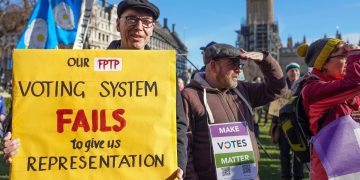
Make Votes Matter protest at Westminster. One activist holds a banner that says, "Our FPTP voting system fails to give us representation in govt".
Constitutional Affairs

On the urgency of reforming our electoral system

by John Cole
23 October 2026
Next Post
“Boris Johnson’s Cabinet Meeting”: Image by UK Prime Minister for Creative Commons

Libertarians do us a grave disservice, especially when it comes to Covid-19

PLEASE SUPPORT OUR CROWDFUNDER

BROWSE BY TAGS

Art Books Boris Johnson Bradford Charity Climate Change Cost of Living Covid-19 Creative Industries Crime Democracy Devolution Donald Trump Environment Equality Experience Farming Festival Gaza Conflict General Election History Human Rights Immigration Iran Journalism Keir Starmer Labour Leeds Media Mental Health NHS Northern Ireland Protocol Pollution Poverty Recipe Refugees and Asylum Seekers Restaurants Retained EU Law Review Rishi Sunak Sheffield Theatre Travel Ukraine USA
Yorkshire Bylines

We are a not-for-profit citizen journalism publication. Our aim is to publish well-written, fact-based articles and opinion pieces on subjects that are of interest to people in Yorkshire and beyond.

Yorkshire Bylines is a trading brand of Bylines Networks Limited which is separate to, but allied with, Byline Times.

Learn more about us

No Result
View All Result
  • About
  • Authors and editors
  • Complaints
  • Contact
  • Donate
  • Letters
  • Privacy
  • Network Map
  • Network RSS Feeds
  • Submission Guidelines
  • Download the Bylines Network App

© 2020-2026 Yorkshire Bylines. Powerful Citizen Journalism. ISSN 3049-9720

No Result
View All Result
  • News
    • Brexit
    • Education
    • Environment
    • Health
    • Home Affairs
    • Transport
    • World
  • Politics
  • Opinion
  • Society
    • Culture
    • Dance
    • Food
    • Music
    • Poetry
    • Recipes
    • Sport
  • Business
    • Economy
    • Science and Technology
    • Trade
  • Region
  • The Davis Downside Dossier
  • The Digby Jones Index
  • Cartoons by Stan
  • Authors and editors

Newsletter sign up

CROWDFUNDER

© 2020-2026 Yorkshire Bylines. Powerful Citizen Journalism. ISSN 3049-9720