• Contact
  • About
  • ISSN 3049-9720
  • Authors and editors
NEWSLETTER SIGN UP
Yorkshire Bylines
Advertisement
  • Home
  • News
    • Brexit
    • Culture
    • Education
    • Environment
    • Home Affairs
    • Transport
    • World
  • Politics
  • Opinion
  • Society
    • Food
    • Music
    • Poetry
    • Sport
  • Business
    • Economy
    • Science and Technology
    • Trade
  • Region
No Result
View All Result
Yorkshire Bylines
Home News Brexit

UK Brexit negotiator: “best-case outcome can’t be as good as what we have now”

David (now Lord) Frost appears to make anti-Brexit comments in a 2016 report uncovered by the Financial Times

Anthony Robinson by Anthony Robinson
17-11-2020 19:32 - Updated on 11-09-2024 14:40
in Brexit, Politics
Reading Time: 6 mins read
A A
Frost pilloried after select committee appearance

David Frost and Michel Barnier Photo: Barnier/TWITTER

Share on Bluesky

In June 2016, just before the referendum David (now Lord) Frost set out cogent reasons against leaving the EU in a report by Portland Communications, described as a strategic communications consultancy. Frost at the time was chief executive of the Scotch Whisky Association and was writing in a personal capacity.

Now elevated to the House of Lords, he is our chief negotiator on the future trading relationship with the EU. This 2016 report provides an insight into Frost’s thoughts. The FT uncovered his earlier comments:

UK’s Brexit negotiator predicted Brussels would have upper hand https://t.co/7C7PHH8iTF

— FT UK Politics (@ftukpolitics) November 16, 2020

As a former diplomat he was well aware of the difficulties that a vote to leave would bring. Here are some direct quotes from his article.

“[Brexit] is a mammoth undertaking. Simply setting out the task underlines how risky a decision to Vote Leave will be.”

Lord Frost June 2016

“First, can any future trading arrangements, as a matter of theory, be as good as the current ones provided by membership? Second, is it possible to negotiate such arrangements, as a matter of practical politics? I have doubts on both points.”

“[In the single market and customs union] there are no tariffs, no paperwork, and no administrative barriers: the same rules apply to all goods wherever they are made, and changes in rules or standards do not create barriers to trade because they instantly apply to everyone.”

“Every time either country changes its internal rules (for example on the standards for a product or the way a service must be delivered) a trade barrier is created.”

“If, as in the case of the UK, a country is already part of a customs union and has already adapted its trading arrangements to it, the case for change has to be overwhelming. It isn’t.”

“Can any of these [models based on Norway, Switzerland, Canada] be economically better for Britain? It’s fairly easy to see that the answer must be… no.”

“A Swiss or Canadian-type arrangement involves a bilateral Free Trade Agreement, or a series of sectoral agreements, with the EU. Even if this eliminated all tariffs on every product (and that has never happened in an FTA), it would still leave UK exporters facing customs administrative barriers and rules of origin enforcement, said by economists overall to be equivalent to 4-8% of the value of the goods traded.”

“Britain will be demandeur and so it will be Britain that has to make the concessions to get the deal. True, other countries will want deals too, but they won’t be under anything like the same time pressure and can afford to make us sweat.”

“In reality therefore what we can negotiate will fall short of the theoretical ideal. Our FTAs are bound to leave tariffs on some sensitive goods, even if we get tariff-free access for most. We are bound to have imperfect arrangements for services access, our real competitive strength, and this would be particularly risky in financial services given the ease with which firms could decamp to (say) Dublin.”

“In short, even the best-case outcome can’t be as good as what we have now; and we won’t be able to negotiate the best-case outcome anyway, because in real life you never can.”

“There is no doubt that leaving would be fraught with economic risk. It would be a step into uncertainty and, in many key respects, into the unknown. If this is the situation on 24th June, we will face an anxious and potentially turbulent time. It will require politicians and businesses to unite and work together to find the best possible route to a more settled future.”

At the very least, Lord Frost’s comments from 2016 – when he could not have expected to find himself at the very centre of the negotiations that will settle our future relationship with the EU – must come as an embarrassment.

In more recent speeches, such as the one he gave in Brussels in February this year, he claims to have voted for Brexit:

“I think that is also why so many commentators seem to find it odd for someone of my background to support Brexit. I recognise I am unusual in doing that. Media profiles regularly say I am ‘one of the few Brexit-voting diplomats’. (Actually, there are a few more of us, but it’s not for me to identify who they are!).”

Frost appears to be claiming that within days of writing his piece, he actually voted for a mammoth undertaking “fraught with economic risk” for the UK, that would see trade barriers erected amounting to 4–8 percent of our exports and would “never be as good as we have now”. He was very concerned about ending up with an “imperfect arrangement” for services access, which was our real competitive strength, and which he thought would be “particularly risky in financial services given the ease with which firms could decamp” to the EU.

On the last point he was spectacularly right, as our Digby-Jones index shows, and this is before Brexit has happened. In fact we may have no better access in services than any other third country.


Sign up for the Yorkshire Bylines newsletter

* indicates required

Consent for having Bylines Network store my submitted information

You can unsubscribe at any time by clicking the link in the footer of our emails. For information about our privacy practices, please visit our website.

We use Mailchimp as our marketing platform. By clicking below to subscribe, you acknowledge that your information will be transferred to Mailchimp for processing. Learn more about Mailchimp's privacy practices.

Anthony Robinson

Anthony Robinson

Anthony is a retired sales engineer, living in North Yorkshire. He has represented several European manufacturers of packaging machinery in the UK. Anthony is interested in politics, although not as an active member of any party, and enjoys reading, gardening and DIY. Follow him on Bluesky

Related Posts

Wooden blocks painted with the European Union EU flag placed on a Europe map, symbolizing European unity, integration, politics, and economy
Politics

Embracing EU free movement should hold no terrors for the UK

by Richard Corbett
6 November 2026
Chelmsford, Essex, United Kingdom - May 08th 2026: Reform UK Leader Nigel Farage speaks at Chelmsford Race Track after sweeping local election victories for his party. Credit: Will Colebourne
Home Affairs

‘Reforming’ Britain? A window to the past

by Dr Pam Jarvis
30 October 2026
Flag of county Yorkshire, UK at cloudy sky background on sunset, panoramic view. County of United kingdom of Great Britain and Northern Ireland, England.
Opinion

Who scrutinises Yorkshire-wide decisions?

by John Hall
29 October 2026
Barack Obama and Donald Trump face one another at the US Capitol during the presidential handover in January 2017. Obama rests his hands on Trump's arms as the two men exchange words.
Opinion

J’Accuse: how Obama’s triumph helped fuel Trump’s rise

by J 'Masharubu' Strauss
26 October 2026
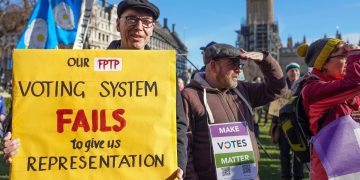
Make Votes Matter protest at Westminster. One activist holds a banner that says, "Our FPTP voting system fails to give us representation in govt".
Constitutional Affairs

On the urgency of reforming our electoral system

by John Cole
23 October 2026
Next Post
photo of face masks

PPE scandal: suppliers with political connections given high-priority access to contracts

PLEASE SUPPORT OUR CROWDFUNDER

BROWSE BY TAGS

Art Books Boris Johnson Bradford Charity Climate Change Cost of Living Covid-19 Creative Industries Crime Democracy Devolution Donald Trump Environment Equality Experience Farming Festival Gaza Conflict General Election History Human Rights Immigration Iran Journalism Keir Starmer Labour Leeds Media Mental Health NHS Northern Ireland Protocol Pollution Poverty Recipe Refugees and Asylum Seekers Restaurants Retained EU Law Review Rishi Sunak Sheffield Theatre Travel Ukraine USA
Yorkshire Bylines

We are a not-for-profit citizen journalism publication. Our aim is to publish well-written, fact-based articles and opinion pieces on subjects that are of interest to people in Yorkshire and beyond.

Yorkshire Bylines is a trading brand of Bylines Networks Limited which is separate to, but allied with, Byline Times.

Learn more about us

No Result
View All Result
  • About
  • Authors and editors
  • Complaints
  • Contact
  • Donate
  • Letters
  • Privacy
  • Network Map
  • Network RSS Feeds
  • Submission Guidelines
  • Download the Bylines Network App

© 2020-2026 Yorkshire Bylines. Powerful Citizen Journalism. ISSN 3049-9720

No Result
View All Result
  • News
    • Brexit
    • Education
    • Environment
    • Health
    • Home Affairs
    • Transport
    • World
  • Politics
  • Opinion
  • Society
    • Culture
    • Dance
    • Food
    • Music
    • Poetry
    • Recipes
    • Sport
  • Business
    • Economy
    • Science and Technology
    • Trade
  • Region
  • The Davis Downside Dossier
  • The Digby Jones Index
  • Cartoons by Stan
  • Authors and editors

Newsletter sign up

CROWDFUNDER

© 2020-2026 Yorkshire Bylines. Powerful Citizen Journalism. ISSN 3049-9720