The quick demise of Liz Truss will leave many lessons for the future of politics. Some may be simple, such as don’t do something which is both hugely unpopular and substantially damaging to the economy. But others will be harder to figure out.
One of these harder questions has to be how someone like Truss got hold of the levers of power in the first place. If Truss’s plans were so clearly problematic, why did the Conservative party not suss this out during the party’s two-month leadership election?
To answer this, we need to understand the patchwork fashion in which party members were brought into leadership elections, what the existing problems are, and what a better model of electing party leaders might look like.
A brief history of leadership elections
Before members were brought into leadership elections, both Labour and the Conservatives simply had MPs pick their leaders.
The major change to the Conservative’s rulebook came in 1998, when William Hague passed a set of reforms to formalise the Conservative party’s governing structures and introduce limited elements of democracy and accountability. This produced the process we are now familiar with, where party members vote on two candidates selected by MPs.
Labour’s introduction of members to the leadership election was more gradual. In 1983, an ‘electoral college’ was introduced, with Labour MPs holding 30% of total votes, affiliates such as unions and Labour societies holding 40%, and Constituency Labour Parties holding 30%.
Then, in 2014, Labour’s leadership process was changed to a version similar to that of the Conservatives, with candidates having to be nominated by 15% of Labour MPs and then go on to a ‘one member one vote’ election with party members.
Conflicting mandates
A key problem with this system is that party leaders are given two mandates, to oversee the party as a whole, and to lead the party’s parliamentary wing.
Moreover, while the election of both Conservative and Labour leaders rests on them winning the support of party members, in both parties it is only MPs who can trigger a leadership challenge. A risk then arises that the favoured candidate of members may not have the support of MPs.
Since members have had a role in leadership elections, two Conservative and two Labour leaders have been elected as the members’ favourite, despite MPs preferring another candidate. The two Labour leaders, Ed Miliband and Jeremy Corbyn, lost the subsequent elections they fought. The two Conservative leaders, Ian Duncan Smith and Liz Truss, were deposed without even getting the chance to go to the polls.
An out-of-touch selectorate
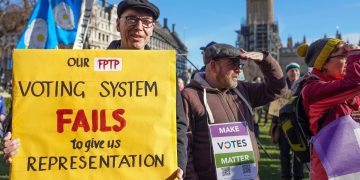
Another problem is the size of the electorate. While UK party leadership elections are often compared to ‘primary’ elections in the US, in which parties select their candidates, the US system has a much more expansive electorate consisting of ‘registered voters’, rather than party members.
While roughly 87.8 million US voters are registered Democrats or Republicans (26% of the population as a whole), in the UK only 846,000 people, or 1.26% of the population, are members of parties represented in parliament.
These members are by their very nature more switched on to politics, and have stronger convictions, than the broader electorate. And they are unrepresentative in other ways, most notably in being disproportionately more elderly, middle class and male than the average voter, regardless of party.
Thus, as we have seen in both Labour and Conservative leadership elections, candidates are incentivised to appeal to their parties’ bases, rather than the general electorate, and the candidate most liked in the party may well not be the most popular one in the country.
Where’s the mandate?
This approach to choosing a leader is particularly problematic when a prime minister resigns halfway through their term. Since the Second World War, only three prime ministers have both come to office and lost power through a general election: Clement Attlee, Harold Wilson (in his first term), and Edward Heath.
Prime ministers rarely resign early in a parliament’s term, and their successor often calls an election relatively quickly after they are elected. However, since the 1945 election, prime ministers who did not lead their party at the previous general election have governed for a total of 4,602 days, a little over 16% of the total time. While this is completely fine constitutionally, it is not great for the state of democracy that we should so frequently be governed by a figure who did not receive an official mandate from the British people.
The British people – politicians take note – are showing signs of being concerned. Polling after Rishi Sunak’s election as prime minister showed that two thirds of people want the new prime minister to call an election to earn his own mandate.
Lack of regulation
It is also concerning that there is little to no regulation of how these elections are conducted, and so no way of ensuring that they are truly democratic.
Unlike general elections, party leadership elections are not overseen by an independent regulator who can hold candidates to account, ensure that disinformation is not spread, and validate that no fraudulent voting has occurred.
And there’s a further problem. Once elected under this process, the new leader – Labour or Conservative – has relatively unchecked power to change it, potentially to their own benefit. Hardly an ideal way to run elections.

What do other countries do?
Most countries with parliamentary systems which don’t elect executive presidents run leadership elections in one of four ways:
- Undemocratic appointment of leaders by a party committee.
- Voting by a party’s parliamentary group.
- Voting by members.
- An ‘electoral college’, usually a 50/50 split between the parliamentary caucus and party members.
Here are some notable examples:
| Country | Party | System |
| Canada | Liberal Party | Popular vote of party members (aggregated by area) |
| Conservative Party | Popular vote of party members (aggregated by area) | |
| Australia | Labor Party | Electoral college (50% upper and lower house members + 50% members) |
| Liberal Party | Leadership ‘spills’ (votes of parliamentary party) | |
| India | BJP | Votes of 11-person Parliamentary Board to nominate prime ministerial candidate |
| Congress | Electoral college (party officials) | |
| Japan | Liberal Democratic Party | Electoral college (50/50 members of Japan’s ‘Diet’ and party members) |
| Constitutional Democratic Party | Electoral college | |
| New Zealand | Labour Party | Electoral college (40% caucus, 40% members, 20% unions) |
| National Party | Vote of Parliamentary Caucus |
One country of potential interest is Germany, where parties run an election process to select a leader, and a separate nomination process to determine their candidate for chancellor at each election. While the former consists of a broad ballot of party members, the latter is voted on by a smaller selectorate of party officials.
So, what can we do?
There is no perfect way to balance democracy in leadership elections against the risk of candidates pandering to their party’s base. Nor is there a clear way to avoid one of the key problems with the Truss premiership – the emergence of a candidate supported by party members but opposed by MPs – without taking the process out of the hands of members (as Hague himself has recently suggested).
Thus far, the only practical effort to bring the wider electorate into UK leadership contests has come from Labour and the Lib Dems. Both parties tried to introduce ‘registered supporters’ to the process but only 14,700 signed up to this scheme for Labour’s 2020 leadership election, and 17,102 to the Lib Dem scheme in mid-2019.
Going forward, one thing which should certainly be done is to bring leadership elections under the control of the Electoral Commission, which can both ensure that they are well run, and potentially do more to encourage participation in them.
An electoral college approach should not necessarily be dismissed out of hand. While it could reasonably be seen as a backwards step democratically speaking, it might help to avoid some of the drama of both Truss’s and Corbyn’s leaderships.
Finally, while it may be tempting to demand a general election for every new prime minister, this would likely mean that unpopular prime ministers stayed in office for longer than they might otherwise. One of the key reasons that Conservative MPs ditched Boris Johnson and Liz Truss was that they were seen as an electoral liability, if removing them triggered a general election it may well not have happened.
Whatever changes may come, as long as our prime minister can be selected by a tiny proportion of our electorate, the process to choose this candidate should be as open, consistent and democratic as possible.