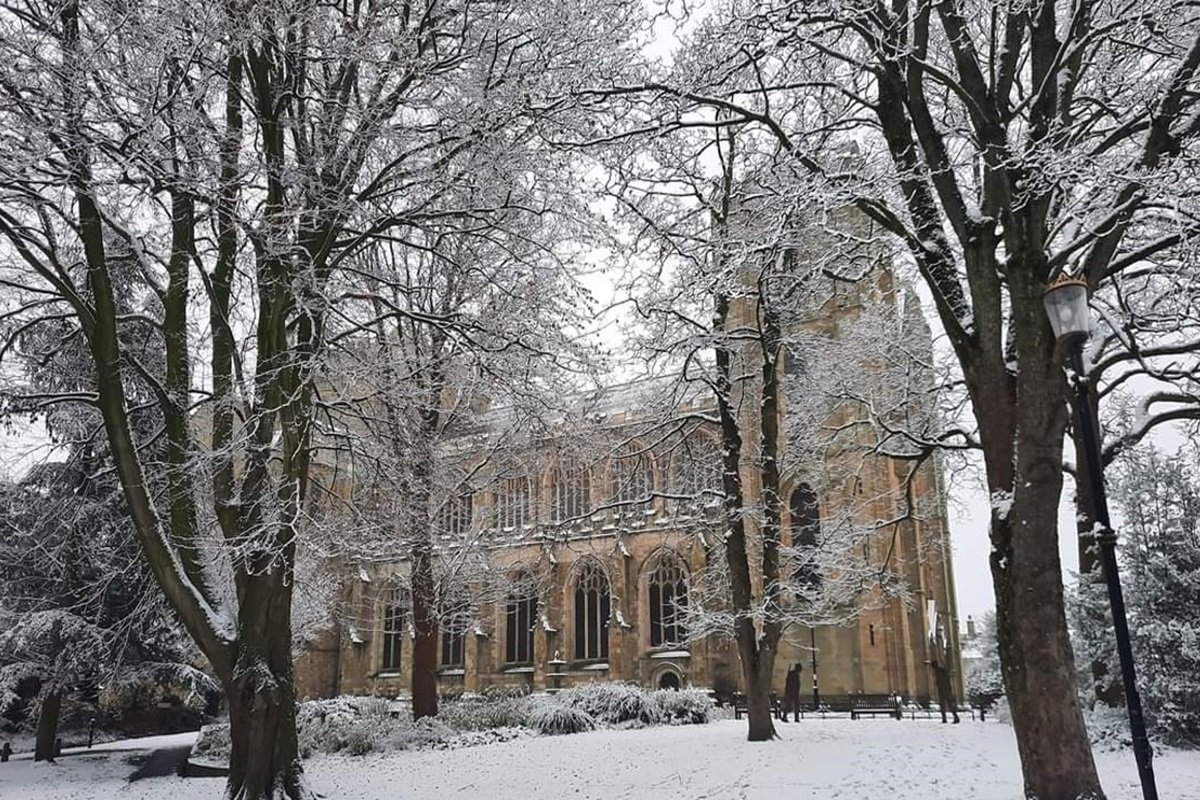
Feargal Sharkey waded into the controversial plans of Ripon Cathedral to fell 11 trees in order to build a £6mn annex with a cafe, song school and toilets, when he described the mitigation plans recently as “greenwashing at its finest”.
The former frontman of The Undertones, turned passionate river and waterways campaigner, posted on social media that these plans were, “Greenwashing at its finest. This is the reality. So much for the rhetoric”. This was in response to a video taken on the off-site planting area near Ripon, which highlighted the lack of a public mitigation strategy from the Cathedral to offset the felling of 11 urban trees.
Sharkey then continued, “If you let us chop down 11 perfectly healthy, mature trees right in the centre of town, so that we can build a cafe, we’ll plant 300 other trees on a muddy slope 30 mins drive away. Hurrah I hear the developers cry”.
The site he refers to is on a local farm, where access and enjoyment for the public will not be as easy as walking past trees in the city centre. The area is a ten-minute drive away from the city, then a further 20-minute walk across fields – presenting challenges to those with mobility issues.
Ripon Cathedral’s missing mitigation strategy
Campaigners have pointed out the comments from the Cathedral that “the loss of these trees will be offset by the planting of 300 trees at Studley Royal, where land has been made available to us”, are incorrect. The Studley Royal estate does not extend and cover the local farm and 300 trees are not mentioned in the publicly available planning documents. The Cathedral has told Yorkshire Bylines that “due process is taking its course and all relevant details will be put in to the public domain at the appropriate time”.
Campaigners have repeatedly argued that the mitigation strategy, which is a core pillar of the Cathedral’s proposal, should be made public to the press, the local community and the planning committee, so that it can be fully scrutinised, evaluated, and conclusions can be drawn about any potential benefit. With the planning decision only weeks away, this mitigation strategy ought to be available and not presented after the decision is made.
Major environmental charities formally object to plans
Sharkey’s comments come on the same day as formal objections to the plans from two major environmental charities – the Yorkshire Wildlife Trust and the Countryside Charity, CPRE were also lodged.
The Yorkshire Wildlife Trust posted on social media: “We’ve objected to these plans today and the loss of beautiful mature and veteran trees – irreplaceable habitat!” Their full statement on the planning portal is not available yet, owing to upload lagging times.
The Woodland Trust has also continued its opposition, by recently stating that:
“The proposed loss of veteran, notable and mature trees within Ripon Cathedral Minster Gardens is unacceptable and contrary to national planning policies designed to protect these important habitats.”

Should nature have rights?
There is a growing momentum to put legislation in place to protect important habitats and to protect nature as a whole. The Irish government will soon consider a request to give nature protected status and this could be the first step in granting nature legal personhood. A national referendum will follow, but this could make Ireland the first country in the EU to enshrine the rights of nature in national legislation.
If successful, the UK could well follow, which could well hinder the rampant tree-felling events that we have seen up and down the country in the last few years. A legal defence could sit alongside a religious defence of nature, allowing individuals to choose which argument they prefer.
Nature should be celebrated – not commercialised
As crowds gather in churches around the country to bear witness to, and to celebrate the birth of Jesus in the context of Christmas services, it becomes important to remember that this is a time of religious reflection for many and not a time for discord. Both the Old Testament and the New Testament celebrate the natural world and see it as a gift from God. As Genesis 1:12 states, “The earth brought forth vegetation, plants yielding seed after their kind, and trees bearing fruit with seed in them, after their kind; and God saw that it was good”.
Tree campaigners in Ripon, Yorkshire, hope then, that the Christian celebration of the Epiphany on the 6th January, commemorating the arrival of the wise men, will be transformed into a modern-day arrival of the wisdom of the planning committee, to reject these tree-felling plans and to urge restraint on the expansion of Ripon cathedral.
Ripon Cathedral were contacted for comment, but no comment was received by the time of publication.