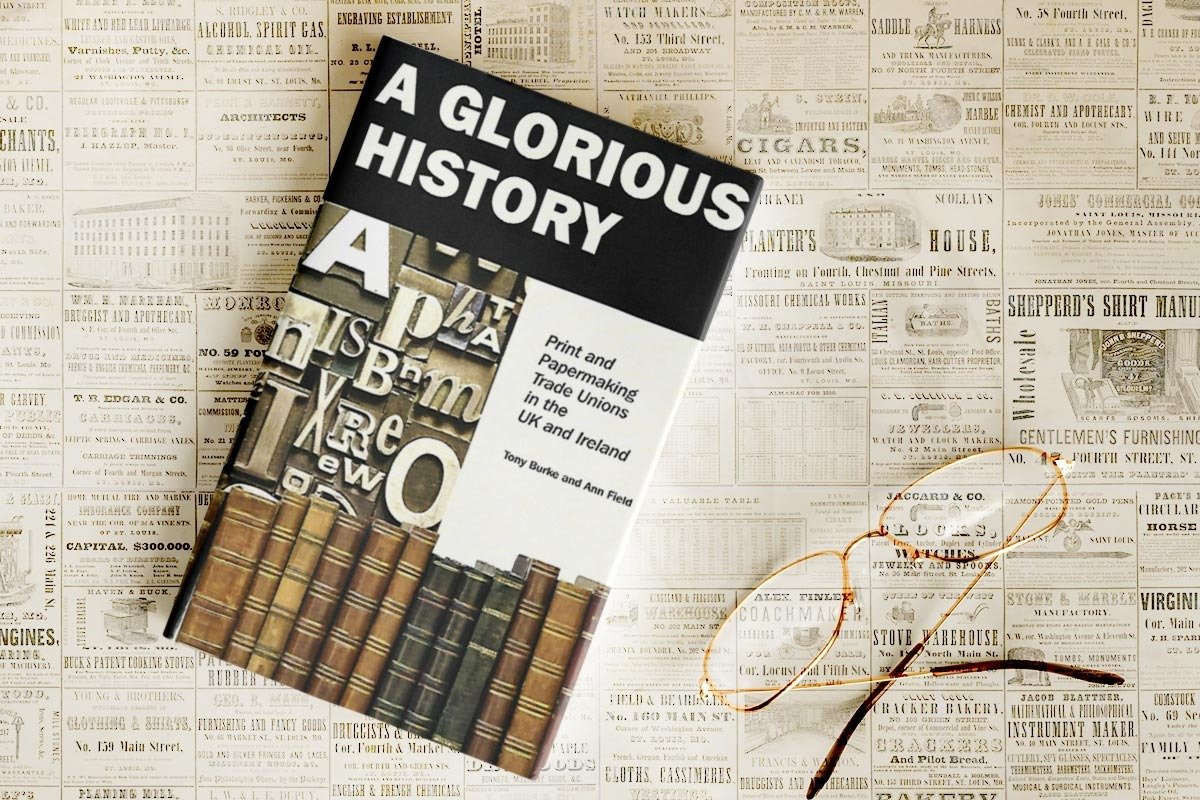
Probably no other industry can match printing and publishing for the strength and intensity of the collective action which has been exercised over several centuries as workers have had to organise themselves to adjust to repeated changes in industrial and employment practices.
Punishing conditions at the press
A Glorious History provides a page-turning kaleidoscope of the countless guilds, societies, associations and trade unions that came and went across the country as printers, bookbinders and assorted paper makers struggled to protect their pay and conditions.
Exploitation was commonplace in the early years. Some printing works were manned largely by boys and apprentices. Cheap labour led to widespread abuse and ill health. One statistic from the book’s introduction leapt from the page:
“Two decades into the twentieth century, conditions were still so bad in printing establishments that the death rate from tuberculosis was 1:3, whereas the national rate was 1:7.”
Here was a vivid reminder of a hidden family secret: my grandfather George Gibson, who at the age of 12 started work for a printer in Sheffield, developed a lung condition that by his mid-20s had advanced to become tuberculosis and he was sent for treatment to a sanatorium on the Isle of Wight.
Such was the public fear and suspicion around tuberculosis – and the handicap this presented to future employment – that after a near-death experience no further mention was made of his illness outside the family.
Reduced to penury by technological change
Echoes of my grandfather’s teenage years in the printing industry appear on page after page of A Glorious History with its vivid illustrations of the artefacts and memorabilia of the time: notices of indentures; early guild and trade union badges and cards; union banners; posters for public meetings and strikes – a compendium of images reflecting struggles that spanned two and a half centuries.
Laid out in the book is the timeline of the haphazard but clearly determined way in which workers across a myriad of kindred trades organised themselves to fight for shorter hours and better pay.
Grandfather Gibson trained as a hand compositor and the book’s authors – Tony Burke and Ann Field – capture the transformation that took place when hand composition was overtaken by the introduction of linotype machines.
A generation of highly paid craftsmen were reduced to penury. Gibson, like so many of his compatriots, went cross country, from job to job, seeking work, for ever reducing rates of pay and worsening conditions.
An exploitative apprenticeship
On leaving school, he started on 4 shillings a week, plus a penny an hour overtime, working from 8am to 7pm. Over the next three years he had jobs at various printing establishments in the city, the last being at the offices of the Sheffield Evening News which collapsed within a year of its launch.
In 1887, at the age of 16, he became a bound apprentice at the Sheffield print works of A T Bescoby on 7 shillings a week, rising by 1 shilling and sixpence a year until he was 21. Replicas of parchment indentures just like Gibson’s, written in pen and ink, complete with red seals and numerous signatures, are reproduced in A Glorious History.
Again, his experience as an apprentice, which he wrote up in a diary, tallies with so many of the personal accounts related in the book.
“I served that apprenticeship and was sacked immediately it ended. Mr Bescoby ran his establishment on apprentices, and as soon as they became entitled to a man’s wage, they went.”
Losing his job in February 1883 was the “very worst time the working printer had ever known” because the linotype machine which had just been introduced could do three or four times the work of the hand compositor.
“Within a few months thousands of these were out of work all over the country. The composing room staff on the Sheffield Telegraph was reduced from about 50 to 18 men on linotypes, and men who had been picking up £5 a week, and driving home in hansom cabs, were soon penniless.”
For the next two and a half years Gibson was in and out of work; a week here on a rush job, two or three weeks unemployed, and then another week or two of work.

The list
In the autumn of 1895, he wrote for a job with Ebenezer Bayliss & Co of Worcester, on what the printers used to call ‘the list’ – the voters lists for elections, which were still set up by hand composition.
Out of hundreds of applicants he happened to be one of the successful ones, and together with three other printers from Sheffield, they left home early in October on what was supposed to be a ten weeks’ job.
Midway through the ten-week contract he heard of a vacancy at another Worcester firm, Littlebury’s, and got a job there.
“It was as near slave-labour as I ever experienced in my printing career. The foreman scarcely ever had his eye off us, and the boss used to boast ‘I have only to hold up my hand and I can have 50 men’. However, I stuck it for over 18 months, till the summer of 1897.”
A few weeks to live
He was more fortunate in his next job. Together with another printer from Littlebury’s, he was hired as a compositor for a new weekly paper being launched in Malvern.
“That was the best job I ever had in the printing trade. It was piecework and we were paid by results, and as I was a pretty quick compositor, I could earn ten to fifteen shillings a week, more than I ever earned on day work.
“But it was too good to last; the newspaper, like many similar ventures, soon failed, and in the early weeks of 1898 we had the bailiffs in.”
Gibson’s next – and final job in the print – was in Wales, as an overseer at the Radnorshire Standard in Llandrindod Wells, where his lung condition worsened, and he contracted tuberculosis.
Accounts of what precisely happened are rather sketchy. His health was said to have “completely broken down”; his life was in “serious danger”; and he was taken to hospital on a stretcher having been told he had “only a few weeks to live”.
By sheer chance I found that the Wellcome Foundation library has a notebook of a doctor who served at the Royal National Hospital for Consumption in Ventnor, Isle of Wight. Gibson was one of the patients he treated.
He was admitted in November 1899, aged 28, having lost five to six pounds of flesh, and was “still feeble” the following April after a “sharp haemorrhage, very protracted”.
An unknown benefactor
There is no record of when he was discharged but on his return to Llandrindod Wells he was advised to get work out of doors and he became an agent going house to house to get orders for a local steam laundry.
One document among Gibson’s correspondence is a clue perhaps to his recovery.
On completing his apprenticeship at Bescoby’s printing works in February 1892, he was accepted as a member of the Sheffield Typographical Society for a 5-shilling entrance fee and a weekly subscription of three pence.
In those pre-NHS days, only the fortunate benefited from specialist treatment, and he was one of the very few printworkers treated at Ventnor. I wonder whether it was the Typographical Society which paid for his stay in hospital, or least contributed to the cost.
Perhaps for their next book on the printing industry, Burke and Field might have an opportunity to explore when and how these early guilds, associations and unions built up funds to help sick and injured members.
A Glorious History, published by Unite, 128 Theobalds Road, London WC1X 8TN, by Tony Burke, former assistant general secretary of Unite and deputy general secretary of GPMU and Ann Field, former national officer of GPMU and Unite.