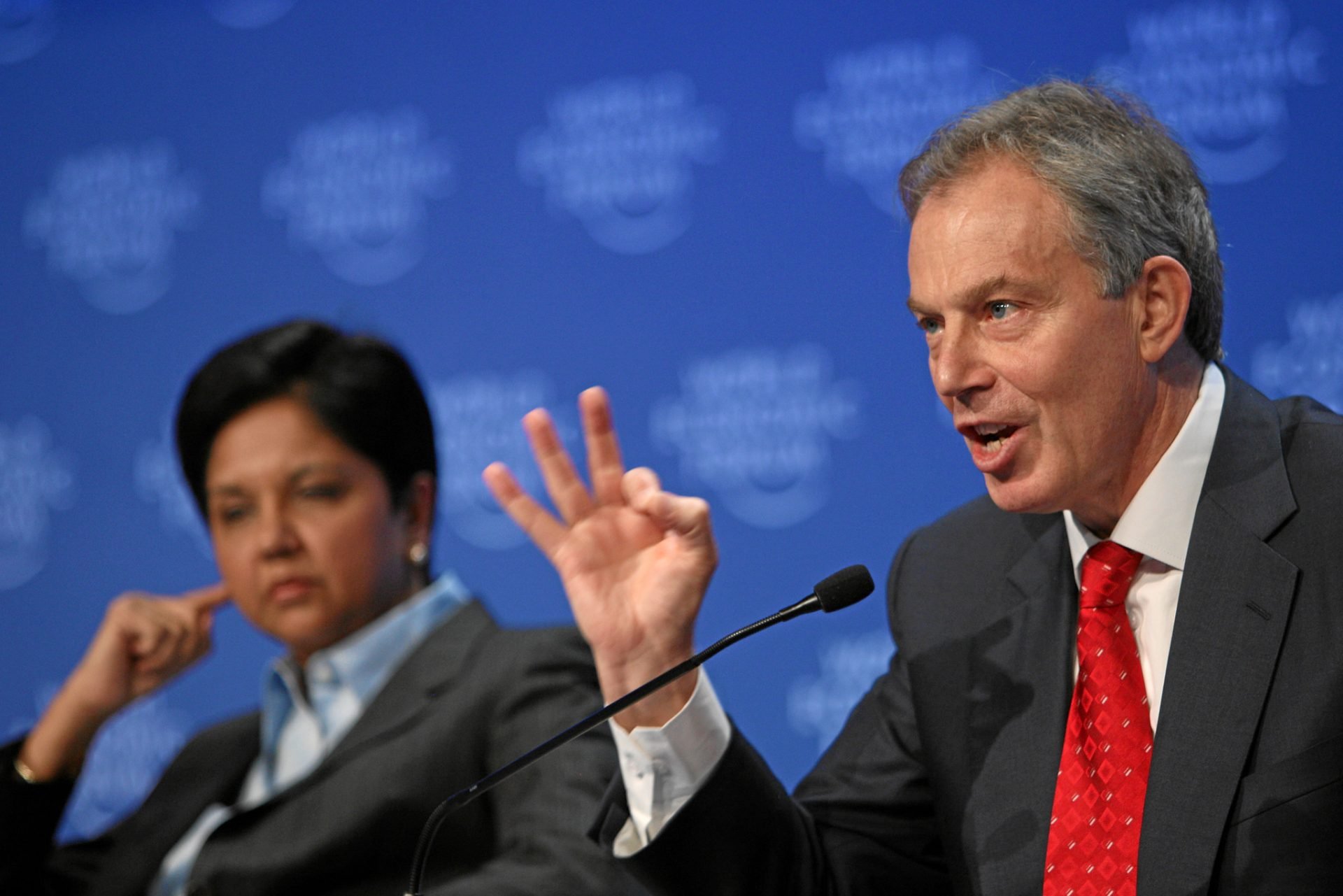
In 1995, two years before his historic landslide election win, Labour opposition leader Tony Blair convened a special conference and persuaded delegates to drop the long-cherished but controversial clause 4 of Labour’s rule book which for decades had committed the party to nationalising huge swathes of the British economy. He recognised that Margaret Thatcher’s privatisation programme had changed the prevailing orthodoxy and the pledge only helped his opponents.
I predict that a future Conservative Party leader will one day need to do the same with Brexit, whose Overton window is also now beginning to move on, or face perpetual opposition. It will be a moment every bit as seminal as Blair’s clause 4.
The last few weeks have revealed a stunning level of incompetence in the Institute of Economic Affairs (IEA) / European Research Group (ERG) faction which has influenced Tory policy for years but has been in total command only since 5 September. In Liz Truss, they couldn’t even organise a decent puppet.
The mini-budget
Shortly after his 23 September mini-budget, Kwasi Kwarteng admitted it had created a “little turbulence” in the financial markets. But like the butterfly’s wings in the Amazon, it eventually resulted in a tornado barrelling through Westminster, taking him with it. Almost certainly the prime minister will soon follow.
The past few weeks will go down as a lasting monument to ineptitude. But in triggering the end of Truss and Kwarteng, it no less signals the beginning of the end of the IEA/ERG agenda for turning Britain into a low-tax, low-regulation Singapore-on-Thames, for which Brexit was merely the means.
Essentially, the markets didn’t like what Brexit-supporting economists like Patrick Minford and Gerard Lyons et al were advocating to boost Britain’s weak growth rate. But if you cannot persuade the markets to fund massive tax cuts under current circumstances, you can hardly argue it’s needed when growth and tax revenues are strong. Trussonomics, it turns out, is not a remedy for anything.
Brexit now tethered to the Tory mast
I wrote last year that the Conservative Party was tethered to the mast of Brexit and would sink with the ship, using what I thought was a memorable quote by an anonymous Tory MP in 2017 to support my piece. I was wrong. And so was the Tory MP. I thought the Tory brand would be tainted by association with Brexit, but now things have got so bad it’s clearly the other way around. Who could believe a bunch of incompetent misfits could have stumbled across the answer to all of Britain’s problems in Brexit?

Articles on the failure of the Brexit project now abound. You can read a different one any day of the week, even including in The Telegraph where Jeremy Warner, an assistant editor and economics commentator, declares: Project Fear was right all along.
What pro-Brexit campaigners dismissed as ‘project fear’ has been on a long fuse, Warner writes, but the predictions “have turned out to be overwhelmingly correct, and if anything have underestimated both the calamitous loss of international standing and the scale of the damage that six years of policy confusion and ineptitude has imposed on the country”.
Soon, ‘we got Brexit done’ will sound less like an election-winning slogan and more like an admission of guilt, with the court of public opinion being asked to take into account other related offences like trashing the economy, forcing millions into poverty, and reducing the nation to a laughing stock.
If recent polling is anything like accurate, the next election is already a foregone conclusion. A Redfield & Wilton poll is suggesting a 380-seat Labour majority with the Tories losing over 90% of their MPs. And this polling was done before what many believe will be the bleakest winter for decades.
A Labour landslide is all but guaranteed. And the scale of the victory will almost certainly see the Tories out of power for a decade and probably much longer, which means they will need to rethink things in opposition, specifically Brexit.
Matthew Syed, a columnist at The Times, recently tweeted that “hardline Brexiteers are now caught in the cruel bind of dissonance: keep doubling down, denying all evidence, or admit their claims were delusional all along”.
This is indeed the choice, but let’s think about how it might play out.
The conspiracy of silence is coming to an end
Governments control the political narrative along with the purse strings. Since 2016, anything negative about Brexit from official sources has been ruthlessly suppressed. The Treasury’s last pronouncement on the malign impact of leaving the EU came in May 2016.
UK business, which largely remained silent during the referendum, was afterwards told to go into meetings with Brexit secretary David Davis saying, ‘they were very excited by the possibilities’ regardless of their fears. Anyone who expressed doubts tended to be asked to leave in the first five minutes, according to Ian Dunt’s book: Brexit: What the Hell Happens Now. Some were forced to sign non-disclosure agreements and advised they shouldn’t even mention Brexit difficulties if they wanted a seat at the table.
All that will change with a new government. The conspiracy of silence will come to an abrupt end.
Civil servants and industry leaders will be actively encouraged to be far more open about the consequences of Brexit. As Joe Mayes at Bloomberg put it recently, the pitfalls of Brexit are no longer taboo. And there are plenty of pitfalls as our David Downside Dossier shows.
In addition, regardless of Keir Starmer or the Labour Party’s official policy, a majority of Labour voters would like to see Labour campaign to rejoin. At the last election, 85% of Labour voters thought Brexit was a mistake. Starmer will be facing grassroots pressure.
Support for Brexit is already falling
Britain’s leading pollster, Professor Sir John Curtice of the University of Strathclyde, writing in the Independent earlier this month said: “The problem Liz Truss faces over Brexit is that it isn’t ageing very well.”
The decision to leave the EU in 2016 is as unpopular now as it has been at any point since the referendum, Curtice said, adding that:
“The average of the last half dozen polls (all conducted during the summer) puts support for rejoining the EU at 54 percent, while only 46 percent want to stay out. That is the highest level of support for going back into the EU since the UK left at the end of January 2020, while support for remaining in the EU was never higher than 54 percent before that.”
But, he claimed, this isn’t driven by “widespread regret about the Brexit decision among Leave voters” with recent polls suggesting that 78% of those who voted Leave would still vote to stay out. He says that being in the EU is the more popular option now, because those who didn’t (or couldn’t) vote in 2016 but who now express a view, support rejoining by more than three to one. This has been a clear trend since 2017.
A recent survey by the Tony Blair Institute for Global Change, taken before Kwarteng’s disastrous mini-budget, shows an “overwhelming majority” of the public (59%) think that Brexit has worsened the UK’s economy, including over a third of leave voters.
In contrast to Sir John Curtice, the Tony Blair Institute finds only a third of voters would support rejoining the EU single market immediately. However, within the next ten to 15 years, nearly one in five leave voters (18%) would either like the UK to rejoin the EU or the single market and a further 45% would like to see a closer relationship with the EU.
This increased support for a closer EU relationship is said to be “mostly driven by the changing attitudes among some 2016 Leavers, who appear to have become more unsure about the effects of Brexit”.
There is virtually zero appetite for Jacob Rees-Mogg’s grand deregulation agenda, according to the poll.
Demographics will tell in the end
So, if support for Brexit has been falling steadily it is reasonable to surmise it will fall even faster when the public for the first time begins to be properly informed.
The latest polls on WhatUKthinks show that in every region of the UK, and every age group except the over 65s, a majority already accept that Brexit was a mistake. Only older voters still think it was the right decision.
In Britain, 12 million people are over 65. Every year about 650,000 die and are replaced by others moving into the cohort. In ten years over half the group will have been replaced. By then, the whole UK electorate may well have a significant anti-Brexit majority. This would probably apply even if Scotland breaks away from the UK in the meantime.
The choice facing a future Tory leader will be either to crank up the arguments for Brexit again, to double down in the face of mounting evidence, or openly admit that it has all been a terrible mistake. There is only one option and it isn’t to resurrect Brexit.
That choice could then become the dividing line that splits the Conservative Party. Brexiters had one chance to show that Brexit would raise prosperity and convince the electorate Britain is better off outside the EU. After six long years it is becoming obvious they have comprehensively failed. At some point, probably in the next five years, a Tory leader will have to persuade the membership that the whole idea of Brexit has to be dropped. It will be a clause 4 moment.
Could the Conservative Party survive intact? It’s unlikely. The Reform party led by arch-Brexiter and multi-millionaire Richard Tice, is said to have hundreds of candidates ready to stand at the next election and no doubt Nigel Farage would be happy to oblige with a swan song.
How likely is it that a UKIP-style party would be able to repeat the successes of the past when voters can now see for themselves what Brexit means? The British public won’t be fooled again