I was recently reading a book written by a local lass called Hazel Wheeler, the book was published in 1992, entitled Huddersfield at War. It gave a fascinating insight into many aspects of the preparations made for WW2 and how life was for residents of wartime Huddersfield.
This book gave me the inspiration to delve deeper into the memories of older friends and family who experienced these times. But alas, they are all gone, so I had to fall back on old-fashioned methods and look at books, and, of course, go on t’interweb in search of further clarification and information, as some of these stories were quite surprising.
‘Adolf’s invading Scammonden!’
One of the most surprising things I discovered was that the ‘blackout’ regulations were introduced to Britain on 1 September 1939, two days before war was declared on Germany. Several areas of the country had already been testing blackout systems for many weeks. When war was eventually declared on 3 September, I would assume that all citizens capable of worry and anxiety would already be in a high state of worry and anxiety.
A lady in Huddersfield in the aforesaid high state of worry and anxiety obviously had never experienced these conditions and assumed that Adolf himself was going to land in Scammonden and wreak havoc in her neighbourhood. With these thoughts deeply buried in her mind, she rushed to the nearest ARP (air raid precautions) station and reported that she had seen a parachutist landing in a nearby field. Investigations discovered a field of sheep happily munching away minding their own business.
Loose matches cost lives
In our modern world we rarely, if ever, experience a proper blackout. When there is a moon or a bright starry night it is fairly easy to see your way about – sort of – and it can be quite spectacular if there is no moon and no artificial light pollution at all – the whole sky is full of thousands of pinpoints of light that appear to be just out of reach. However, in our beautiful country, this is rare. Blackouts during an overcast night must have been a frightening experience.
I can think of several people that should not be put in uniform and given any sort of authority. Unfortunately, wartime conditions meant that they could not pick and choose, as most of the people fit to be put in uniform were off fighting somewhere. Butchers, bakers, and candlestick makers were given ARP or police special uniforms and lots and lots of authority.
The blackout regulations stated that no naked light will be shown during the hours of darkness. No streetlights, no lights from shops, advertisements, or vehicles, the regulations even forbade smoking outside during the hours of darkness; apparently the dastardly German bomb aimers could see a glowing match from 15,000 feet.

A less-than-fine time for a fine
A fine for showing a light could easily be £1 to £2 for an individual who failed to dim their torch with the proper coloured paper. Tissue paper was advised, but not red or green in case it confused a passerby who could mistake it for a stop-go sign from the two feet away that the light would illuminate. In the early days, lighting a match to find the bus stop, chemist or doctors could be met with a hefty fine.
These fines came at a time when the average wage for a 44-hour week was less than £2. Dad was earning about £3 as a mule spinner; as the average earning would suggest, many people were earning much less, and women only half that.
In 1941, a Huddersfield court official, Waldo Briggs, fined a man £10 with 10s (50p) costs for being absent from his fire-watching duties without good reason. That was three to four times a week’s wage for not turning up for work. The court also warned that in the future absentees would be sent to prison.
Obviously, fire-watching was thought a very essential and responsible job, but taking into account the average wages and hours worked, this was equivalent to £1,900 in today’s money whilst also being threatened with prison. Slackers definitely got their arse kicked if they didn’t toe the line. However, this chap must have upset someone on his way to the magistrates’ court and continued to upset Waldo when he got there.
Might hindsight have improved eyesight?
All vehicles had to cover their headlights with a shield, and even without this shield, the headlights at the time were quite dim. With the shield, this dim light was almost useless. Buses and lorries were also in virtual darkness – what could possibly go wrong?
While speaking at the opening of the new special constabulary headquarters, Chief Constable AC Allen boasted “Huddersfield was now one of the most effective blacked out towns in the country”. This, of course, was a double-edged sword. Road traffic accidents doubled as did other accidents such as falling over walls and into rivers and canals. Criminals also made killings, sometimes literally under the cloak of darkness.
There are no reports of any deaths in Huddersfield as a direct result of German air raids, but there were countless deaths and injuries as a result of the precautions. Hindsight is a wonderful thing and I’m sure if the authorities had known what threat the bombing posed to Huddersfield at the time, they would at least have allowed the lighting of the occasional cigarette outside.
Saved by a guidebook?
There was considerable bombing damage at Pat Martins Mill in Lindley resulting in a few cuts and bruises and a broken arm. A nearby hen run full of chickens completely disappeared due to another bomb. An incendiary bomb hit the roof of Royds Hall School’s dining room and burnt through a table. Another unexploded incendiary bomb was found in the underdrawing of the same school some 15 years later during renovations.
It was surprising that Huddersfield was spared any significant German bombing. It was, and still is, one of the largest towns in Britain. It had two large chemical factories in the shape of ICI and LB Holidays, several engineering factories, Thomas Broadbent, Brook Motors, Hopkinson’s and David Brown producing tractors and gearing for many military applications. The only places that suffered from the Luftwaffe’s air raids seemed to be the textile areas of or near the Colne Valley. There has been speculation ever since that these raids were as a result of the German aircrew ditching their bomb load somewhere, anywhere on their way home.
Another reason that Huddersfield was spared may have something to do with the dastardly Luftwaffe using the Baedeker travel and tourist guides books to choose potential targets. These were called the Baedeker raids. Of course Huddersfield probably wouldn’t have featured in any of the German tourist guidebooks!
Not a job for the faint of heart
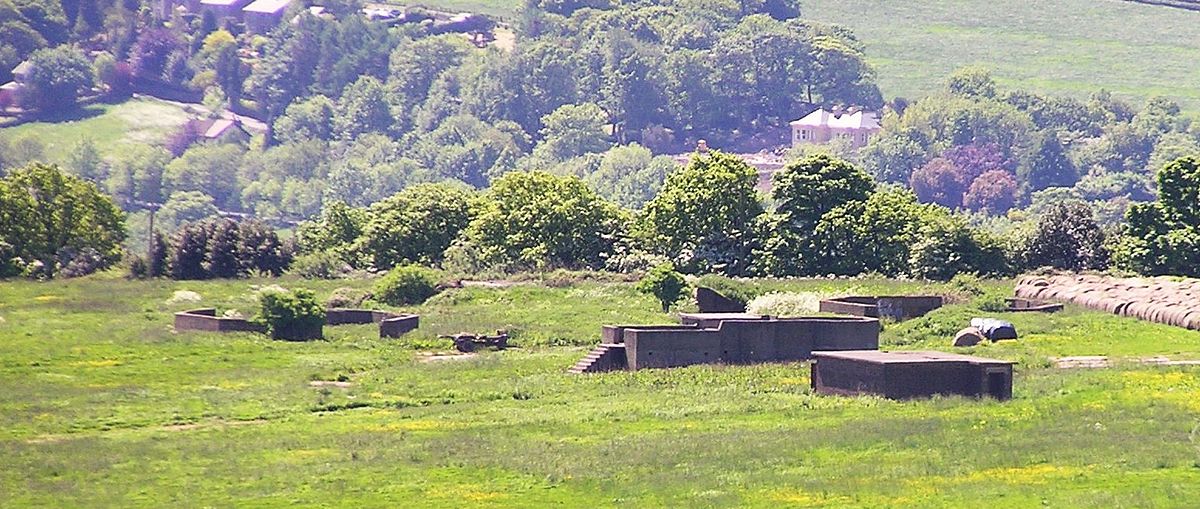
It may be difficult to believe, but dastardly underhand tactics were not the sole province of the German military. This is a photo of a decoy bunker way out in our local moors. These sites were part of Colonel John Turner’s decoy programme. Code-named ‘Q’ or Starfish sites, they were meant to divert enemy bombers away from important or vulnerable areas and were developed following the near-total destruction of Coventry in November 1940.
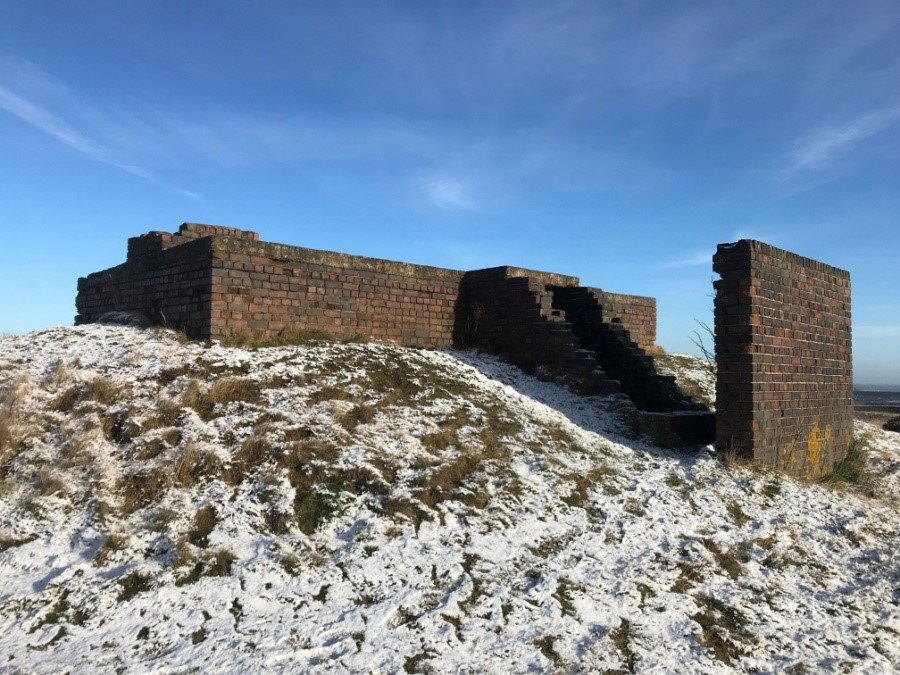
There were many around the country. The idea was to either house a generator that powered a series of lights to mimic a nearby airfield, or store flammable liquid to place out on the moor at the appropriate time to mimic damage caused by earlier bombing. The blast wall to the right was to protect army and air force personnel – men and women who had rushed into the shelter after they had attracted the bombers to their doorstep.
I suppose it wasn’t the worst job in the military, but I’d be interested to learn which jobs were worse than this. One estimate has suggested that 968 tons of ordnance were dropped on these decoy sites – so good on you, Colonel Turner! I haven’t been able to discover what the soldiers and airmen and women thought of it though.