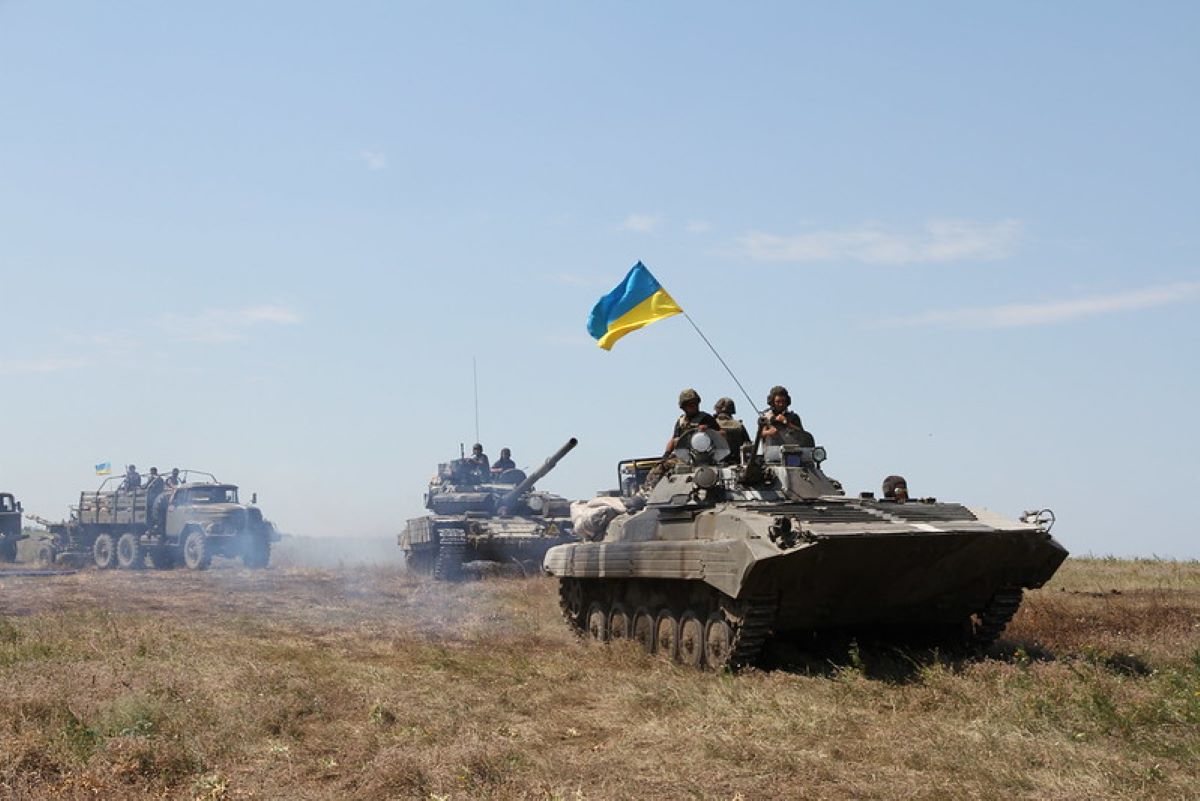
In recent days, the Ukrainian counter-offensive in the north east of the country has seen the liberation of some 8,500sq km of territory, including the strategically important and much contested town of Izyum in Kharkiv Oblast which President Zelenskiy visited on 14 September in a surprise move.
The welcome for the Ukrainian troops by the local population has been heartfelt, while collaborators have been evacuating with the withdrawing Russian troops to escape retribution. All kinds of vehicles, equipment, arms and ammunition, and even large quantities of roubles have apparently been abandoned by forces which, according to the official Russian military spokesman, were simply ‘regrouping’.
Evidence of brutal Russian war crimes uncovered
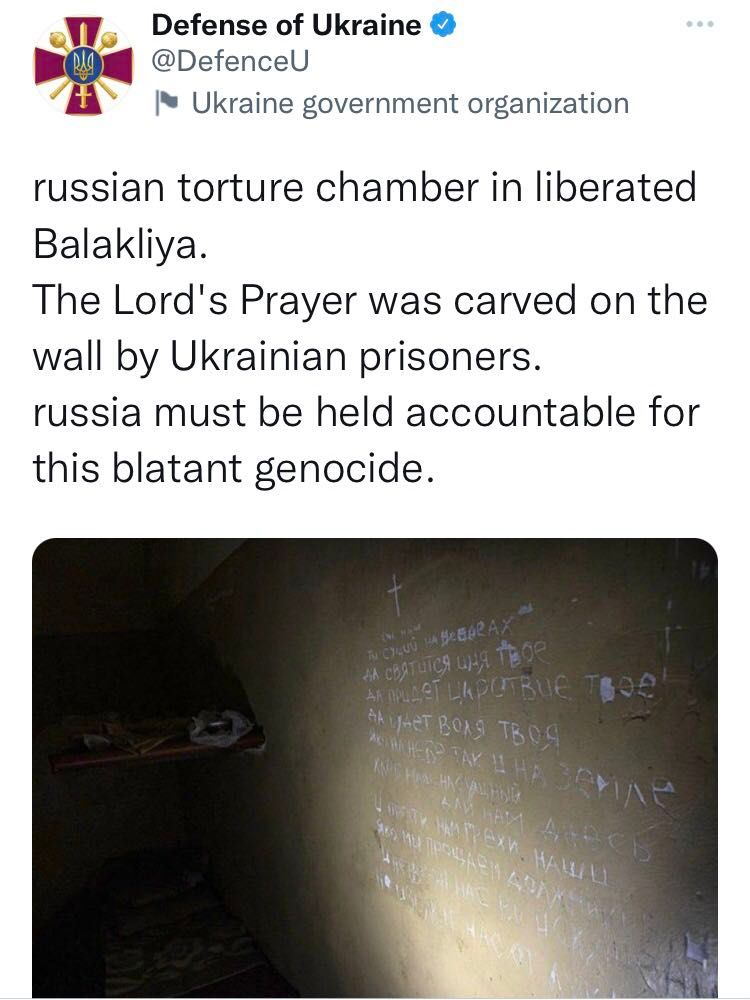
In nearby Balakliya, sinister signs of occupation have been discovered in the form of a torture chamber where allegedly prisoners were tortured with electric shocks. On the wall of a cell at the local police station the Lord’s Prayer can be read, poignant testimony to the suffering caused by Russians’ inhumane behaviour, a brutality which has so shocked and disgusted the civilised world since the start of the war.
Izyum is quickly revealing the full horrors of its five-month occupation now that the bodies of its 443 war-dead are being exhumed. While some appear to have been victims of shelling, many bear the signs of torture and execution – hands tied behind their backs or ropes around the neck.
The failure of the Russian army to hold on to the seized territories has led to a mixed reaction within the Russian Federation. Mikhail Sheremet, a member of Russia’s State Duma security committee, suggested on 12 September in an interview with URA.RU that general mobilisation was necessary for Russia to achieve its aims, and this view has been echoed by right-wing and nationalist bloggers on social media platforms.
But the official government view that Russia has enough trained forces and volunteers to succeed in the ‘special operation’ continues to be restated. On 14 September, Duma-member Yury Shvytkin of the ruling United Russia Party denied that general mobilisation was either necessary or pending.
The Chechen leader, Ramzan Kadyrov, disagrees. He has now called for ‘self-mobilisation’. Writing on his Telegram channel, Kadyrov suggests that each region provide at least a thousand volunteers. This would provide an extra 85,000 men for Russia’s forces, thus obviating the need for general mobilisation. This would mean that the Kremlin could continue to deny that the ‘special operation’ is in fact a full-blooded war.
The Kremlin savagely pursues its critics
By contrast, a number of local politicians in Moscow and St Petersburg have called for Putin to be removed from office and charged with treason for the consequences of his foolhardy policies, citing the high number of casualties, damage to the economy, the arming of Ukraine by the West and the expansion of NATO. In an interview shown by Radio Free Europe, Dmitry Palyuga, an independent member of Smolninskoye Municipal Okrug, which covers a well-healed downtown district of St Petersburg, refers to the large amount of public support for his views he has had on social media.
The councillors have been charged with ‘discrediting the Russian Armed Forces’, the catch-all accusation for critics of the war whom the authorities wish to silence. To date, thousands of Russian citizens have been so charged, resulting in various fines, terms of imprisonment and consequential job losses. The Kremlin has shown itself to be ruthless in the pursuit of its most prominent and influential critics, especially journalists.
Journalists meet mysterious deaths
Earlier this month, the renowned investigative journalist Ivan Safronov was handed a 22-year jail sentence for treason. The case had been prosecuted with secret evidence and was held behind closed doors. In 2007, Safronov’s father, also an investigative journalist who touched raw nerves among the authorities, mysteriously fell to his death from the window of his Moscow flat, a fate which curiously continues to befall Putin critics to this day. Over 20 Putin critics, oligarchs and top-managers have died in peculiar circumstances in Russia and abroad in the last two years alone, as euronews reported on 14 September.
Earlier this month, Novaya gazeta, Russia’s leading independent newspaper was stripped of its licence on a trumped-up charge: Roskomnadzor, Russia’s media regulator claimed the newspaper had failed to provide the necessary documents relating to a change of ownership in 2006. Six of its journalists, including Anna Politkovskaya, famous for her reporting of the second Chechen War, have met untimely and unnatural ends.

The struggle to overcome fascist despotism continues
There will no doubt be many more such tragic fates among Putin’s critics before this president and his regime finally fall. Meanwhile, the civilised world must continue to isolate the Russian regime and support Ukraine with arms, humanitarian aid and moral support while not forgetting that within Russia there are significant numbers of good people who do not support Putin, his policies or his regressive nationalist imperialist agenda.
Outside Russia, there are thousands of Russians standing up to Putin and aiming to defeat his apparent aim of turning their country into a variant of fascist despotism. The organisation True Russia has a number of projects which are intended to assist Ukrainians affected by the war and Russians who have fled the country. These commendable initiatives are there to help a range of people: anti-war activists, those persecuted for being LGBTQ+, environmental activists, victims of domestic violence and others persecuted or disadvantaged by the Putin regime.
As Ukraine gradually moves to liberate her territories and Russia starts to implode as a result of Putin’s failed venture, the free world must do everything to ensure that good ultimately triumphs over evil.