



Trigger warning: contains one brief reference to suicide
I started my journey of looking for the iconic writer Ernest Hemingway by travelling from my home in West Yorkshire to New York. I wanted to attend my university reunion in New York on the way to visiting the Ernest Hemingway Home and Museum in Key West, a small island in Florida which is the southernmost point of the continental USA. Key West has roughly 25,000 inhabitants, over twice the population of the wider Hebden Bridge area, where I now live.
I found Hemingway connections immediately. A university lecture on collective memory coincided with meeting friends staying at the Lexington Hotel in midtown Manhattan, home of New York’s only official Hemingway suite, complete with tropical motifs, alcohol, writing desk and typewriter. The suite is a remarkable tribute to the writer, who visited New York on many occasions.
On this particular visit to New York, I’m staying with a friend on West 86th Street a neighbourhood far more relaxed than the area near Grand Central Station where I normally reside. The sights and noises of New York are familiar to me, so gradually I ease myself into the buzz and the vibe.
Later I meet a group of over 20 former university classmates at a trendy restaurant owned by one of them. The food is good, but the owner-classmate retires early feeling unwell. The staff then mix up the dessert orders and my ex-classmates, being mainly New Yorkers, argue about it.
Miami to Key West
On the next stage of my journey to find Hemingway’s essence – or his inspiration – I fly to Miami and then hire a car to travel on US Route 1, the Overseas Highway, which stretches 119 miles south over 42 islands. The drive to Key West takes about three hours. Many of the islands have hypnotic names: Key Largo (long island), Islamorada (purple island, like the colour of the sea), Big Pine Key. The road is primarily flat, single lane and passes through some typical American suburban sprawl. But as I approach Key West, spectacular ocean views open up on both sides.
Like many others, I am fascinated by Hemingway’s troubled and turbulent life, marred by the suicide of his father and later of the writer himself. But above all the problems and violence of his life, Hemingway remains an iconic and inspirational writer. His 1959 Nobel Prize acceptance speech displays both a deep humility and an unswerving dedication to the artistic process.
Reading Hemingway
I have brought along with me Hemingway’s first successful novel. Fiesta: The Sun Also Rises. Hemingway is famous for his lean, stripped-down prose, but he does use figurative language and descriptors to paint scenes with landscapes, trees and characters. To a modern reader, instances of antisemitic or racist language can be troubling. The novel Fiesta moves forward through lots of dialogue as its characters struggle with alcohol, themselves and each other. There is a definite narrative ‘Hemingway voice’.
In his creation of a ‘manly’ writing style, Hemingway writes about women in a complex way. They are the landscape, the predators, controllers, objects of intense desire and frustration for the male characters. Hemingway aims for his writing to be strong, without the use of expletives, though he uses them in his personal letters. Characters get drunk, argue – sometimes violently – and tell each other to “Go to hell.” They also show forbearance, compassion and generosity. Some of the writing is staggeringly good:
“I have never seen a man in civil life as nervous as Robert Cohn –nor as eager. I was enjoying it. It was lousy to enjoy it, but I felt lousy. Cohn has a wonderful quality of bringing out the worst in anybody.” Fiesta, Ch.10.
The wooden house of six-toed cats
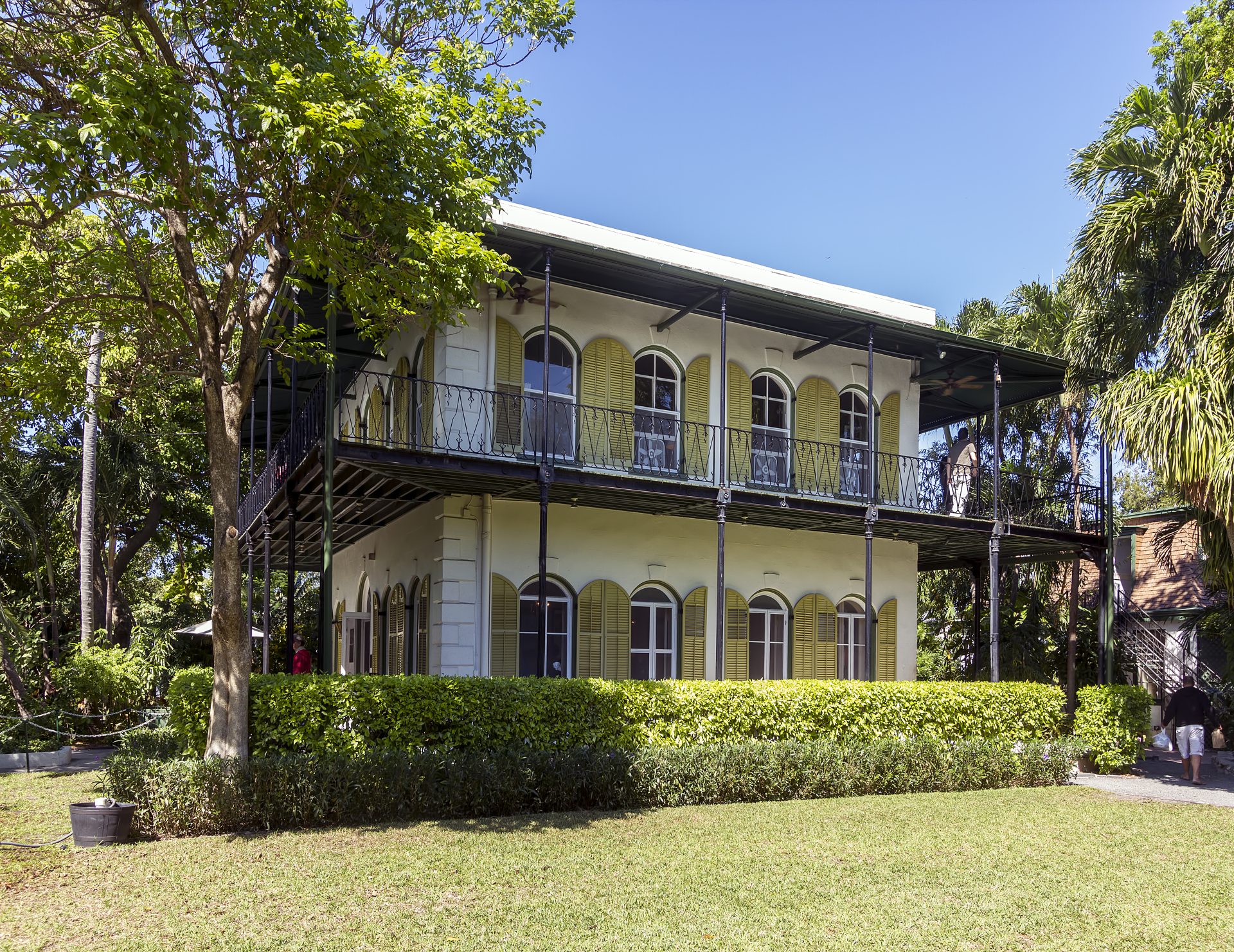
The Hemingway Home and Museum on Key West is a large wooden house he bought in 1931. It sits on the second highest point in Key West. A tour is included in the admission price. The house has the only full cellar on the island, which he used as a wine store. The lighthouse across the street served the novelist as a marker when he came home drunk. The imposing wooden structure, surrounded by a wide verandah, has so far withstood all the many passing hurricanes and tropical storms.
Inside is a treasure of memorabilia. Pictures of the young Hemingway, with movie-star good looks, line the walls. One shows him in bed after being severely wounded in World War I. He had a large, separate writing studio containing stuffed animal heads and a stuffed marlin, trophies of his many expeditions. As Gertude Stein put it, “There’s no manlier man than who Ernest Hemingway thinks he is.”
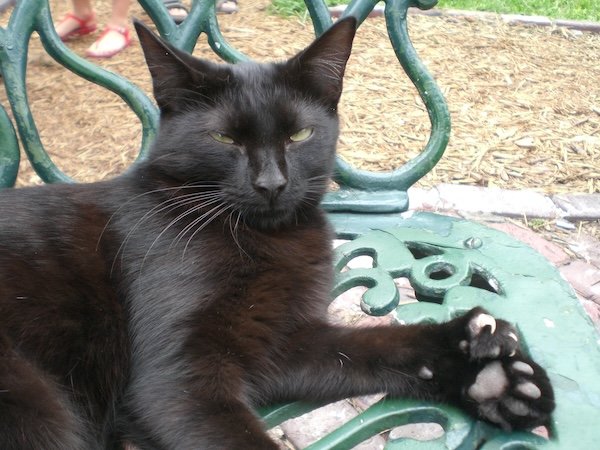
As well as the memory of the larger-than-life writer, the house is home to 59 special cats. The cats carry the gene for having extra toes (six or seven on their front legs). According to the tour guide, many people visit the Hemingway Home and Museum solely to see the cats. They are all descended from the original cat given to Ernest Hemingway by a ship’s captain.
The secret of success
As I finish my journey to Key West, the warmest city in the USA, I think about the many notable writers associated with the island. I asked the tour guide at the modest but fascinating Tennessee Williams Museum why there were very few visitors there, meaning myself and one or two others, compared to the five hundred visitors who pass daily through Hemingway’s home. According to the Tennessee Williams Museum’s literature, Williams, the author of A Streetcar Named Desire, and many other important works, was America’s greatest playwright as well as a poet and screenwriter.
The answer to the question of Hemingway’s phenomenal popularity, she said, was simple: “Marketing.”
Friends of Bylines Network
There has never been a greater need for grassroots journalism that investigates the stories that really matter, holds power to account and champions the voices of everyday citizens. We are proudly powered by volunteers but what we do isn’t free.
STAND WITH US for independent, citizen-led journalism that makes democracy stronger, and you will even get some exclusive benefits.