“Destroy your safe and happy lives before it is too late.” The Mekons, Memphis Egypt
Continuing this series of articles on the concepts of I and We, and the thinking associated with each one, we can sum up these concepts with simple diagrams.
Visualising I and We
Here’s a diagram of I:

I told you it was simple.
The space inside the circle represents the concerns of a specific individual, or group, or company, or government. A second individual (or group etc) would be represented by a second circle – unless they decided to team up for a specific project – or forever (until they decided not to!). For the purposes of making decisions, only the potential benefits and losses inside the circle are relevant – everything outside the circle (other people, companies, habitats, resources, species, future generations) are not considered relevant.
The actions taken inside the circle may well affect things which lie outside the circle, but these effects are not part of the decision-making process – they are outside, collateral, beyond the pale. They are externalised.
Here is a diagram of We:
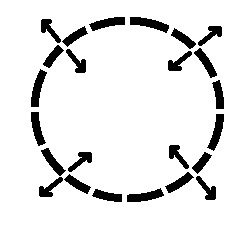
It’s not vastly different. There is still a circle representing the boundaries of the individual, company, government etc. Exactly the same kinds of decisions can take place inside the ‘sphere of influence’. This time, though, nothing outside the circle is excluded, or forgotten, or ignored, or considered unimportant. There is an implicit recognition that things that lie inside the circle affect things outside the circle, and, importantly … things that happen ‘on the outside’ affect things at the centre.
These mutual effects can be economic (poor workers don’t buy as much), or aspirational (well-run companies, or inspiring individuals, act as a role model for others), or quality of life issues (it affects us all to live alongside poverty, or litter-strewn streets), or environmental (it’s hard to live through a Texas winter blackout, an Australian wildfire, or have to walk 10 miles for water). The We diagram has been made a little more elaborate by adding arrows flowing in and out of the gaps – to represent the two-way flow of ideas, and support, and involvement, and consideration, that come hand in hand with every decision that is made.
The question now is not (as with I) ‘How can we bring greater advantage to ourselves?’. The question now is ‘What can we do, as we go along with improving our day-to-day business, so that we also enhance the quality of everything that we interact with?’ That’s much more involved – but in asking that question the actions that result act as a positive multiplier – benefits bounce backwards and forwards in and out of the circle, and of adjacent circles, and on, and on …
Out in the real world – with an I company…
Let’s take an everyday example.
An I company wishes to increase its profits. This will increase the dividends to managers and shareholders, and allow for expansion, which should lead to further profits. To achieve this, it has several levers it can pull, so it decides on the following courses of action (all decisions that can be taken from within the circle in the diagram above, although many of the decisions affect things outside the circle – or even push things outside the circle):
- Close one of its factories and open a new base in a country with lower wages and lower regulatory standards.
- Outsource as many of the roles within its organisations as it can – so cleaning, IT support, security, payroll operations, transport operations are all put out to tender. Many of the jobs become lower waged or zero-hours. Holiday and sickness pay and other ‘benefits’ for its workers (who are no longer its workers) are scrapped – money saved. All of these activities are pushed outside the circle.
- Change several of its suppliers to cheaper, lower quality, or lower wage companies – possibly overseas.
- Stop supplying several of its products through ‘bricks and mortar’ outlets and move the sales online with the attendant savings in rates, rents and some utility bills.
- Build short lifespans into its products by a process of continual upgrades, and planned obsolescence – so that purchase of new products is seen as desirable and inevitable.
- Repackage its products using cheap but attractive plastic packaging giving greater ‘presence’ on supermarket shelves and on websites.
- Restructure the company to take advantage of tax havens where possible, and make use of ‘tax-efficient’ procedures.
All of these have positive short-term financial effects for the company – but the negative impacts are obvious, and will accumulate over time, especially as more companies introduce similar strategies. Poverty, empty high streets, unemployment, poor working conditions, increased environmental damage – and more. PR becomes very important.

And what would a We company do?
Another company still wishes to increase its profits, but wishes to follow a We way of doing things. It wants to increase the wages and conditions of service of its workers. It’s also interested in expanding the business because it believes in the product that it’s making, and it wishes to offer employment to more people. It decides on the following course of action:
- Restructure the company to bring in an employee-ownership model – which surveys have shown to have higher job satisfaction and higher productivity.
- Consider a shorter working week, or a flexible approach to working from home – it has read up on the research that points to the increased productivity, wellbeing, and commitment that results from these.
- Bring its operations in-house – reversing an outsourcing of the cleaners’ jobs a decade earlier, with the attendant reinstatement of sickness and holiday benefits.
- Focus on building a local network of suppliers and retailers, to build wealth within its local community.
- Join with other companies to lobby local councils to pledge to put tenders out to local businesses first (the Preston model).
- Join the Living Wage Foundation in a pledge to pay the independently assessed living wage as a minimum – both to its own workers, and to lobby its suppliers to do the same.
- Implement a pay ratio policy, through company-wide discussion, to set a maximum top pay / bottom pay differential.
- Carry out a B impact assessment to measure its impact on its workers, community, environment and customers.
- Make use of the above moves to build an increasingly loyal customer base.
- Lobby central government to make choices such as those above more widespread in the economy.
- Move away from non-recyclable packaging.
- Improve the design of its products to increase longevity, repairability and ease of recycling, and to reduce energy and, where appropriate, water consumption – both in the manufacturing process and in their use.
- Audit its suppliers to ensure that their conditions of service for employees, and environmental standards, are of a high standard.
If any of these actions seem pie in the sky, then maybe reflect on the fact that a huge number of companies are already implementing them (presumably because they work!) – a number that is growing every day, across the world.
This is a very different set of outcomes to those achieved by the company following I guidelines. In some ways, to be sure, they are not as positive:
- Increased returns to shareholders and owners may not be as great, or as rapid, or they may even flatline (but they may be greater in the longer run).
- Growth of the company may not be as rapid (but it may be quicker).
In other ways, though, the returns will be much more impressive:
- Affect a greater number of people positively.
- Affect no-one negatively (apart from directors and shareholders financially – but they’re happy).
- Improve employee loyalty and (surveys prove) productivity.
- Lead to stable improvements in its own business, and in the local economy.
- Reduce pollution.
- Improve the ‘brand satisfaction’ of customers.
- Become a better long-term investment as its positive credentials foster customer loyalty.
- Encourage other councils and companies to follow similar strategies – resulting in a benefits multiplier.
These returns will also reduce the level of government expenditure required on health (physical and mental), waste disposal, pollution control, benefits, crime and more.
Next time … Externalities – a key concept