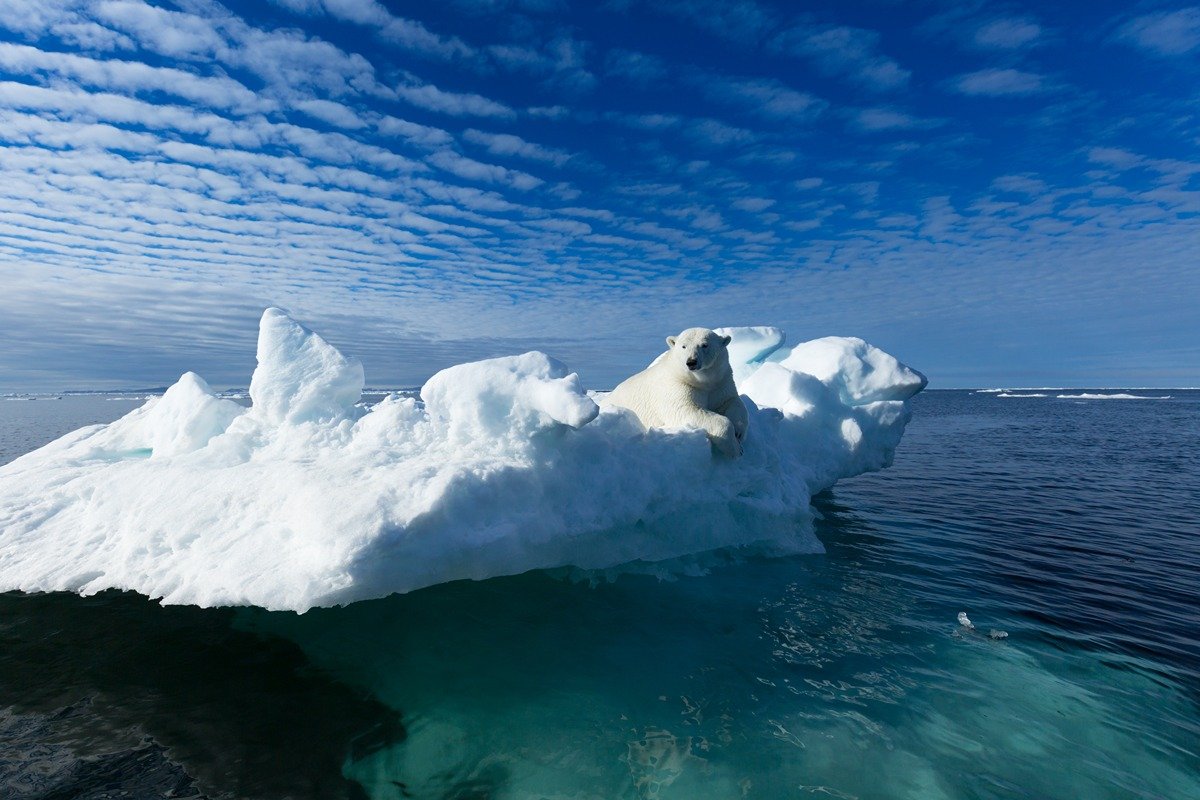
A report, published this week in the journal Nature Reviews Earth & Environment, suggested that the first ice-free summer in the Arctic could be recorded as early as the end of this decade and is likely to occur in the next 25 years.
“In the September monthly mean, the earliest ice-free conditions (the first single occurrence of an ice-free Arctic) could occur in 2020–2030s under all emission trajectories and are likely to occur by 2050.”
The report highlighted that the Arctic, where the rate of warming is happening at four times the global rate since 1979, could be an early warning alarm of ecosystem collapse, but might also offer opportunities to reduce the impact of human-caused climate change. ‘Observed Arctic sea ice losses are a sentinel of anthropogenic climate change.’
Dr Zack Labe, an atmospheric climate scientist from Princeton University, told Yorkshire Bylines:
“This paper is a very important reference piece, and it documents a story of a rapidly transforming place and our scientific understanding of it from institutions and leading experts around the world. The extent of future climate impacts though – both the amount of warming and total amount of sea ice that is lost – remains up to us.”
He warned though that focusing on the exact year of the first ice-free summer – although significant – might miss the long-term decline, as well as geopolitical issues.
“Parts of the Arctic are already becoming ice-free in summer. This again impacts local marine ecosystems, nearby communities, and other economic/political factors, like increased shipping.
“So for me, I am less interested in the exact year and somewhat arbitrary definition of the first ice-free summer. Rather, I think we should focus on the ongoing long-term decline and subsequent regional impacts of newly ice-free locations.
“These shorter-term trends are much harder to predict, but the overall multi-decadal decline due to human-caused climate change is obvious.”
Labe concluded by emphasising the transformation that has already been witnessed in the Arctic.
“The Arctic has already become a radically different place than just a few decades ago. This has impacted ecosystems and people living around the Arctic Circle. These impacts also extend elsewhere around the world.
“We also know with very high confidence that without a reduction in greenhouse gas emissions, climate models project the first ice-free summer to occur within the next few decades. And if there are even higher emissions, this timing may be sooner than later.”
What happens in the Arctic doesn’t stay in the Arctic
Dr Alexandra Jahn, an associate professor of atmospheric and oceanic sciences at the University of Colorado, also supported the issue of global impacts, when she told Yorkshire Bylines:
“While first ice-free conditions are nearly unavoidable at this point, with only a small chance (10-20%) percent chance to avoid them potentially if warming can be kept below the 1.5 Paris target, the duration and frequency of an ice-free Arctic can be kept to a minimum by reducing greenhouse gas emissions globally as much as possible.
“By doing that, ice-free conditions could be limited to occurring just in September most years, rather than stretching for over 3-5 months or even more under high emissions scenarios with less or no emission mitigation.”
Jahn continued:
“An ice-free Arctic has impacts both in the Arctic and globally. In the Arctic, it affects light availability in the ocean, impacting the ocean ecosystem. It also affects wave heights, as without sea ice, waves are higher, leading to more coastal erosion on the Arctic coasts. Loss of sea ice also impacts many species that are adapted to living in a sea ice covered environment, such as seals and polar bears, which can lose their habitat.
“That has impacts for people living in the Arctic who depend on hunting, as well as depend on sea ice for travelling, as many Arctic towns and settlements are not accessible by roads, only by air (expensive) and through travel over sea ice.”
A blue Arctic?
Jahn continued to highlight the amplified dangers of a transferred Arctic, from a white zone to a ‘blue Arctic’.
“By reducing sea ice, more solar radiation is absorbed in the Arctic, as sea ice is much more reflective than open water (white versus blue surface, increases absorption of incoming solar energy by about 60%). That affects the global climate and it has been shown to further amplify global warming.”
These fears were echoed in the report itself which argued that this transformation signifies a ‘regime shift’.
“Such changes have probably not occurred for at least 80,000 years and will have important impacts on the local and global climate and on ecological systems.”

Impacts to marine ecosystems
Professor Kate Hendry, an expert in biogeochemical processes in the Arctic Ocean, working with the British Antarctic Survey, acknowledged that a lot of the changes are ‘locked in’, but this did not mean that there should be no action. “Ice-free days are going to happen. We can reduce the impact of this by ensuring that there is no more carbon in the atmosphere.”
Hendry was concerned that the “Changing growth patterns of algae which lie at the bottom of the food chain can lead to uncertain consequences and can also impact carbon sequestration”. She additionally warned about the dangers of ocean acidification and further highlighted the global impacts of changes in the Arctic.
“The Arctic is at the forefront of climate change, the different properties and processes of ice in the Arctic can control weather patterns and sea level rises.”
Ice-free conditions elsewhere
The report concludes that, “Arctic sea ice has declined substantially since the beginning of the satellite observations in 1978, and is projected to continue to do so into the future”. It also notes though hopefully, that “there remains a small chance that ice-free conditions can be avoided. In particular, if warming is limited to <1.5 °C or only exceeds 1.5 °C for a short time, there is a <10% chance that the Arctic does not become ice free.”
Dr Rob Larter, marine geophysicist with the British Antarctic Survey and winner of the Polar Medal, highlighted that ice-free conditions have already been observed in Antarctica, when he told Yorkshire Bylines:
“At the other end of the world, Antarctic sea-ice extent has declined steeply since 2016, and a year ago there were already ice-free conditions for more than three months in the Bellingshausen Sea.
“This contrasts with the average conditions observed since comprehensive satellite observations began in 1979, and even more starkly with the conditions experienced by participants in the Belgica expedition 125 years earlier.”
Will the UK’s internal politics help or hinder the climate crisis?
The UK Government published its Arctic policy last year, which stated:
“Climate change poses an existential threat to the Arctic as we know it, with the region experiencing warming at four times the global average. The impacts on Arctic ecosystems and biodiversity will be devastating unless action is taken to tackle global climate change.”
It remains to be seen whether internal UK politics this year in the form of a general election will take attention and awareness away from the urgent action needed to tackle the climate crisis.