“Tractors to the left of us,
Tractors to the right.
Into the valley of Death
Rode the six hundred.”
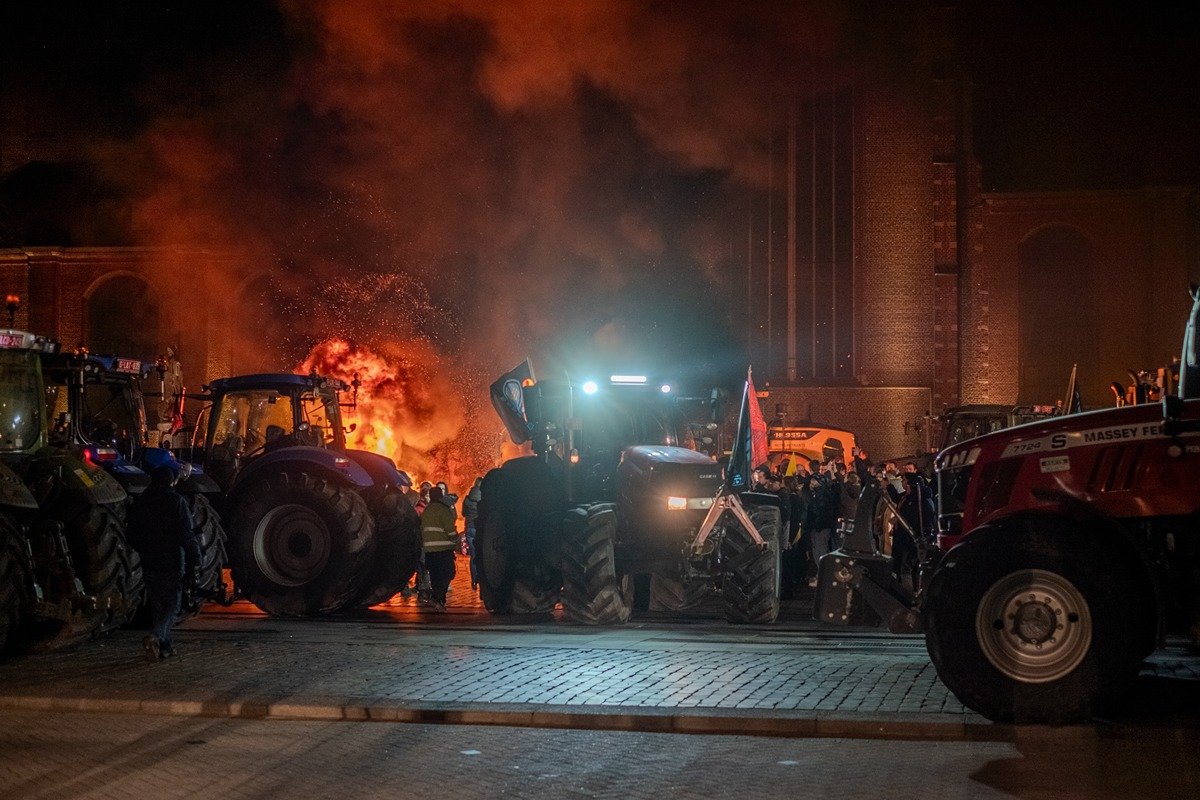
This isn’t how Tennyson’s Charge of the Light Brigade opens up, but residents across Europe’s capital cities could be forgiven for thinking it should have done. In Brussels, people had to run the gauntlet between tractors lining the streets around the European Parliament, part of farmers’ protests against cuts in fuel subsidies, land set-aside obligations and low-cost food imports.
Farming protests kicking off everywhere
The protests kicked off everywhere. Germany, France, Romania, Portugal, Greece, Poland, the UK, and the Netherlands all witnessed demonstrations about farming in crisis. Some were hostile, with rubbish dumped on motorways, eggs thrown at parliaments and traffic brought to a grinding halt. Some, at least, brought humour too, with farmers in France offering croissants to passers-by.
Behind the protests lie towering issues about food, farming, climate, and democracy. And while none of the protagonists are 100% correct, none of our political leaders even grasp the profound changes needed if we want an equitable and secure food future.
The Guardian put the protestors’ case in a nutshell: “Farmers have said they face falling sale prices, rising costs, heavy regulation … domineering retailers, debt, climate change and cheap … imports, all within an EU agricultural system based on the premise that ‘bigger is better’.”
UK farmers are saying much the same. The political danger is that it is the far right that has been quickest to throw in political support. Their fraudulent claims are that if we just ditch all the climate stuff and deregulate everything else, the problem disappears. As if! “… Into the valley of death …”
Blame bureaucracy and climate obligations?
For farmers, struggling to pay the bills and survive, you can see the appeal of narrow, far-right solutions. Blame bureaucracy and climate obligations. Blame foreigners and cheap imports. For progressive politics, the problem is different. Orthodoxy cannot bring itself to admit that the globalisation that liberal societies have embraced has become the ideology that would destroy us.
Globalisation became a mandate for the multinationals. Corporate fiefdoms hoover the lifeblood out of our soils, societies, and solidarities. Their voracious accumulation of wealth detached itself from public wellbeing. Political elites that became the defenders of such a moribund ideology would end up as our undertakers not our lifesavers.
In India, the elite’s response is to throw up roadblocks around New Delhi, close down social media and place restrictions on the travel/movements of farmers. But it will not make their food problems go away (or bring an end to farm suicides). What the world needs is a different lens through which to view today’s and tomorrow’s greatest food challenges.
When climate runs AMOC
Wherever you look, extreme weather events are disrupting food production and the seasonality of planting and harvesting. Britain is awash with water, a situation made worse by the chemicals and fertilisers that flow into our streams, rivers, and bathing waters as a consequence. Flooding is exacerbated not just by the intensity of downpours but by farm practices like still ploughing fields in vertical furrows, rather than following Europe’s preference for horizontal ‘terracing’.
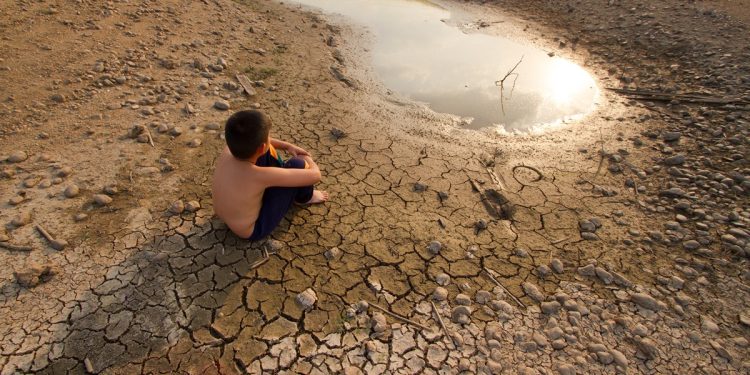
At the other extreme, reservoirs in southern Spain are down to 4% capacity. Some of South America’s greatest rivers are reduced to trickles, and great swathes of their forest ‘lungs’ are being ripped out in uncontrollable fires. California and eastern Australia seem to have had their share of both flood and fire … and it’s about to get worse.
So far, only obsessed scientists have paid much attention to AMOC – the Atlantic meridional overturning circulation. In essence, this is the ocean circulation pattern that gives Britain the temperate climate we have been blessed with. But climate scientists have been warning for decades that global warming, and melting polar icecaps, are weakening the ‘pump’ that pushes warm water up from the Gulf of Mexico, holding back the flow of cold, arctic air that, in winter, would wish to embrace us.
If the pump stops, which at some point looks likely, all bets about weather patterns will be off. Farmers (and a host of unconventional food producers) need to be part of a conversation about what local, national, and international food security must then look like.
A bridge over troubled waters
We need a new bridge for such conversations. And this cannot be a variation of today’s free-trade, free-for-all. It would begin by guaranteeing farmers a secure living wage; prioritising more localised production and distribution networks (following the example of Liège’s ‘Food-Land Belt’, which aims to produce 50% of food needs from within its own region); prioritising low-mileage, local distribution networks over the international demands of supermarkets; levying carbon taxation on food imports and processes; and offering 50% reductions on business rates for goods produced within 50 miles of their urban outlets.
Soil health and environmental repair must be part of the deal too, but not in a stupid way. The French farmer who pointed out that the fields he was to set-aside would otherwise have produced 300,000 baguettes was making an important point. Families don’t feed off empty shelves. But we must shift from carbon intensive farming to organic and regenerative systems. If farms were given reducing annual carbon budgets to work within it would force a fundamental rethink about our obsessions with meat and dairy production.
Sadly, the response across Europe has been the opposite. Political leaders are busy ducking fundamental reforms in favour of a retreat from climate undertakings. Commitments to tax fertiliser use and farm-diesel are being reneged on. So too is the timetable for raising environmental repair duties. And little is being done to reverse the corporate takeover of land itself.
Brexit gave control away – we need it back
This is the real argument we failed to have in Britain’s sham Brexit debate. The central issue was never about sovereignty. As soon as Britain’s neoliberals had the power to do so, they handed sovereignty to corporate elites. Often it wasn’t even to the highest bidder, just to the nearest mate or donor. What Britain lost was solidarity, not just between citizens but between food producers and food consumers.
It isn’t too late to set a different agenda, but it won’t come out of an adherence to today’s corporately rigged markets or from a politics desperate to become more anodyne by the day. As systems break down so the opportunities for radical alternatives will increase.
Such alternatives will cross continental frontiers as easily as national ones. We just have to tax the accumulations of corporate and personal wealth. The developing world only feeds us in preference to itself because it lacks the money to do otherwise. A Tobin Tax on speculative capital movements would sort that out.
We desperately need a new coalition between farmers, families, and climate activists. Our whole approach to food and wellbeing needs to be rethought. Have a read of Tim Spector’s book Food for Life and you get a sense of how the journey from farm gate to plate has fallen hostage to an army of additives and preservatives that boost the profits of food giants but do little for our wellbeing. It doesn’t need to be this way.
Take back control of farming
Some 40% of global food production goes to waste because poor countries lack the resources to store or transport it. You don’t need rocket-science solutions to resolve that. Innovative programmes of urban agriculture are already creating new links between low-mileage food and farming. In Britain, expanding the current production of sea vegetables around the nation’s coastline would both clean up our waters and offer huge nutritional value to the food chain.
The key to any such systems change is ultimately institutional. For all our shortcomings, the fundamental problem is not with farmers or with food consumers. It is with rancid politics. We have to take power away from the fiefdoms that control distorted food markets, disfigured landscapes, and dilapidated politics.
Will this come from today’s political leaders? Unlikely. Will it come from the farmers’ protests? Not if the far right capture disgruntled loyalties first. But it could come if citizens’ movements – north and south – rise up to offer a different narrative, one driven by a hunger as much from the heart as from the belly.
If today’s politics is in its death throes anyway, what have we to lose? Only the chains that bind us to junk food, no food, or to fiefdoms that impoverish the grower, the eater, and the Earth that we depend on. It ought to be an easy choice.