In the retirement years, some couples are more than happy within their own relationship where they are always in each other’s company, perhaps doing different things but mostly in the same room, shop or house. Moi and I are rarely in the same room or shop and often not in the same house. The fact that we have been married nearly 57 years seems to indicate that this arrangement works for us.
Togetherness – and personal space
The few times that we may find ourselves in the same room together is through the night, at the one main mealtime of the day in the late afternoon, or when we watch DVDs together. We have recently started watching our favourite 300 DVDs again and we usually cuddle up on the couch with a drink and often get as much satisfaction from the film as we did the first, second or multiple times we have watched it previously.
This is due to the fact that we can’t remember the plot, nor the ending and often whether we have even seen the film before. Age sometimes has its benefits: just like young children, everything is a surprise. We don’t have a TV licence, so we do not, nor do we want to, watch anything broadcast on the traditional airwaves.
Luckily, Moi and I have similar ideas about respecting each other’s space. If we find ourselves home together, Moi may be upstairs sewing, reading or browsing on her computer, while I may be downstairs doing something similar, except the sewing thing. However, due to Mum’s much earlier instructions, I’m sure I could still sew a button on something or even patch a pair of trousers, but Moi won’t let me.

Crocheting for beginners
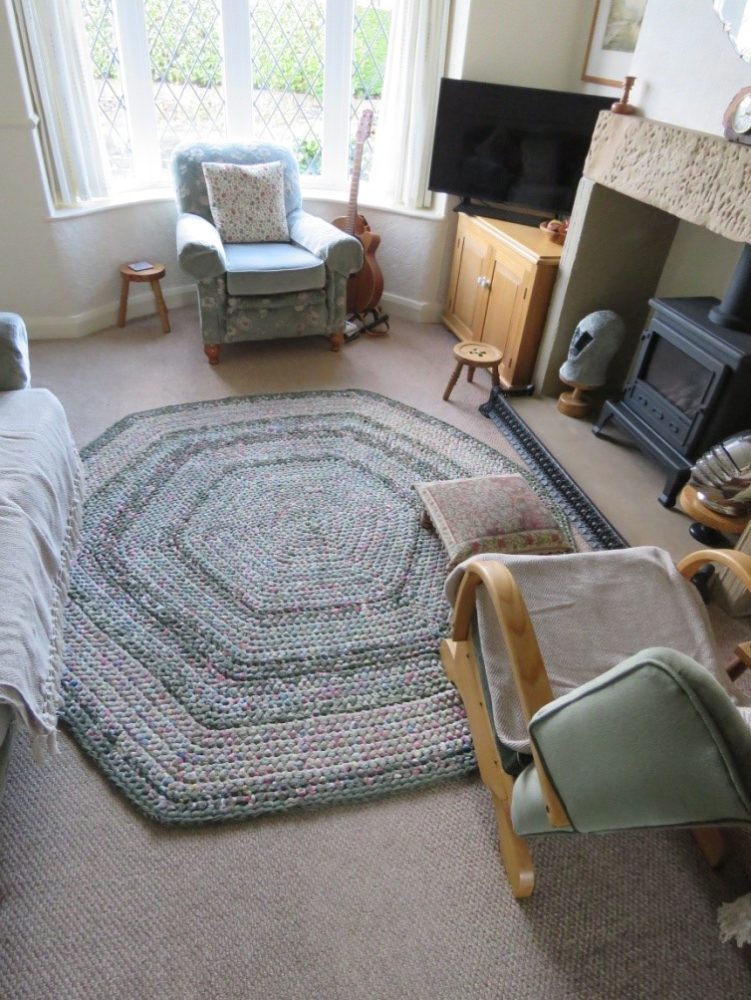
Moi has also crocheted several rugs for different areas of the house, much less bother than replacing the carpets and it adds a certain amount of style and colour to a room. Trying to describe how something is done when the person describing it doesn’t know can be troublesome, but I’ll have a go.
Start with 60 metres of special jersey material of your chosen colours. This will probably be 60 inches wide (yes, another industry using both metric and imperial). Cut the long length into manageable lengths, say five metres, then sew the ends together off-set by one inch. Then, start at one of the offsets and cut the whole thing up going round and round until there is a one-inch length of material approximately 300 metres long. This is then wrapped around a large bobbin, then repeated with another colour and wrapped around another large bobbin, then and only then can the construction begin.
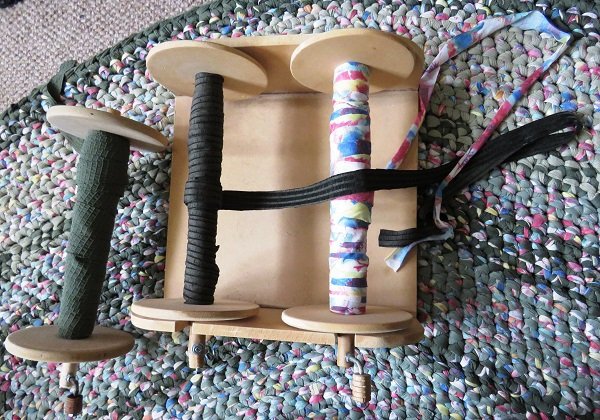
In this case Moi uses both strips together to achieve a mottled effect on big number 10 crochet hooks. After a couple of days, the whole process starts again with perhaps another two colours to give a finished striped effect as in the photograph. The larger the rug the more material and more time it takes to go all the way around. Each of the final rows may take all day to complete.
Moi has made six or eight of these rugs, some of which have not turned out to her liking and have been given away, but at least three now sit proudly in various rooms of the house.
Welcome to the man cave and woodturning
I also have my man cave, where I carry out my knackling and woodturning. Much of this I have described in the ramble ‘Yorkshire memories: knacklers, erry carts and rugby league’.

Here is where I also spent many happy hours tinkering with my bikes, but as the biking days are behind me, I often tinker with my 19-year-old Volvo and do a little bit of woodturning in and among.
The general principles of woodturning are to get a piece of wood spinning as fast as it will go without too much vibration and definitely before the lathe starts to walk across the workshop. Then with the aid of a sturdy rest fastened to a sturdy part of the lathe, which ideally is sturdily fastened to the floor, we then can carefully jam a sharpened piece of steel into the spinning wood and hope for the best. What could possibly go wrong?
If care is taken, practice and experience usually indicate when something is about to go wrong and if/when it does go wrong, it can be quite dramatic, so it is to be avoided. It is also prudent to ensure that any vulnerable part of your body is not in the trajectory of a flying chunk of wood.
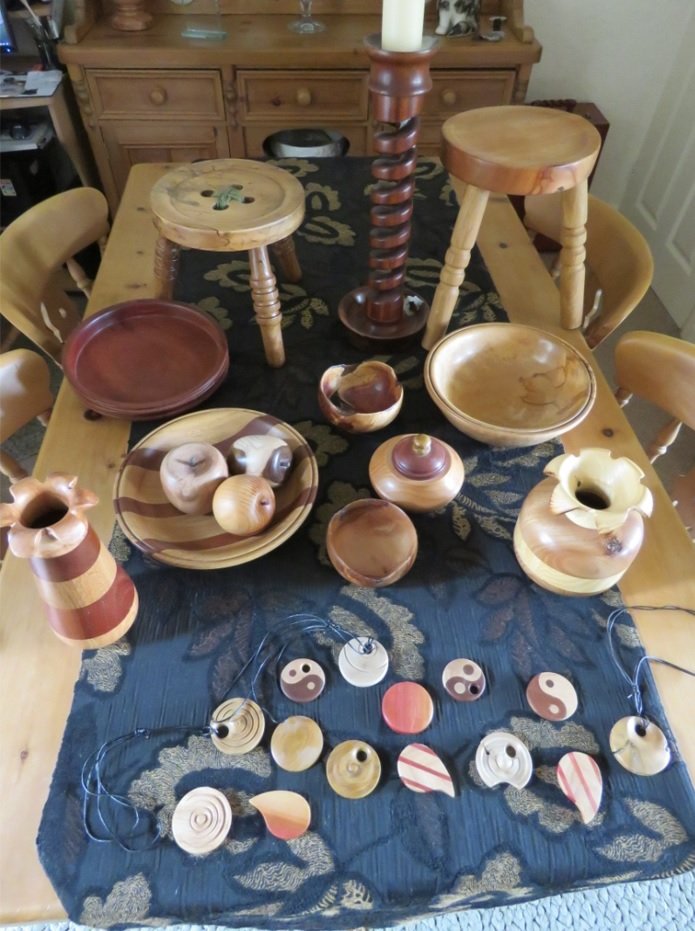
If all the necessary precautions are carried out, some beautiful results can be achieved as the photo, I hope, indicates. I have found that the creation of a wood turning item can follow a very similar path to the writing of Norky’s Ramblings. I may start with an idea in mind then something happens to shift the story in another direction. With wood turning it’s the wood itself that can often dictate the final result; I may start by making a bowl and finish with a goblet, or start to make a leg for a stool and end up with firewood.
Man caves of yore
In the aforementioned article about knacklers, erry carts and rugby league, I also described how my great-granddad Brown made and fixed things, often with the help of his grandson, my dad. After my great grandma Louisa died at the age of 62, granddad Brown turned his whole house into a man cave and his wood lath proudly sat in his lounge. A fine fellow and one of my heroes.
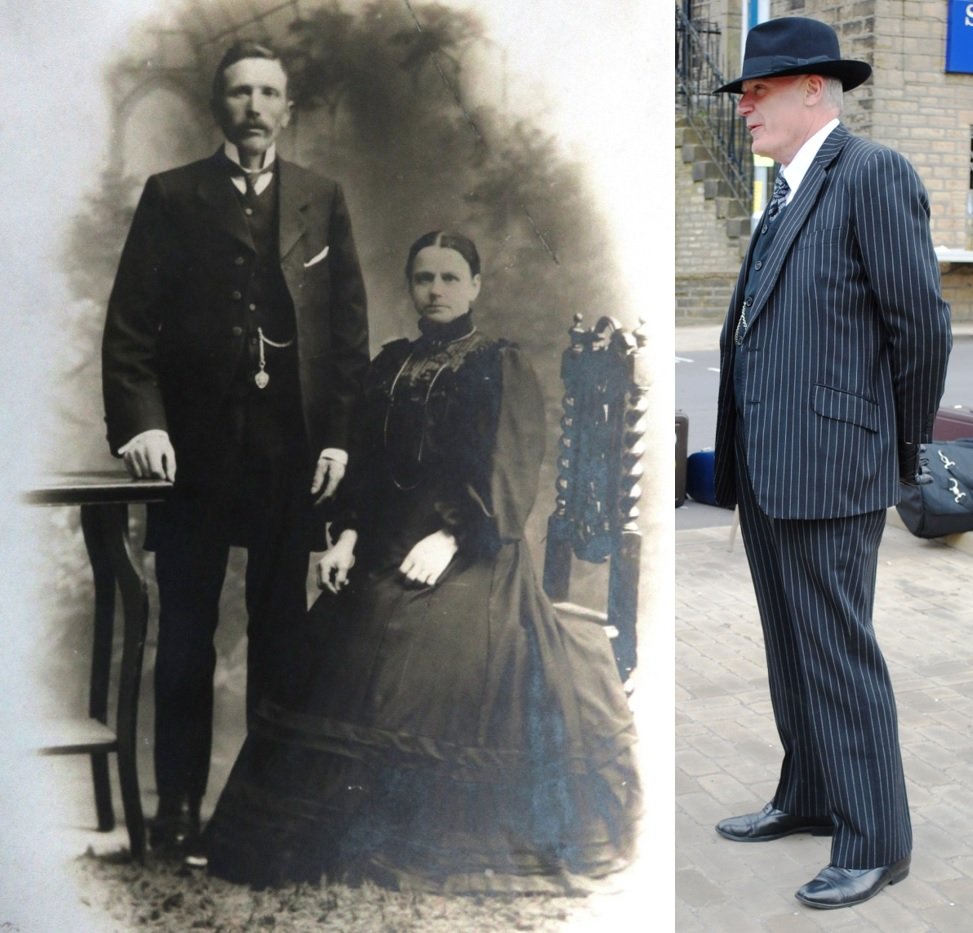
This is Joseph and Louisa Brown on their wedding day 23 May 1886. Joseph was 21 years old, and Louisa was 23. The photo on the right was a fancy-dress occasion when I was able to proudly wear the same watch that he was wearing on his wedding day.