



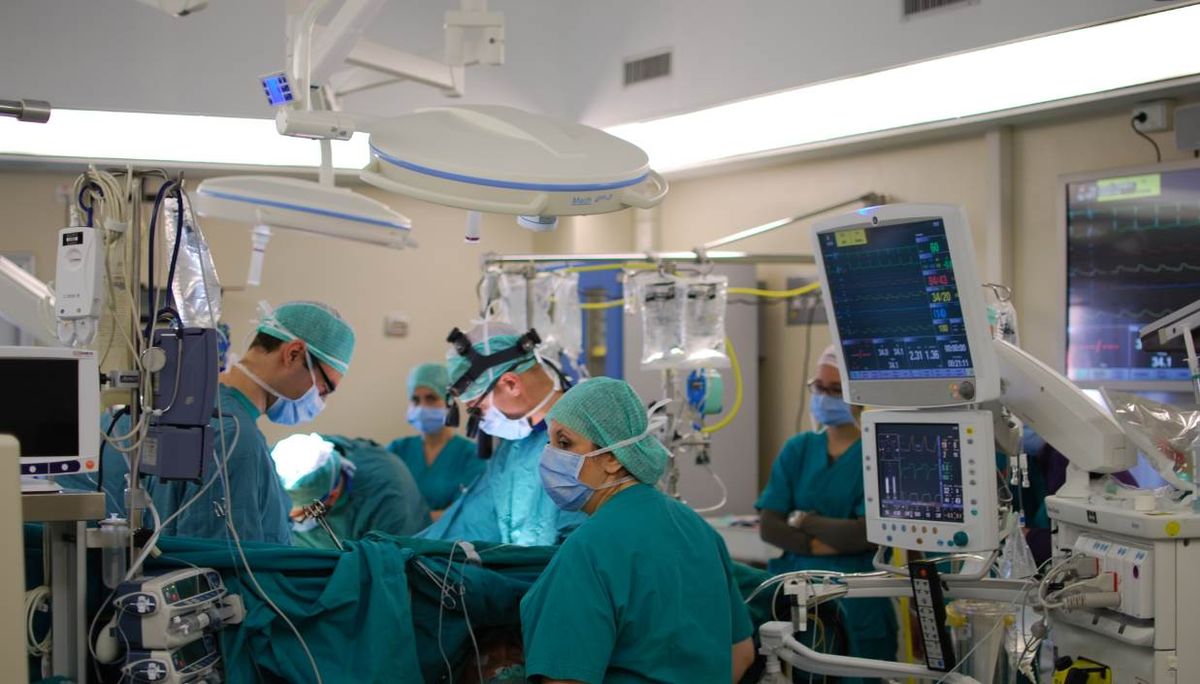
Millions are now waiting for NHS treatment, including thousands needing hip and knee replacements. These are routine and straightforward procedures – known as planned or ‘elective’ surgery – that restore mobility and relieve pain, transforming lives ruined by discomfort and disability. The situation is worse in the UK than in comparable countries. Why is this the case?
I’m a retired consultant orthopaedic and trauma surgeon, lucky enough to have had three decades of doing this type of work with committed, capable and hardworking colleagues at all levels in the NHS. Covid demonstrated just how poor and fragile our health structure is compared with equally wealthy countries. No doubt we need to spend more, pay higher wages to staff and be more efficient. It’s the roots of that last criticism – the inefficiency of the NHS – that are worth exploring.
Explaining “inefficiency”
Here is a truly worrying statistic. When I worked as a consultant surgeon, I would ask people: “How many hours a week do you think I actually spend with a pair of gloves on doing elective/non-urgent surgery?” Replies varied anywhere from 10 to 25 hours, but were generally closer to 20. It’s what you’d expect. The job title, people assume, gives it away. Just as a plumber spends the day mending boilers and pipes, so a surgeon spends it doing surgery.
But those estimates were wrong. In my experience, a consultant surgeon on a standard NHS contract spends a stunningly meagre five and a half to six hours per week undertaking elective surgery. A study by Professor Yates published in Health Service Journal two decades ago arrived at a similar figure of an hour a day.
Exactly the same contract and working environment applies to hundreds of other NHS consultant surgeons, too. I used to call it “gloves-on time”, literally the time from when I put on a pair of rubber gloves to when I took them off again. It seems remarkably wasteful, given it takes at best 15 years to train us, that “gloves-on time” should account for so little of a surgeon’s working week.
Consultant surgeon contracts – how much time is actually available for surgery?
What drives surgeons’ limited hours doing actual surgery? The answer lies in just how consultants are contracted and not, as people often assume, in the cost of salaries. Consultant surgeon pay is about £50 an hour. It takes roughly 1.5 hours for a surgeon to put an artificial hip or knee in. That’s £45 after tax. Compare that with the hourly rate for a car service, solicitor, electrician, or plumber – it’s not excessive.
What are the actual contractual arrangements? Consultant surgeons work a standard 40-hour, five-day working week. The eight-hour working day is split into two four-hour sessions: that’s ten sessions a week. Now subtract weekends and nights on-call for emergencies – about one or two sessions a week depending on the number of consultant surgeons in a team.
Of the eight sessions remaining, much time is given up for other responsibilities. These include:
- A clinic seeing new and follow-up injuries (trauma/fracture surgery)
- A clinic seeing patients referred from GPs
- A clinic following up all the patients who have been operated on, generally on three to four occasions, until people are fully recovered
- A session for administration, such as planning surgical procedures, checking letters, handling complaints, and supervising junior colleagues
- And finally, a session for auditing work, ward rounds and clinical meetings.
However, as we are also trauma surgeons, we operate on people admitted with injuries during the week. Trauma operating sessions are undertaken daily after our on-call night. About a third of our work is related to skeletal injuries which are admitted 24/7, known collectively as ‘trauma’ patients. So, one operating session a week is used for that work.
That leaves two sessions for elective (non-emergency) work such as hip and knee replacements. What happens in those four operating hours?
Inefficient use of doctors’ time in theatre
When a patient enters the anaesthetic room, various things happen. First, staff check they are the correct patient and which side is to be operated on. They are then anaesthetised and placed in a suitable, secure position. Their skin is cleaned and various drapes applied to cover all but the operating area. This could take anything from 15 to 30 minutes.
When the surgery is completed, the anaesthetist, who has been present throughout, has to wake the patient up and be absolutely sure they are stable and breathing normally, before he or she can move on to the next case.
The upshot of this process is that, in a four-hour operating session, a consultant surgeon may only spend three hours actually operating.

Use of surgeons’ time in other countries
Elsewhere in the world, particularly in Europe and North America, surgeons’ time is used more efficiently. There are several factors that contribute to this.
First, according to the OECD, Germany has 50% more doctors than the UK, and France has about 20% more. This is an unambiguous benefit to patients. The UK is well down the list in comparison to other European countries.
Second, European and North American healthcare systems have specialists in something called ‘musculoskeletal medicine’ who diagnose and treat the sort of conditions we operate on, ones that are heading towards an operation but can be treated with things like injections, tablets and physiotherapy. Only about a third of the patients we see in the UK actually require surgery because our training includes knowledge of how to deal with the other two thirds utilising the aforesaid treatments. Having more specialists would free us up for surgery.
Third, other health systems run separate hospitals for elective surgery and trauma cases of all types. Cases such as head injuries, abdominal and chest injuries and limb injuries are concentrated in so-called ‘trauma centres’. The UK Government is in fact beginning to talk about ‘surgical hubs’. Could I ask, what happened to Nightingale hospitals? They would make great hubs.
Fourth, North America particularly employs ‘physician assistants’. These are highly trained non-medical staff like specialist nurses in anaesthesia who will recover and maintain anaesthesia while an anaesthetist moves on to the next case. They also undertake much of the ward and clinic-based work. As yet, we don’t have such a role. Many of the non-operating sessions described above could be – and are in other countries – undertaken by such individuals working as a team with the surgeon. This releases surgeons to spend more time operating. But there is also a fifth and important reason: employee incentive.
Barriers to innovation in the NHS
Regardless of productivity, the monthly paycheque to staff in the NHS is always there. The main criticism of those on the political right is that the NHS is the last of the great socialist enterprises, where there is little accountability, competition or appetite for efficiency gains. Those on the left would argue that a market approach to healthcare would be the death knell for universal provision.
Politics aside, the NHS is indeed a non-profit public service, in stark contrast with the ‘for-profit’ American healthcare system, something I certainly hope never comes our way. However, it is the case, in my experience, that in the NHS there is no real incentive at any level to improve productivity or be innovative.
I found that all sorts of innovations simply never became embedded in the system. For example, if the operating list for treating trauma had a space because fewer people were injuring themselves that day, I had a list of those who would come in for their op at short notice to fill that four-hour session. You would think this was obvious and would be routine by now. Not the case.
There is no doubt that there has been some innovation, but this is driven more by expediency and desperation, such as allowing the independent healthcare sector to do elective orthopaedics in order to reduce some of the pressure on NHS provision.
Many NHS patients now have hip or knee replacements in private hospitals, at no cost to them. This is not privatisation, as public money is paid at the same rate to the private provider as the NHS receives. Indeed, it is the same consultant surgeons doing the work, outside those 40 contracted hours. And it works because these relatively small hospitals are not undertaking emergency work. In addition, the NHS is still the main employer and is maximising surgical skills.
The need for an honest debate
In summary then, the pretty shocking statistic we began with has its roots in an understaffed service (we have fewer doctors per head of population that similarly wealthy countries), where the surgeons who are not particularly well paid for their skills and responsibilities are also carrying out other tasks, often only partly related to the primary task of operating on debilitating disease.
In fairness, the NHS is having a terrible time and criticism needs to be viewed against a background of years of political interference, poor long-term capacity planning and low pay, particularly to nurses. Being target-driven, the service has shifted to political and populist efficiency measurements, such as outpatient and emergency waiting times, to the detriment of core activities such as actually carrying out surgery. Virtually everybody who replied to my original question would have been happy to pay more national insurance contributions for an effective service.
If there is going to be an informed debate on the future of healthcare, people should know the reality. For too long we’ve been told the NHS is one of the best healthcare systems in the world. It clearly isn’t. A surgeon spending five to six hours a week on elective surgery is a nonsense.