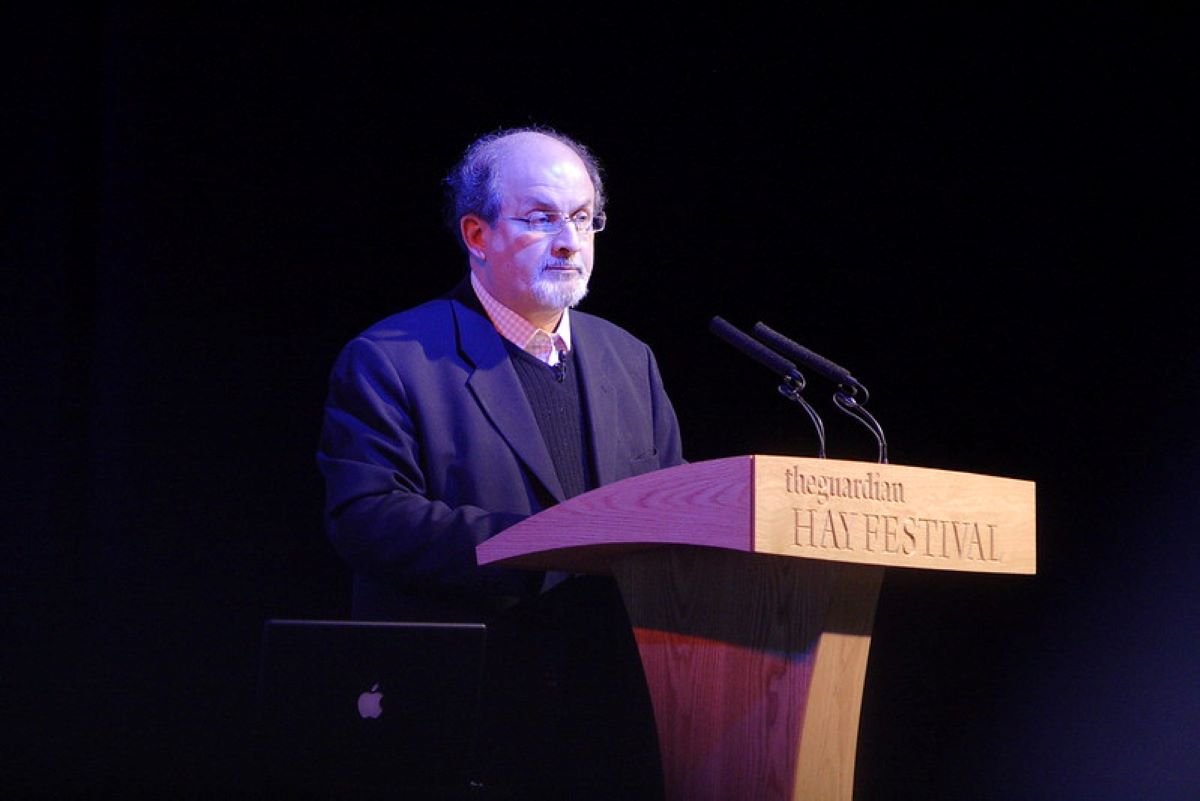
In the immediate aftermath of the attack on Salman Rushdie on 12 August 2022, politicians and newspapers fell over themselves to praise the author for risking his own life in the cause of freedom of expression.
How different from February 1989, when the fatwa was announced on account of The Satanic Verses.
Responding to the fatwa on Salman Rushdie
Notoriously Norman Tebbit called Rushdie “an outstanding villain”, a man whose “public life has been a record of despicable acts of betrayal of his upbringing, religion, adopted home and nationality. Now he betrays even his own sneers at the British establishment as he cowers under the protection of a government, a police force, and a society he once denounced as racist and undemocratic”.
The venom of such attacks increased when Rushdie met prime minister John Major in 1993 and foreign secretary Robin Cook in 1997, reaching their apogee in 2007 when he was knighted. Inevitably the Mail, which Rushdie in his memoir Joseph Anton refers to as the Daily Insult, was always at the forefront of this campaign.
In the Atlantic Magazine, March 1994, Geoffrey Wheatcroft described such reactions as “naked schadenfreude” and “malicious glee run riot”, and in the Guardian, 2 February 1993, Melvyn Bragg noted not only the racism of these attacks but also “the baying of brute philistinism, and a poverty-stricken inability to recognise and support the call to a noble cause – the defence, in this country, of freedom of speech within the law”.
Change of tactics now
So why the volte-face by the forces of the Right in 2022? The simple answer is because they could weaponise him in their obsessive culture war against the ‘woke’ and ‘cancel culture’.
In 2015 Rushdie had criticised those authors who had withdrawn from the PEN American Center gala in protest at PEN’s decision to honour Charlie Hebdo. This was because they considered offensive to Muslims the cartoons which had brought about the murder of many of its staff.
Suddenly he became an icon of free speech for exactly the same kind of people who were utterly indifferent to his exercising this right in 1989 and to the personal consequences of steadfastly defending it in the decades following.

Perpetuating the culture war
At this point the term ‘woke’ had not yet been mobilised as a term of abuse by the Right, but the attack on Rushdie provided the press with a field day in their culture war. After the knife attack, J. K. Rowling, who has been involved in bitter disputes over trans issues, tweeted: “Horrifying news. Feeling very sick right now. Let him be OK”, and Meer Asif Aziz, a student political activist based in Karachi, responded: “Don’t worry you are next”, and described the attacker as a “revolutionary Shia fighter”. There is not the slightest reason to think that Aziz’s threat had anything remotely to do with Rowling’s views on gender and sexuality, of which he was probably entirely ignorant, but the press fuse had been well and truly lit.
For example, the Mail, 15 August, enquired in its Comment column:
“What’s the difference between an Islamist fundamentalist and a trans rights extremist? Not as much as we may have thought, it seems. Where crushing free speech is concerned, they are very much on the same page.”
In the same day’s MailOnline Frank Furedi attacked “the cowardice of leftists who fail to defend free speech” and Dan Wootton argued that “It’s the same type of organisations and individuals who bravely backed Rushdie back then who now so casually call for the cancellation of Rowling in 2022”, and complained that, “free speech is being eroded as the cancel culture mob bows to external malevolent forces on a regular basis”.
Two days later in the MailOnline, Gillian Philip, in an article headed “It’s a bitter irony: how the literati pledging support for Rushdie are too often cheerleaders of woke censorship”, alleged that, “The cracks in the liberal façade of resolution showed almost as soon as the fatwa was pronounced … Even at the time there were many public figures who equivocated or even sided with the bigots and book burners”.
The rewriting of history?
What is happening here, and in similar articles in other right-wing papers, is that history is quite simply being rewritten. It was predominantly the forces of the Right that refused to support Rushdie in 1989 and, in some cases, bitterly attacked him in his plight.
Now papers such as the Mail are both drawing a veil over their own malign role in the original Satanic Verses affair and engaging in a defence of freedom of expression which appears to extend only to forms of expression of which they approve and which they can fit to their own ideological purposes. Thus, for these papers, Rushdie’s right freely to express himself would appear to depend solely on whether what he is actually saying accords with the Mail ideological line – which is not a meaningful right in any sense of the word.
Article first published in Media North: Campaign for Press and Broadcasting Freedom (North). For more from Media North, and to subscribe to their newsletter, visit their website.