


• Contact
  • About
  • ISSN 3049-9720
  • Authors and editors
NEWSLETTER SIGN UP
Yorkshire Bylines
Advertisement
  • Home
  • News
    • Brexit
    • Culture
    • Education
    • Environment
    • Home Affairs
    • Transport
    • World
  • Politics
  • Opinion
  • Society
    • Food
    • Music
    • Poetry
    • Sport
  • Business
    • Economy
    • Science and Technology
    • Trade
  • Region
No Result
View All Result
  • Home
  • News
    • Brexit
    • Culture
    • Education
    • Environment
    • Home Affairs
    • Transport
    • World
  • Politics
  • Opinion
  • Society
    • Food
    • Music
    • Poetry
    • Sport
  • Business
    • Economy
    • Science and Technology
    • Trade
  • Region
No Result
View All Result
Yorkshire Bylines
Home News World

Morocco earthquake: six months on

In the remote Atlas mountains, 350,000 displaced villagers survive precariously, still awaiting promised government rebuilding aid

Dr Stella Perrott by Dr Stella Perrott
20-02-2024 17:01
in World
Reading Time: 7 mins read
A A
morocco earthquake

Image by Dr Stella Perrott

Share on Bluesky

On 8 September 2023, a 6.8 magnitude earthquake rocked Morrocco. The epicentre was about 80 kilometres South West of Marrakesh in the High Atlas mountains. Just under 3,000 people died and over six million people were affected through loss of life or injury, or the destruction of their homes, schools, and villages.

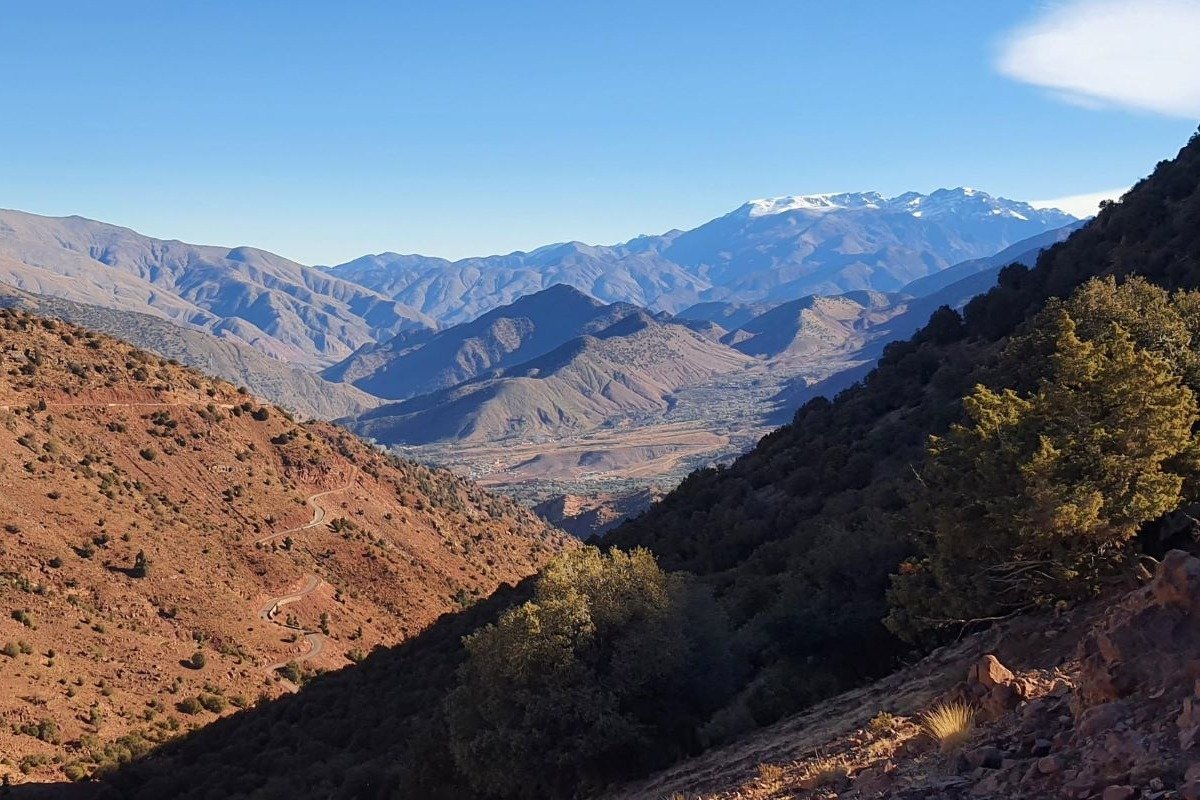
This past week, six months after the earthquake, I travelled through the area most affected. My journey, over the course of two days was via the 30-kilometre Tizi-n-Test pass going North from Taroudant to Marrakesh. The top of the pass sits at 2,093 metres. We did the trip slowly over two days to bring some much-needed business into the area.

Isolated and difficult to get to villages

The Tizi-n-Test was built between 1926 and 1932 by colonial French engineers to meet their needs for control of the area and to open a route across the mountains. It is a stunning feat but is now neglected. Today, a motorway bypasses the High Atlas and only local people or those wishing to see the mountains in all their awe-inducing majesty are tempted by the difficult journey. It is a challenging route at the best of times and not for the faint-hearted (I am faint-hearted and spent some part of the journey with eyes closed and clenched buttocks).

The road climbs and twists with vertiginous drops on one side and overhanging cliffs on the other. It comprises dirt piste, scraps of tarmac left over from the time of the French, and a few stretches of retarmacked road. It is rarely more than one vehicle wide. Even before the earthquake, it was weather sensitive, with mudslides, avalanches and snow and fog on the higher reaches.

The earthquake sent much of the mountainside down into the valleys and gorges, falling on cars and houses and blocking this narrow road through which all emergency services and aid had to travel.

The unsteady rocks continue to fall, and bulldozers work constantly to clear the road, pushing huge boulders and mounds of dirt to the side, reducing the width of the road still further. The occasional small stone walls and the aluminium rails on the most precipitous sections, which acted as barriers to plunging to the bottom of the valleys and gorges, are now rubble and dust or are hanging, still attached to their bits of road, over the cliff edges.

Some parts of the road over gullies and streams had to be rebuilt for emergency vehicles to get through and an army camp is still stationed on the Marrakech side.

Although some villages are scattered along the road most are a few kilometres from it, down narrow dirt tracks, mostly inaccessible without donkeys or 4x4s. Many of these tracks were also blocked. Tenzirt for example, is a tiny village hidden from view and tucked in behind a mountain gully. It lost 22 people and many more were injured. It was several days before outside help could get through to many of these mountain villages and people were trapped in the rubble of their homes and died.
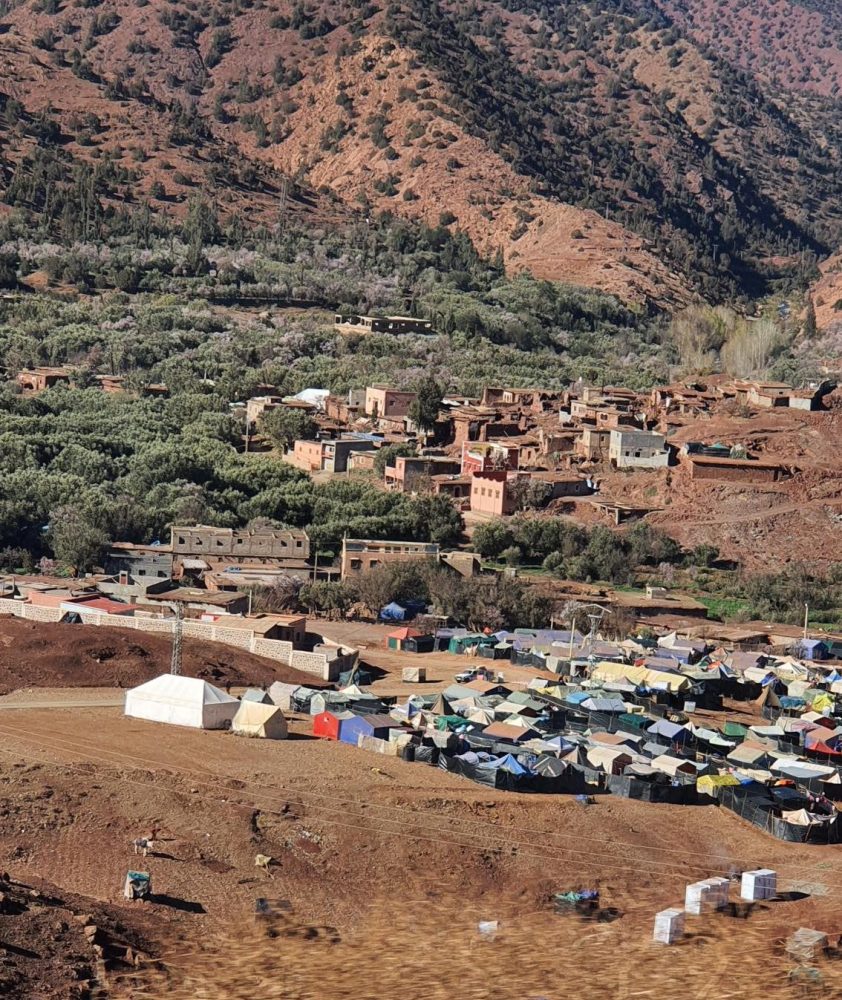
Image by author

Villages destroyed

Looking down the mountain side, we could see the remains of destroyed villages, painted walls exposed and roofs collapsed inward, destroying everything beneath them. Houses were piles of red mud bricks, dust, and wooden rafter rubble.

Occasionally a more substantial modern house appeared to have withstood the quake and after quakes but, closer to, the cracks in the walls could be seen, and in one village we could see the mosque tower had separated from the main part of the building.

Some remnants of people’s homes and lives have been rescued, but piles of furniture and bedding have yet to be cleared from where the bulldozers pushed them to get rescue services through. Few people here have cars, and the few that were here at the time are still buried beneath rocks and debris.
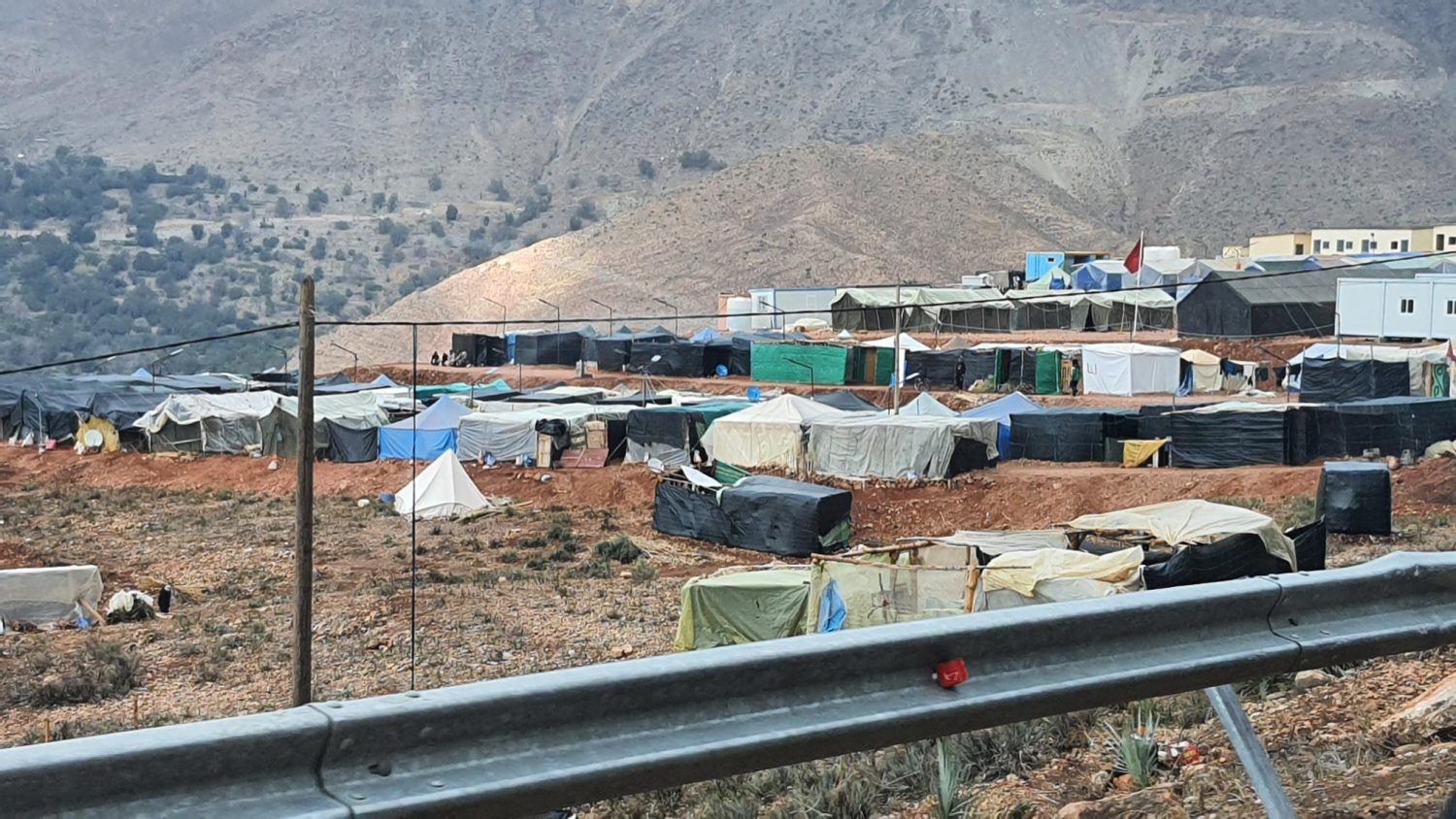
Image by author

Some 350,000 people displaced

According to the Red Cross about 350,000 people in the Tizi-n-Tist area are temporarily ‘housed’. All along the road the hillsides have been flattened and excavated to place tents and portacabins. Mostly, people are in tents cobbled together from plastic, tarpaulins and rugs.

There are some Red Crescent and other disaster relief tents and now there are some portacabins, which are better able to withstand the dirt and the weather. But these seem to be arriving only slowly. It is sweltering in the middle of the day and very cold at night. We were as high at 31 degrees Celsius and as low as 4 degrees over the course of the two days.

Some families have created shelters directly outside their homes, along the road or down in the valley in their village. Earthquakes continue at about a 2.2 to 2.8 magnitude, on average one a month, and being next to a weakened building carries considerable danger.

Most of the villages now have a makeshift school and mosque, and people are trying to do the work they did before the quake hit. They tend the fields and animals, have opened a café from a tent, or sell fruit and veg from a few crates on the roadside. We bought a drink from a young man operating a small shop and café from a tent and looked down on his ‘cabin’ that had plunged to its end on the rocks below.

Britain immigration refugee crisis concept as people on a border wall with a British flag as a symbol of UK illegal immigrants with the shadow of a group of migrants with 3D illustration elements.
Home Affairs

Refugee conversions to Christianity: are we being misled by the media?

by Dr Stella Perrott
7 February 2024 - Updated on 8 September 2025

Rebuilding after the earthquake

Victims of the earthquake require much more than rebuilding help and there are organisations, including the Red Crescent supporting communities in their mental, emotional and social recovery. The Moroccan government has allocated $11.7bn for reconstruction over the next five years but reconstruction appears not to have started.

Families build their homes generation by generation, brick by brick, room by room, as finances permit and the family grows. In many of the villages the men work away to support their families and the rebuilding of homes will be challenging, even with the $14,000 the government is allocating for each family. People living in the area fear they will be forgotten. The tented villages and the rubble of houses is a reminder of the devastation, and the scale of the task ahead.

February update US AID can be found here.

Other aid organisations:

How Can I Help Morocco Earthquake Victims?

Sign up for the Yorkshire Bylines newsletter

* indicates required

Consent for having Bylines Network store my submitted information

You can unsubscribe at any time by clicking the link in the footer of our emails. For information about our privacy practices, please visit our website.

We use Mailchimp as our marketing platform. By clicking below to subscribe, you acknowledge that your information will be transferred to Mailchimp for processing. Learn more about Mailchimp's privacy practices.

Dr Stella Perrott

Dr Stella Perrott

Stella Perrott is a consultant in criminal justice and children’s services who has spent 25 years reviewing public services when things have gone wrong. She lives in North Yorkshire.

Related Posts

WASHINGTON, USA, 8 September 2018 - 3D rendering idea for the President of the United States under fire and pressure.
Politics

The new silent majority

by J 'Masharubu' Strauss
8 October 2026
Gold bars or ingots as a tool for balance, financial investment, and savings. Backdrop of Venezuelan flag.
World

Sitting gold: the fight for Venezuela’s assets to be released by the Bank of England

by Tony Burke
23 September 2026
Midterm Elections 2026 USA Banner Set – Patriotic Red Blue Political Campaign Background with American Flag Style Design
Politics

US midterms: the days grow short

by J 'Masharubu' Strauss
17 September 2026
Two wooden Adirondack chairs painted with the Canadian flag sit side by side at the end of a dock, facing out over a calm Muskoka lake in Ontario's cottage country. The red maple leaf stands out crisply against the white painted slats, while long shadows stretch across the warm wood planks. Still, mirror-like water reflects the forested shoreline that frames the lake under a soft blue summer sky. Shot from behind in a rear view, the two empty chairs invite the viewer to sit, relax, and take in the peaceful waterfront scene. With no people in the frame, the image captures the quiet beauty of Canadian cottage life, evoking tranquility, escape, and slow summer days at the lake. This patriotic Canada Day image suits travel and tourism, cottage and real estate marketing, lifestyle content, and summer long weekend campaigns. The flag-painted chairs make it especially well suited to Canada Day, July 1st, and national pride themes, as well as broader ideas of relaxation, leisure, and the idyllic Canadian lakeside lifestyle.
Culture

What Yorkshire looks like after the family tree crosses the Atlantic

by Joshua W J Brown
6 September 2026
Various cheese with different Europe flags
Trade

Travesty of language – the hollowing-out of the most-favoured nation clause

by John A Clarke
11 August 2026
Next Post
Image shows the Yorkshire flag

The Basque Country: a model for Yorkshire?

PLEASE SUPPORT OUR CROWDFUNDER

BROWSE BY TAGS

Art Books Boris Johnson Bradford Charity Climate Change Cost of Living Covid-19 Creative Industries Crime Democracy Devolution Donald Trump Environment Equality Experience Farming Festival Gaza Conflict General Election History Human Rights Immigration Iran Journalism Keir Starmer Labour Leeds Media Mental Health NHS Northern Ireland Protocol Pollution Poverty Recipe Refugees and Asylum Seekers Restaurants Retained EU Law Review Rishi Sunak Sheffield Theatre Travel Ukraine USA
Yorkshire Bylines

We are a not-for-profit citizen journalism publication. Our aim is to publish well-written, fact-based articles and opinion pieces on subjects that are of interest to people in Yorkshire and beyond.

Yorkshire Bylines is a trading brand of Bylines Networks Limited which is separate to, but allied with, Byline Times.

Learn more about us

No Result
View All Result
  • About
  • Authors and editors
  • Complaints
  • Contact
  • Donate
  • Letters
  • Privacy
  • Network Map
  • Network RSS Feeds
  • Submission Guidelines
  • Download the Bylines Network App

© 2020-2026 Yorkshire Bylines. Powerful Citizen Journalism. ISSN 3049-9720

No Result
View All Result
  • News
    • Brexit
    • Education
    • Environment
    • Health
    • Home Affairs
    • Transport
    • World
  • Politics
  • Opinion
  • Society
    • Culture
    • Dance
    • Food
    • Music
    • Poetry
    • Recipes
    • Sport
  • Business
    • Economy
    • Science and Technology
    • Trade
  • Region
  • The Davis Downside Dossier
  • The Digby Jones Index
  • Cartoons by Stan
  • Authors and editors

Newsletter sign up

CROWDFUNDER

© 2020-2026 Yorkshire Bylines. Powerful Citizen Journalism. ISSN 3049-9720
