



As crisis after crisis unfolds, it’s beginning to seem as if governments have been asleep on the job. We have seen everything from the flouting of evidence before and after the Brexit referendum to febrile buck-passing over issues like the disastrous handling of covid, climate change, water company scandals, poverty, the weaponisation of asylum and migration, foreign interference in elections, international turmoil, and war. Yet little has seemed on point. And to top it off, the US apparently changed sides in 2025.
Thugs on the block?
Just when it seemed things couldn’t get any worse, they did. And not simply because – to use the cliché – the world has changed. Crisis management and multilateralism have been smashed, while belligerent, rampant oligarchic grand-scale theft is being increasingly normalised. There is a sense of thugs disempowering and fracturing societies, as respect for democracy, the rule of law, equality, democracy, human rights and common decency are trashed. Meanwhile, only a few governments refuse to watch while the common interests of us all are violated.
Tempting as it is to suggest that the rot set in with Brexit and its champions, the malaise goes deeper. The devious, unnecessary closures of parliament during the first waves of covid demonstrated that the unthinkable could be foisted on MPs who seemed to be asleep on the job – some even content to be so, especially after the rumbunctious former Commons speaker John Bercow had been dispatched.
Was it stupidity or lazy disinterest in the traps set hundreds of years ago by that royal dictator Henry VIII – traps set to emasculate parliament – that encouraged MPs to abdicate their responsibility to protect us all from ignoble, evidence-denying decisions? Time and the All-Party Parliamentary Groups will tell.
Humans in crisis?
As the world lurches from one crisis to another, our coping mechanisms are being tested at every turn. The deceptively alluring antidote of ever more AI is not an answer to our failure to cope. It is a mirage – expensive in terms of technology, environmental impact, and above all, in its potential impact on what it means to be human.
Governments have been slow to wake up to the dangers of social media and AI inundating the lives of our children, robbing them of their childhood with games that ‘reward’ and hook them into ‘games’ and online lives informed by the logic of addictive gambling. Worse still, they are exposed to extreme content and self-disclosure by malign individuals and bots.
In 2025, we face an obscene future where people interact less with humans and more with virtual assistants – bots seemingly primed to feed them with whatever their owners want to elicit from their targets.
And still, politicians and decisionmakers wring their hands over safety online legislation that should have been enforced decades ago. Had they considered the potential harms of social media (and AI and its chatbot descendants) and had not just been transfixed by the glitter of often ephemeral economic gains, a less somnolent and more thoughtful approach might have been taken.

Do not trust a bot
There are many reasons why we shouldn’t rely on bots to give us definitive answers about anything, from the symptoms of ill health to politics. Chief among them is the fact that ‘they’ don’t provide answers at all. Instead, they generate strings of codes and words based on algorithms that sift and manipulate the ‘answer’ in a specific direction – veracity is not necessarily the prime consideration.
If the same question is fed into an AI search engine 100 times, it repeats and magnifies its ‘answer’, often compounding bias and mistakes – which can become increasingly harmful to users, particularly in matters of health. AI does not replace human insight and experience. Humans are at risk if we assume that the virtual assistant, code and bots – and crucially their owners and masters – have our well-being at heart.
The slow dawn of truth?
Back in 2019, few politicians were comfortable challenging social media giants over their glossily presented goals. Many assumed they would protect our data without actually fully understanding what ‘data’ comprised or how we humans were being monetised every time we logged on or scrolled on our phones.
Few foresaw the relentless lobbying by tech giants to exempt them from key laws – like the EU’s Digital Services Act – designed to protect our human rights. Even fewer anticipated the creeping suppression of dissent, least of all in liberal Britain.
Did we really need to witness the invasions of Ukraine and Gaza to make us think about the kind of world our children experience – where brute force and lies seem to carry such weight? It seems that our political class is blind to how our values and human rights are emptied of meaning whenever they remain silent in the face of deceit, or when they push difficult questions into the long grass of public inquiries rather than engaging with citizens on what they need.
Back to the future of civics?
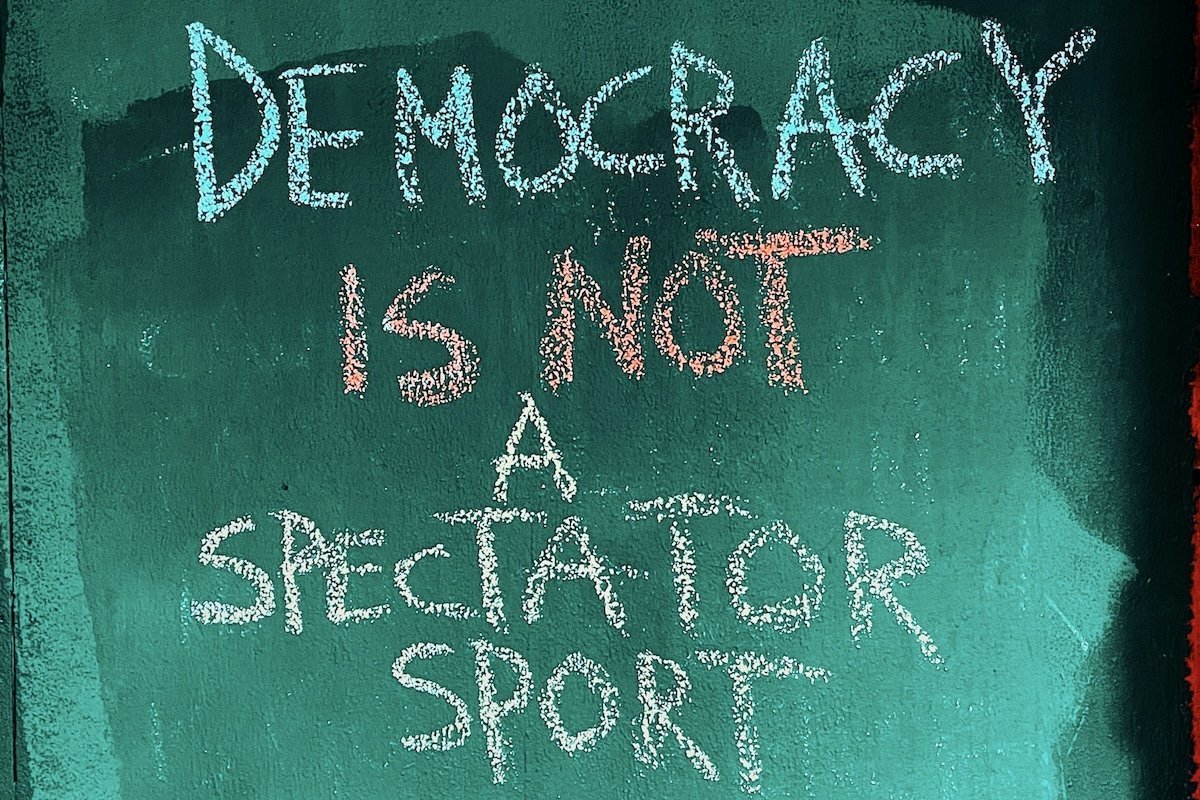
Many young people are dissatisfied with politics and shun voting as meaningless to them. Several of our European neighbours are addressing this by creating new civic and political spaces – like Ireland did on abortion and the EU did on the future of Europe – to give voice to aspirations, shared values, and goals. They are exploring new ways for ordinary citizens to shape political outcomes. This contrasts with the hate and polarisation that social media platforms do not always remove, despite having the power to do so.
Who would have thought in 2019 that so much more would need to be done to counter the far-right lurch across this country, and elsewhere in the world, including in Europe? In 2025, could we muster the courage to confront post-truth politics, re-engage with Europe, and play a steering role in reimagining a tangible, law-respecting, meaningful democracy?