




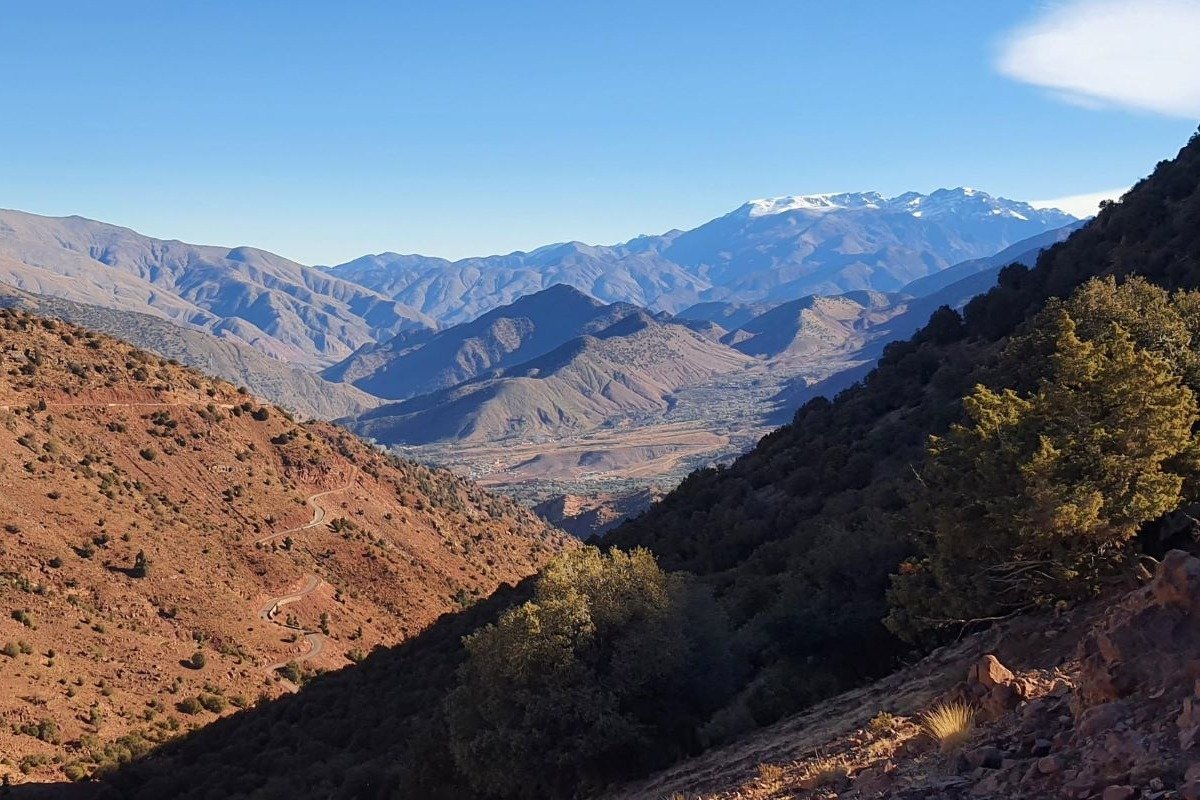
On 8 September 2023, a 6.8 magnitude earthquake rocked Morrocco. The epicentre was about 80 kilometres South West of Marrakesh in the High Atlas mountains. Just under 3,000 people died and over six million people were affected through loss of life or injury, or the destruction of their homes, schools, and villages.
This past week, six months after the earthquake, I travelled through the area most affected. My journey, over the course of two days was via the 30-kilometre Tizi-n-Test pass going North from Taroudant to Marrakesh. The top of the pass sits at 2,093 metres. We did the trip slowly over two days to bring some much-needed business into the area.
Isolated and difficult to get to villages
The Tizi-n-Test was built between 1926 and 1932 by colonial French engineers to meet their needs for control of the area and to open a route across the mountains. It is a stunning feat but is now neglected. Today, a motorway bypasses the High Atlas and only local people or those wishing to see the mountains in all their awe-inducing majesty are tempted by the difficult journey. It is a challenging route at the best of times and not for the faint-hearted (I am faint-hearted and spent some part of the journey with eyes closed and clenched buttocks).
The road climbs and twists with vertiginous drops on one side and overhanging cliffs on the other. It comprises dirt piste, scraps of tarmac left over from the time of the French, and a few stretches of retarmacked road. It is rarely more than one vehicle wide. Even before the earthquake, it was weather sensitive, with mudslides, avalanches and snow and fog on the higher reaches.
The earthquake sent much of the mountainside down into the valleys and gorges, falling on cars and houses and blocking this narrow road through which all emergency services and aid had to travel.
The unsteady rocks continue to fall, and bulldozers work constantly to clear the road, pushing huge boulders and mounds of dirt to the side, reducing the width of the road still further. The occasional small stone walls and the aluminium rails on the most precipitous sections, which acted as barriers to plunging to the bottom of the valleys and gorges, are now rubble and dust or are hanging, still attached to their bits of road, over the cliff edges.
Some parts of the road over gullies and streams had to be rebuilt for emergency vehicles to get through and an army camp is still stationed on the Marrakech side.
Although some villages are scattered along the road most are a few kilometres from it, down narrow dirt tracks, mostly inaccessible without donkeys or 4x4s. Many of these tracks were also blocked. Tenzirt for example, is a tiny village hidden from view and tucked in behind a mountain gully. It lost 22 people and many more were injured. It was several days before outside help could get through to many of these mountain villages and people were trapped in the rubble of their homes and died.
Villages destroyed
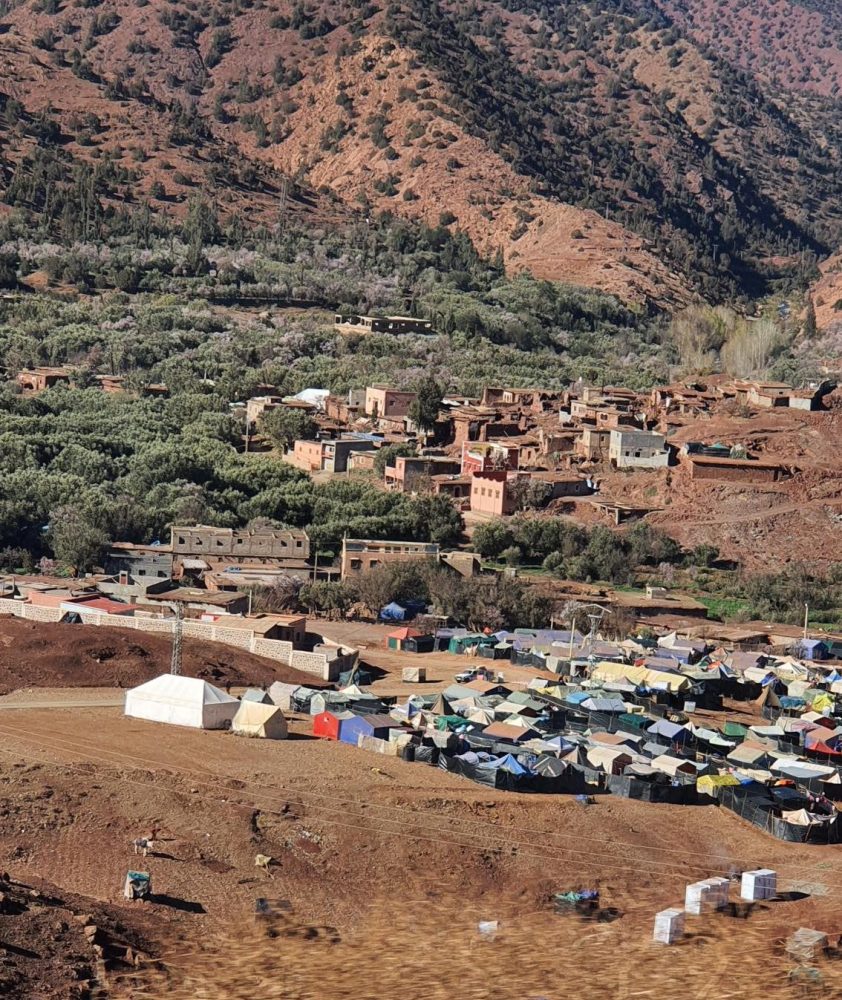
Looking down the mountain side, we could see the remains of destroyed villages, painted walls exposed and roofs collapsed inward, destroying everything beneath them. Houses were piles of red mud bricks, dust, and wooden rafter rubble.
Occasionally a more substantial modern house appeared to have withstood the quake and after quakes but, closer to, the cracks in the walls could be seen, and in one village we could see the mosque tower had separated from the main part of the building.
Some remnants of people’s homes and lives have been rescued, but piles of furniture and bedding have yet to be cleared from where the bulldozers pushed them to get rescue services through. Few people here have cars, and the few that were here at the time are still buried beneath rocks and debris.
Some 350,000 people displaced
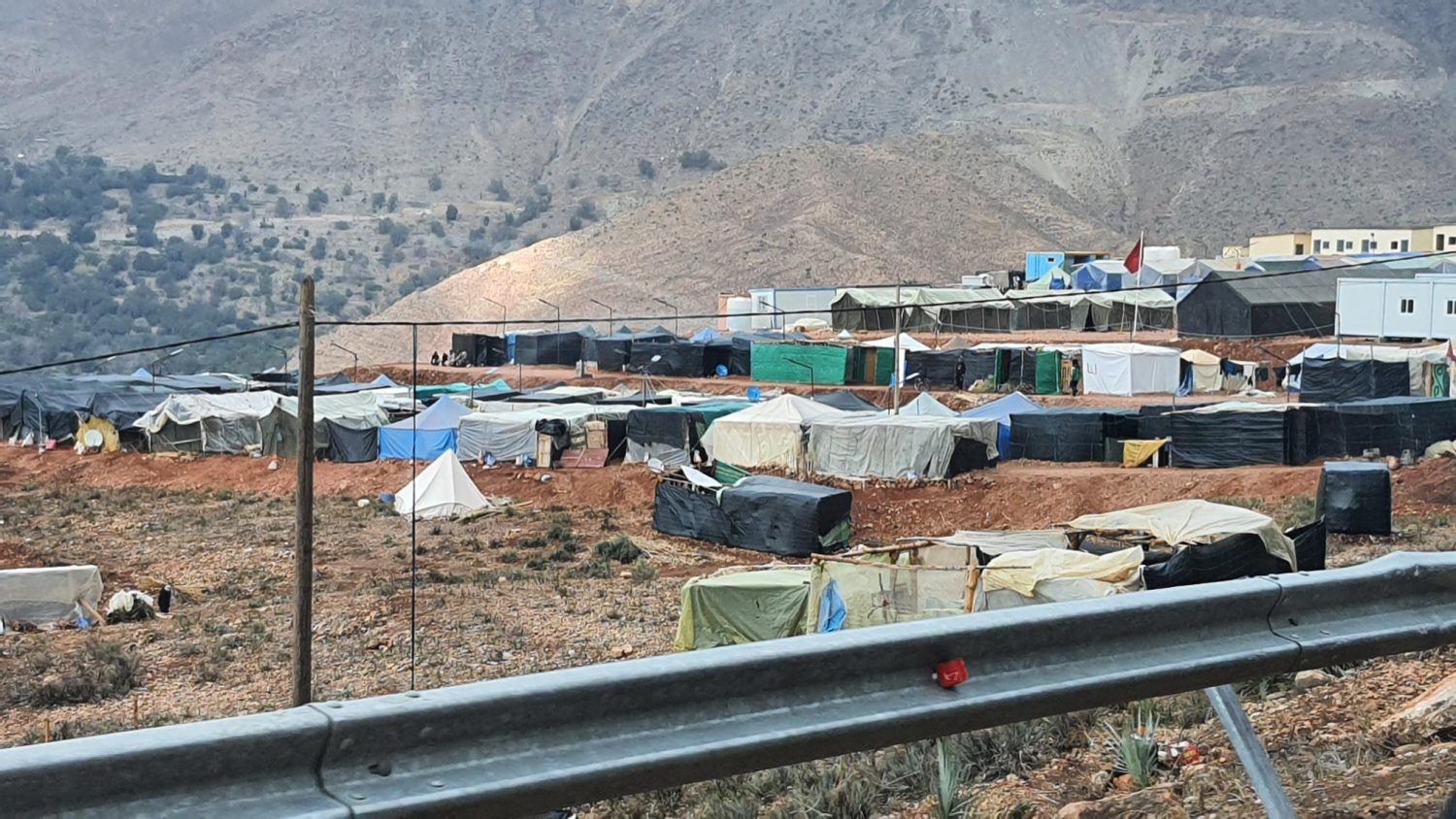
According to the Red Cross about 350,000 people in the Tizi-n-Tist area are temporarily ‘housed’. All along the road the hillsides have been flattened and excavated to place tents and portacabins. Mostly, people are in tents cobbled together from plastic, tarpaulins and rugs.
There are some Red Crescent and other disaster relief tents and now there are some portacabins, which are better able to withstand the dirt and the weather. But these seem to be arriving only slowly. It is sweltering in the middle of the day and very cold at night. We were as high at 31 degrees Celsius and as low as 4 degrees over the course of the two days.
Some families have created shelters directly outside their homes, along the road or down in the valley in their village. Earthquakes continue at about a 2.2 to 2.8 magnitude, on average one a month, and being next to a weakened building carries considerable danger.
Most of the villages now have a makeshift school and mosque, and people are trying to do the work they did before the quake hit. They tend the fields and animals, have opened a café from a tent, or sell fruit and veg from a few crates on the roadside. We bought a drink from a young man operating a small shop and café from a tent and looked down on his ‘cabin’ that had plunged to its end on the rocks below.

Rebuilding after the earthquake
Victims of the earthquake require much more than rebuilding help and there are organisations, including the Red Crescent supporting communities in their mental, emotional and social recovery. The Moroccan government has allocated $11.7bn for reconstruction over the next five years but reconstruction appears not to have started.
Families build their homes generation by generation, brick by brick, room by room, as finances permit and the family grows. In many of the villages the men work away to support their families and the rebuilding of homes will be challenging, even with the $14,000 the government is allocating for each family. People living in the area fear they will be forgotten. The tented villages and the rubble of houses is a reminder of the devastation, and the scale of the task ahead.
February update US AID can be found here.
Other aid organisations:



