
Have you ever stopped to wonder why we are governed and surrounded by the numbers 7, 12 and 60? These are numbers we have grown up with as part of our everyday lives and so they’ve become something natural that we just take for granted.
Take, for example, the number 12. The multiplying or dividing of this number is everywhere: seconds, minutes and hours on a clock, months in the year, degrees in a circle and up to 1971 pence in a shilling. The numbers 7 and 60 are equally central to our calculations of time and space.
Why and where did they come from?
Lunar and solar rhythms: at odds with our need for regularity
As far as it is known, humans are the only creatures that recognise and understand the aging process and also have developed the ability to anticipate the future. To plot the timing of any impending event humans have used the lunar (moon) and solar (sun) rhythms as an aid. (Not that we all agree: the world’s cultures and religions use these methods in very varying ways to time the celebration of their festivals and observances.)
One complication of using celestial bodies to calculate time is that we get differing calculations depending on which celestial body is most prominent or of perceived importance at the time. And just to complicate things even further, the earth spins in relation to the moon every 27.3 days (the sidorial orbit period) but as both slide through space and orbit the sun together, we must wait 27.5 days for light from the sun in relation to the moon and earth to show a full lunar cycle. And if that wasn’t enough the earth takes 365 days, 5 hours, 59 minutes and 16 seconds, give or take, to orbit the sun.
These are very inconvenient rhythms by which to live our modern lives and so, in order to impose a regularity that is easier to work with, we have rounded up and rounded down here and there. As a result, we have had to occasionally add or remove seconds, minutes, hours, days and even weeks to get us back in line with the lunar/solar cycles and in line with the rest of the world.
7 days of the week; 12 signs of the zodiac
Almost two thousand years ago the ancient Babylonians of Mesopotamia, in the area we now call Iraq and Syria was a centre of culture and learning. As today, many of their festivals and observances were influenced by our celestial bodies.The significant celestial bodies to the Babylonians were the Moon, Sun, Mars, Mercury, Jupiter, Saturn and Venus and they invented the seven-day week in veneration to each.
It also seems to have been the Babylonians, with the Egyptians, who came up with the zodiac, though we don’t know who came up with the idea of joining up the dots to form 12signs. And it was obviously unknown to them at the time that the dots that formed each of their signs were millions of light years away from each other (or did they know?).
Who, or more importantly why, anybody thought that lumps of rock, ice and gas millions of light years away could influence our character and personality is a mystery to me. As is why a 13th sign Ophiuchus (serpent-bearer) was either unknown or ignored.

A number system based on 60
Perhaps it was because it didn’t fit in with the Babylonians’ obsession with their mathematical base 60 system. Having a number system with 60 as its base is useful because 60 is divisible by 12 factors, enabling it to be easily broken down into fractions. With regard to the unfortunate serpent-bearer, it’s divisible by 12 but not 13, so we can suppose he had to go.
The centrality of 60 has come down to us in the form of seconds in a minute and minutes in an hour. It’s also at the root of the 360 degrees in a circle. The Babylonians determined that each of the angles in an equilateral triangle would be 60 degrees. Thus, when multiplying this angle of 60 degrees by a further six equilateral triangles, we get a 360-degree circle.
12: a crucial number in our division of time
We have to thank the Romans for our calendar of 12 months in the year – and also for complicating the number of days in a month. Julius Caesar, with the help of an Egyptian astrologer, arrogantly added a month to their original very convenient ten, and then Caesar Augustus (Octavian) added another, thus giving us July and August.
To further emphasise their personal magnitude, they also stole a day each from February. Presumably Caesar Augustus could have stolen October as well but must have thought better of it, as this month was given a very convenient and uncomplicated, if not a little boring, name: October is derived from the Latin for eight.
The 12-hour clock was also used by the Romans but can be traced back further to Mesopotamia and ancient Egypt. It represents the breaking-up of the day into two cycles of 12 hours each.
Sundials and clocks
If we are being picky, the name ‘clock’ in fact refers to a timepiece with a bell. The original timepiece was the sundial which means if this invention or the need to keep time had been developed in the southern hemisphere then our clocks would run in the other direction!
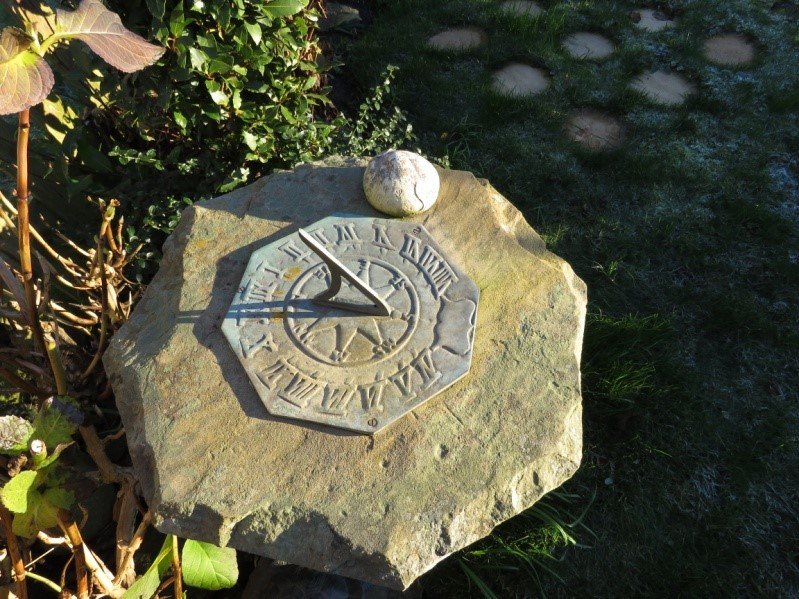
This sundial sits in our garden and, as the photos were taken at the same time, should indicate a similar time to the mantle clock in the photo below, although I haven’t wound the sundial up this week and it may be running a little slow.

This is an American mantle clock manufactured in about 1900.They were churned out in their thousands and worth little but this particular one has sentimental value to me. Not only was it given to me by a good friend, but he had acquired it from a lady who had moved into the very same house to which I was born approximately 60 years later, almost as if me and it were eventually meant for each other. It now sits proudly on our dining room fireplace.
Spring forward/fall back and the impact of another ‘celestial body’
The official explanation to the spring forward/fall back one hour malarkey that we have to endure every year has nothing to do with celestial bodies. The idea was to use daylight hours more efficiently. It was first suggested by the American president Benjamin Franklin, although it was not introduced into Britain until 1916.Government advice was needed for making the adjustment because many of the clocks at the time could be damaged by turning the hands backwards.
It could be argued that celestial bodies were involved in why the clocks were not turned back in the Autumn in 1940 but were still put forward one hour in the following spring thus making the time two hours ahead of GMT (Greenwich Mean Time).The celestial body in question this time was the German Luftwaffe. The two-hour difference was to give workers more time to get home before the blackout, and of course to confuse the dastardly Luftwaffe.
I’ll have to give up there, my brain hurts. I’m gonna sit in a quiet room with a nice cup a tea now.