The last solar eclipse seen in the UK was on 11 August 1999. On that particular occasion the full eclipse could only be viewed from the very tip of Cornwall but, as full eclipses are very rare, Me, Moi and Rachel decided to have one of the adventures never to be repeated.
Cornwall is a long way from anywhere: I think it’s even a long way from Cornwall. It’s about 100 miles from top to bottom corner, with 300 miles of coastline; it is almost completely surrounded by the Atlantic Ocean; and shares a 40-mile-long narrow border with the rest of England.
Over the centuries, therefore, it has been relatively easy for the Cornish people to become isolated, which has gone a long way towards them developing very individual customs and identities, very much like Yorkshire in many ways. But in the case of Yorkshire we have an approximately 300-mile border with our neighbours and 100 miles of coastline, depending on what one believes are the borders of Yorkshire, and how many separate parts there are.
What made us Yorkshire
Over the centuries we have proudly developed our own attitude of superior arrogance, argumentative bullishness, resentment of authority and potentially offensive honesty. I suppose we have some bad points as well, but I can’t think of any just now.
No doubt these positive attributes outlined above were honed during the time when our Germanic and Viking ancestors settled in these parts, and, of course, we resented William the Conqueror telling us what to do – which resulted in the ‘Harrying of the North’. During the years 1069–70, William laid waste to much of the north of England, where the inhabitants were still supporting the previous Wessex King backed by rebellious Anglo-Saxons, Scandinavians and Danes.
If a much more accurate and detailed history of Yorkshire is what you are looking for, I can highly recommend a book written by Colin Speakman, Yorkshire: Ancient Nation, Future Province, published by Gritstone Publishing.

To Cornwall
Any-road-up, back to Cornwall and the eclipse. Whatever the reason the Cornish did what they did and how they did it has been a mystery, but I’m sure they thought they could make a killing out of this full eclipse malarkey. We were told weeks in advance that all accommodation, caravan and camp sites were booked up, even the news at the time suggested as much, and we were warned that Cornwall was going to be gridlocked.
I managed to book a sloping, overpriced caravan pitch just north of The Lizard, which was an ideal location for viewing the eclipse, but a very poor location for pitching a caravan. Another problem was that I didn’t have a caravan.
Have caravan, will travel
Gary to the rescue. Our friend and neighbour offered his caravan but I had to pick it up from their holiday site. Luckily it was on the way and my trusty old Volvo had a tow bar. As we were nearing our destination it became clear that many of the locals had greedily shot themselves in the foot. All the previous warnings had put people off booking and, on arrival, we noticed many empty fields with unused portaloos and hastily displayed, last-minute signs suggesting desperation.
With or without dragging a caravan, Cornwall is a tiresome journey. In all, I drove 390 miles and it took seven-and-a-half hours. A regular Cornwall enthusiast has told me that It could have been much worse. My little brother Nick and his family thought it would be a good idea to join us. He lived in Orpington, Kent, at the time and, being in the south, I had assumed it would be but a short dash across the bottom. When he arrived, he told me that he had also driven over 300 miles. Cornwall is certainly a long way from anywhere.
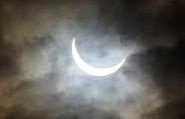
A magical sight
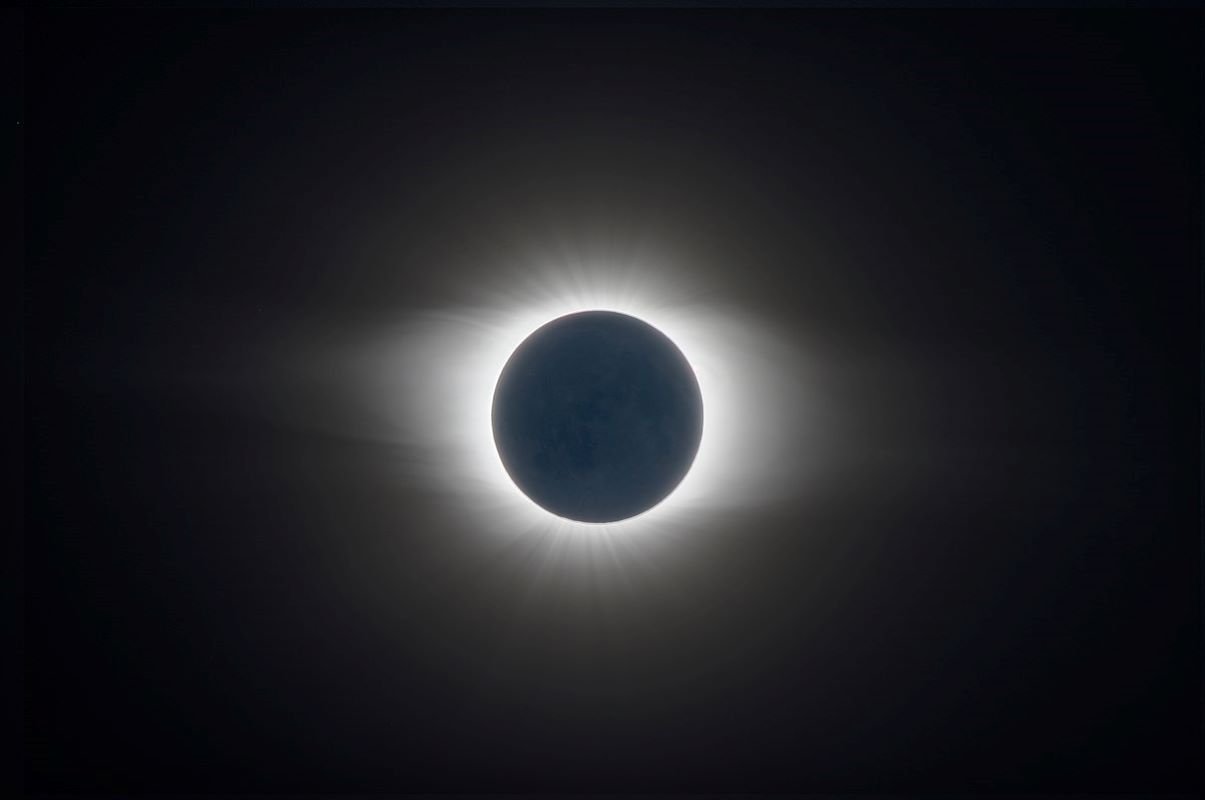
The eclipse itself was indeed a magical event. As the photo shows it was a little overcast, but even this failed to devalue the occasion. During the few seconds up to the full eclipse we could see the shadow rushing towards us, much quicker and denser than any cloud shadow: the nearby noisy rookery became instantly and eerily silent, as did everything around us.
The two photos below give some idea of what it was like, one minute we were in full daytime sunshine and the next it was night. I have to admit, it was one of the spookiest and most unnatural experiences of my life. Not counting my first sexual encounter, of course.
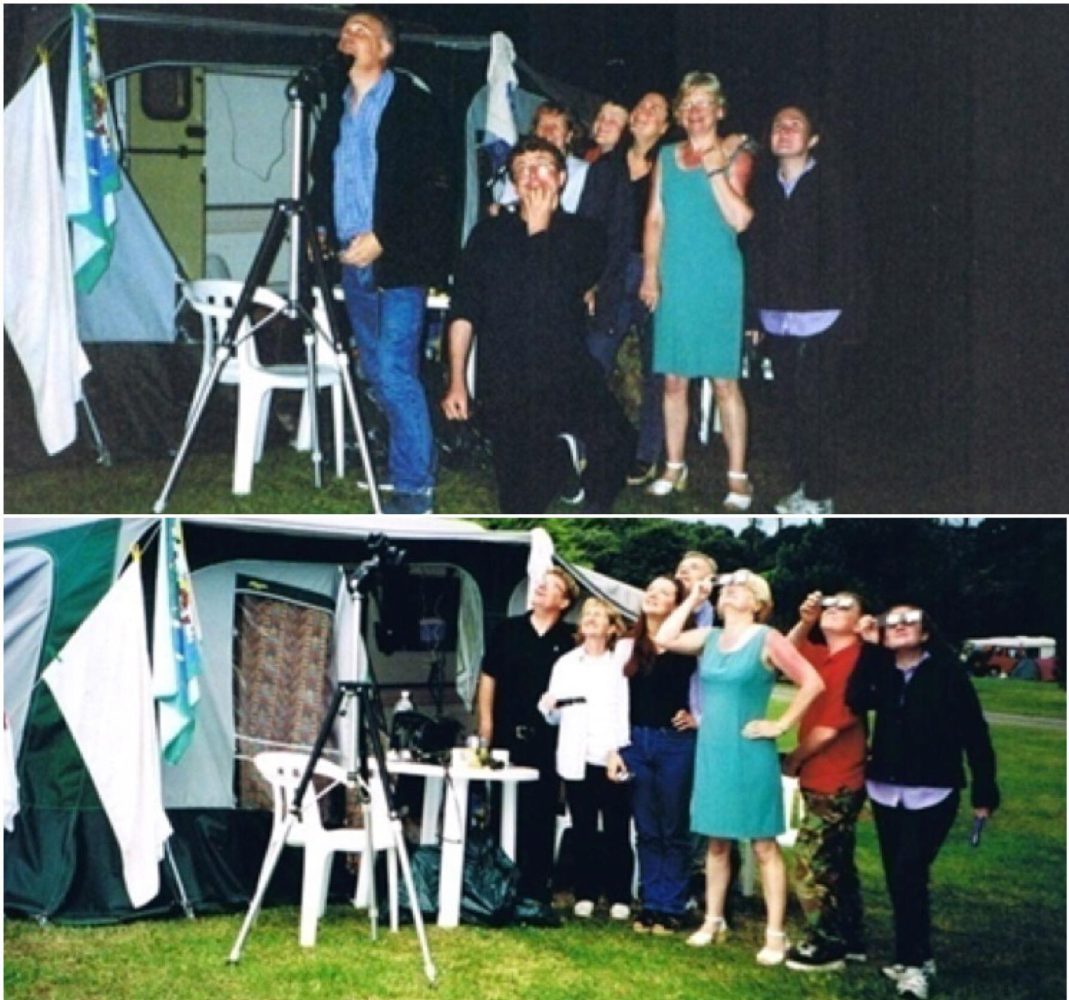
And a terrifying omen
What our ancestors must have thought of this is only to be guessed at, but I’m sure evil spirits, bad omens and the Gods would be involved somehow. To a humble shepherd tending their flock to suddenly to be confronted with this darkness during the day must have been frightening. Just a few seconds ago the sun would have been where it always had been all their lives, as it was for their parents and grandparents.
The sun had always appeared from the east (in the northern hemisphere) and disappeared over the horizon to the west, there would have been no indication that the moon was in the sky, no reason to think there was a connection – after all it’s only there at night. It must have appeared as if a giant invisible creature was biting lumps out of their lifeblood.
It is the coincidence of astrophysics, gravity and magic that the moon is in just the right place in the sky to fully block out the sun. The diameter of the moon is about 400 times smaller than that of the sun and the moon is about 400 times closer to the earth than the sun.
There is another 400 coincidence (a little under to be more accurate) but, if you are impressed by your first solar eclipse but don’t want to travel far, you only have to wait another 400 years for the next one to come round to just where you are sitting. And by that time you’ll have forgotten how eerily scary it all was the first time around and be eerily scared again.