I have written about Slaithwaite (Slawit Moonrakers) and Marsden (Cuckoos) in my rambles of late, and of course included my home village of Golcar (Gowca Lilies) many times. But there are several other villages along the length of the Colne Valley that deserve an honourable mention.
The Colne Valley takes its name from the winding river that flows along the length of the valley. I’m sure it’s of no surprise that this river is called the River Colne, but what may be confusing to the casual observer is that the name of the river continues for a further five miles past the Colne Valley.
The river starts its journey high in the Pennines, near an area called Eastergate Bridge overlooking the village of Marsden. Being so close to the moors, this area is also a beautiful but potentially very bleak part of the Colne Valley. The river then meanders eastwards for eleven miles through Huddersfield and on to Cooper Bridge where it flows into the River Calder.
The Colne Valley’s urban district
Officially, the urban district of Colne Valley was formed in 1937, following the merger of Golcar, Linthwaite, Marsden, Scammonden and Slaithwaite. How Scammonden managed to get itself elevated into this illustrious group is beyond me. Not only is it not in the Colne Valley (I think), but in 1937 it was populated by cattle rustlers and several Lancastrians. Lancashire at the time was but a stone’s throw away, and became even closer following the Local Government Act 1974, which moved the borders, abolished the Colne Valley Urban District and created, in its infinite wisdom, Kirklees.
I’m joking about the good people of Scammonden, of course. Our milk is provided by a farm in that part of the world and what fine chaps they are, particularly when they leave a free bottle on the doorstep now and again. And besides, desperate as they are, I don’t think even they would have Lancastrians living among them (joking again a bit!).
Evidence remains of the Colne Valley’s industrial heritage
Anyway, if we ignore the forming of urban councils and Local government acts, the actual geological valley starts at the Pennines near Marsden and continues on to Longroyd Bridge, which lies to the west of Huddersfield. Up until the Clean Air acts of the 50s and 60s, the valley had shown much of what the industrial revolution has given us – there was muck, dirt and grime everywhere, with little in the way of prosperity for the masses but lots of prosperity for the few. Nawt new there then.
I think it fair to say that Longroyd Bridge and its neighbours of Thornton Lodge, Lockwood, Paddock and Milnsbridge have suffered most in the Colne Valley from lack of investment and retain much of their industrial heritage. This probably has something to do with their proximity to the town centre. Even though many of the mills have now gone and the few that are left have been converted into flats and apartments, the housing stock remains. Most are well over 100 years old and have a wide range of questionable quality.
One exception to this perhaps is the area of Longroyd Bridge where once Brook Motors stood. A large part of the factory was demolished, to be replaced by a very smart building called Cathedral House, which is run by the Huddersfield Christian Fellowship. The building has a 1,500-seater auditorium with several meeting rooms, a café and library, and a large car park. (I wonder if following this plug these good people will also leave a free bottle of milk on our doorstep every now and again … ). The piece of land that the Cathedral entrance now sits is where Brook Motors number six department was situated and where I spent seven mostly happy times as a welder fitter.

Investment makes Colne Valley villages a nice place to live
Most of the other villages of the valley would be large enough to be called towns in many other parts of the country. The populations of Linthwaite, Slaithwaite, Marsden and Golcar (which include Bolster Moor and Scapegoat Hill),range from approximately five to ten thousand, and as the industry has largely gone, replaced by trees, the investment in the housing and social infrastructure and activities that all add to a nicer place to live has taken over. These activities including the Golcar Lily day, Marsden festival, and the Slaithwaite Moonraking festival, and many more varied community activities, all now adding to the wellbeing of the people of the valley.
What’s more, these and the smaller villages of Cowlersley, Crosland Moor, Longwood, Linthwaite and Wellhouse have benefited from their proximity to the countryside, of which there is an abundance.
Colne Valley villages’ claims to fame
It’s fair to say of course that all these villages have some claim to fame.
Linthwaite, home of the Linfit Leadboilers, I would say can boast the best view of the valley. It is also the home of Colne Valley High School, which was opened in 1956 as the first purpose-built comprehensive school in the north of England. However, my own four years there from 1958 to 1962 were not a particularly happy time for me.

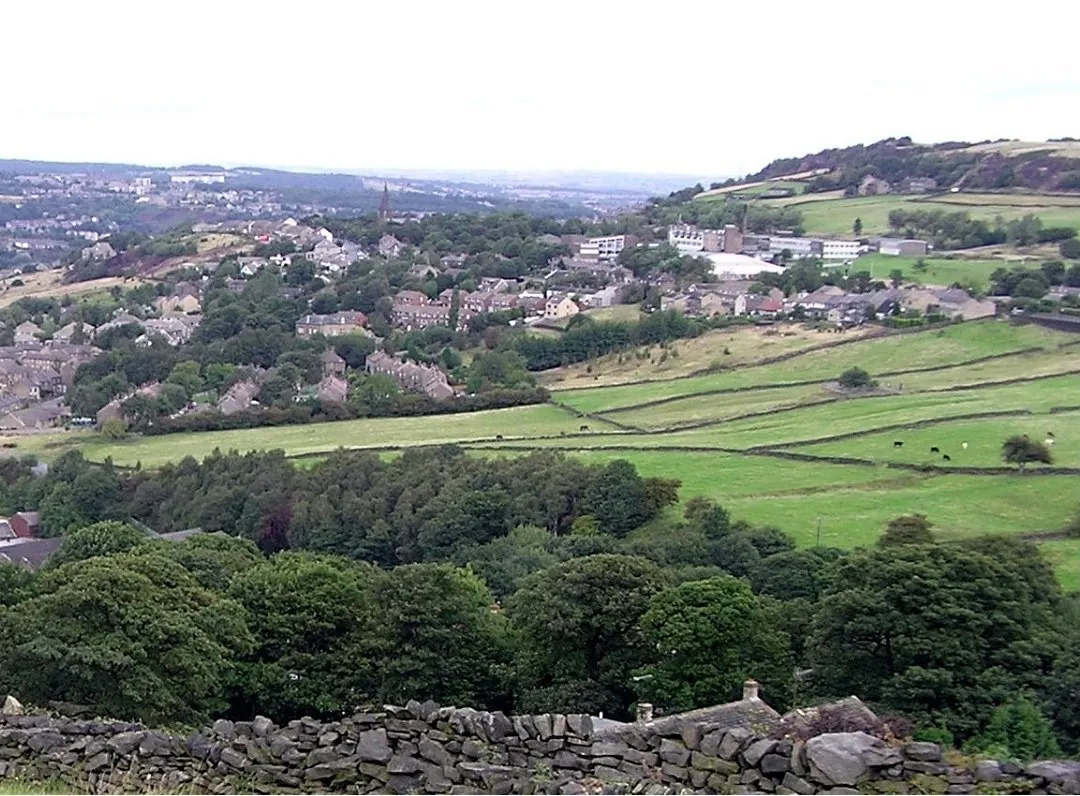
This is a view of the Colne Valley looking from Linfit along the valley towards Slawit and on to Marsden just around the corner in the distance. Bolster Moor is the hill and plateau on the right.
Harold Wilson, who was our prime minister from mid to late 60s and then again in the mid 70s, was born at Warneford Road, Cowlersley. I have devoted a whole chapter to Longwood (Longud) Tower, and the church in the village was where I was married to the lovely Moi in 1966.
I’m sure Crosland Moor and Wellhouse also have a claim to fame but I can’t think of one just now, perhaps that IS their distinction; it is conceivable that nothing has ever happened there. I pass through both villages often on my way to somewhere else and hardly anything happens to me while I am doing so, this is no bad thing of course, and is certainly not meant as an insult, carrying out our journeys without being accosted by the locals is a good thing surely and a reputation of which the good people of Crosland Moor and Wellhouse should be proud.