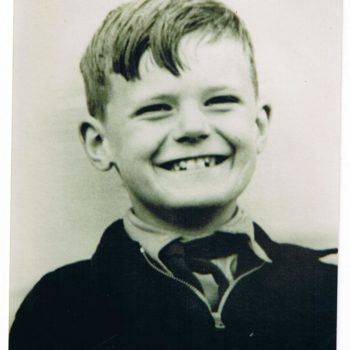

True stories from ‘Norky’ who comes from Scapegoat Hill, a small, isolated farming village, high on the Pennines in West Yorkshire. You can catch up on his ramblings so far via his author page.
My memory of my experiences of childhood in the late forties and fifties is that they were very happy. Children were encouraged to play out, particularly on fine days, which I seem to remember was every day. It wasn’t frowned upon for kids to play in mud, and the consensus was that eating a bit of muck “did em good”.
There have always been mums who insist on cushions and brakes on little Johnnie’s erry cart, but most mums were happy to get them out from under “t” feet. Some of the stories that I’m about to recount may seem to portray parental behaviour that was careless and cavalier, but as far as my mum is concerned, that is far from the case; Mum was very caring and loving.
(By the way, the “t” used above to describe the Yorkshire dialect is a silent “t”. Many people from the outside world and some ‘comersin’ (incomers) will use it wrongly, not knowing the finer points of proper English.)
Families tended to be larger in those days, although gone were the days when many parents had 10 to 14 children. In my generation three to five was more common, which still left me with many other kids to play with, particularly when we moved to the Golcar council estate. There were always dozens of children outside getting up to something. Many if not all of our games were boisterous, and often bordered on violence. The group would split into two warring groups to re-enact some imaginary battle. In winter, when we had proper snow, we would make forts out of the snow and one group would try to capture the fort using snowballs as missiles while the defenders did the same.
We lived in a farming community at Scapegoat Hill and Bolster Moor, which we left when I was seven years old. All the following memories are therefore from before 1955.
As the land in the Colne Valley was hilly and the soil wasn’t good enough to grow anything other than grass, all the farms, as now, were livestock farms – hens, pigs, cattle, sheep and so on. Many practical families also kept their own chickens for regular fresh eggs and meat. Both Mum and Dad were very hard working people. Dad also kept chickens in our back garden and worked on the local farm in his spare time. It was very much an outdoor lifestyle. I often accompanied Dad while he was carrying out his part-time duties and tried to help in my small way. I vividly remember feeling very grown up when Dad allowed me to carry the Tilley lamp (lantern) – a mantle burner fuelled by paraffin – through the fields to check on and secure the hens during the winter evenings.
The farm where Dad worked, at Headwall Green, Bolster Moor, was owned by Israel Newton, a fine name. One of Dad’s duties – this would be around 1950–52 – was to clean out the hen batteries, which consisted of two rows of a two-tier bank of wire gages of about 18-inches square, with the bottom sloping forward so that the eggs would roll to the front for easy collection.
When Dad was milking, he would occasionally give me a glass of milk directly from the cow, still warm, very different from the milk we now get in bottles, although the latter poses somewhat less of a risk to health! The doorway to the pigsty was the scene of a landmark moment, which sticks as vividly in my memory as I’m sure the same achievement does in other people’s: it was where I learned to whistle.
Farming methods were very different in those days. Pigs were fed on any household waste, as well as waste not usually associated with the household, such as from local shops, grocers and butchers. Pigs are not at all fussy and will eat anything. Bones and all went into a large potboiler to be fed to them. I was allowed to stir the pot from time to time – not a pleasant job and none of my wimpy cousins would take their turn with the stirring. However, it was best not knowing what went into the pot sometimes. This practice was eventually outlawed; we have to inform the coroner when granny dies nowadays…
The milking herds of cattle had to be kept in the fields near the farm for regular milking throughout the year, whereas sheep are a hardy creature and were quite happy left to themselves for most of the summer, except when dipping and shearing was required. In winter, they were brought down from the hills and moors to lower pastures and the cattle were housed under some sort of structural shelter. The sheep would shelter behind walls during heavy blizzards, which in turn meant that any snowdrift formed would bury the sheep. When this happened, the farmer had to dig each sheep out by hand, employing as much help as he could.

Another time when help was needed was during ‘hay making’. Mechanical means to cut the grass was now common, but this only consisted of a carthorse pulling a shearing machine. The grass was left for a short period and then stacked upright in small bundles (sheaths) all over the field. In turn, these were then collected on a flat back wagon or sled, pulled by the trusty carthorse. The farm I remember most was my uncle Harold and auntie Zena’s, situated just down the road from Headwall Green. Their carthorse was a huge, gentle Clydesdale called Judy. The Clydesdale was a very popular working breed in those days, quite rare now.
When the grass was dry enough to stack, a convenient place was chosen in the field for the stack construction. One team would fill the flat back, another team would construct the stack. This was very time consuming and constructing a stack that didn’t blow over was a skilled undertaking. These stacks were often 15 feet high. The chap on the flat back tossed the sheaths of hay up to the chap on top of the stack using a pitchfork, hence the name. A pitchfork has two prongs; a four-pronged fork is a manure fork. (I remember a scythe hung at the back of our shed for many years. I never saw it used in anger (it’s a good job). It probably originally belonged to Great Granddad Brown). Eventually the top of each stack was covered with a tarpaulin (waterproof canvas) and weighted down with ropes, either pinned into the ground or with stones tied to the ends, to prevent the stack from getting too wet and also allowing it to dry out slowly. Too wet and the stack would rot; too little ventilation and the stack could catch fire through spontaneous combustion.

Tractors were becoming increasingly popular, and baling machines were hired out to local farms, which bundled the grass into oblong bales, each bail bound by baling band (hairy twine). These bales were much easier to stack and store but had to be manhandled and could weigh as much as 30 pounds or more. People didn’t need the weight training gymnasiums in those days. A day throwing a few hundred of these bales around certainly built up the muscles. Nowadays, after the hay has had time to dry a little, the farmer comes along in a baling machine that automatically bundles it all and wraps it in black plastic without having to climb off the tractor. A very impressive and fascinating machine to watch.

This picture is of another memory of Dad: showing us the finer points of lighting the primus stove. It is similar to a Tilley but instead of a mantle burner, it has an open flame for boiling the kettle on our journeys to the seaside. There were no motorways, of course, so travelling to the nearest seaside town often took three hours or more. There was no stopping at a wasteful cafe for Dad; we had to manage on our own. I’m sure it was also part of the holiday ritual.