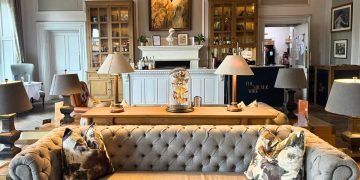
Wortley Hall has two histories, the first concerning the family who built and lived in the hall and the second when it became ‘the Workers’ Stately Home’.
Early history of Wortley Hall
Wortley Hall was the ancestral home of the Earls of Wharncliffe – the lords of the manor of Wortley. The earliest recording being for Alnus de Wortley, mentioned in the Pipe Rolls for 1165. During the English civil war of 1642–51, Sir Francis Wortley commanded a loyalist garrison based at Wortley Hall.
Wortley Hall fell into decay until the mid-18th century, when Edward Wortley commissioned the rebuilding of the hall. In 1800, James Archibald Stuart Wortley and his wife Caroline Creighton should have taken up residence, but were unable to do so because for some reason the architect had omitted to include a staircase.
The second world war and post-war period
During the 1939–45 war period, parts of the hall were occupied by US and British armies. But, after 1945, the hall once again fell into a state of disrepair and the family finally moved out.
In 1949 Wortley Hall was on the market. Vin Williams, a lecturer with the National Council of Labour Colleges – later to become the Workers Education Association (WEA) – immediately began making enquiries because for a number of years he had the belief that the working class should own such a building for use as an education and holiday centre.
Williams approached the Sheffield district committee of the Amalgamated Engineering Union (AEU) and convinced the committee to get involved and, as a result, a provisional committee was formed.
Following negotiations with the Wharncliffe Estates, an agreement was reached, which became effective from September 1950, under which a lease was granted with a rent of £50 for the first year and £500 a year thereafter, with a lease period of 14 years.
National appeal to trade unionists
In June 1950 a national appeal was launched to raise the necessary money to convert Wortley Hall into an educational holiday centre. Ten thousand circulars were sent out to trade union branches and district committees, co-operative guilds, ward and constituency labour parties, shop stewards committees and so on, inviting the organisations to take out one-shilling shares, to make donations or to sell tickets for a draw on the 1950 St Leger.
The response was quite amazing — a profit of £1,300 was made on the St Leger draw and applications for one-shilling shares poured in from individuals and organisations of all types, from all parts of the country.
With this fine response, Williams and the provisional committee knew there was widespread interest in what they were doing, and that gave them inspiration to carry on. The next step was to start the job of converting Wortley Hall into an educational holiday centre.
Converting a semi-derelict building
This was no easy task. It had not been occupied for three or four years, had been terribly neglected and was in a semi-derelict condition. The task of conversion was formidable. Building surveyors who were brought in to advise on the cost of conversion estimated that between £40,000 and £50,000 would have to be spent to do the necessary works. This sort of expense was beyond the wildest dreams of the provisional committee, the only way to do the job was to buy the necessary materials and get volunteers to come and do the work.
Undaunted, the committee appealed in local workplaces and the response was terrific. Engineering workers, miners, railway men, foundry men, builders, labourers, housewives, people from all walks of life, trades and professions volunteered their services due to a shared belief in the ideals of creating a ‘home for the labour movement’. From September 1950 to 5 May 1951 – when the hall was officially opened as Labour’s Educational Recreational Holiday Homes Limited (the use of the name Wortley Hall being prohibited by the owners, Wharncliffe Estates) – the hall was a hive of activity as the workers poured in their skills and enthusiasm in cleaning, renovating and converting Wortley Hall.
Wortley Hall grand opening and a fine start
The hall was opened by Frank Soskice QC MP, Member of Parliament for Sheffield Neepsend, who later became Lord Stow Hill. Hickleton Main Colliery Brass band and Scunthorpe Ladies Choir provided the entertainment.
Approximately 3,000 people turned up to the opening celebration to give the venture their best wishes. To get some measure of the amount of voluntary labour given to the venture, the full capital outlay in converting, furnishing and fitting out the hall was £10,000 and not the £40–50,000 estimated by the professional advisers.
In 1954 the organisation was asked if it was interested in purchasing the property. Negotiations took place and it was finally agreed that the hall, together with six cottages and approximately 28 acres of land, would exchange hands for £10,000.
Room names reflect trades union support and Labour leaders
On 28 October 1959, Labour’s Educational Recreational Holiday Homes Ltd was established.
Several trade unions adopted rooms — the Fire Brigades Union and AEU did so, and one lecture room was named after Henry Collins, an Oxford University lecturer in economics who lectured to the Foundry Workers Union. The lecture room has since been renamed the Unison Room.
More recently we have had rooms named for the Associated Society of Locomotive Engineers and Firemen (Aslef), the Stewart Charnley Room, Sylvia Pankhurst Library, the National Assembly of Women Room and the Unite Ballroom.
The bedroom wings were named after labour movement figures including Keir Hardy, Robert Owen, Tom Mann, George Lansbury, Abe Moffat, Vin Williams, Harry Johnson and the first secretary of Wortley Hall, Alf Hague. He, his wife Marion, and son Richard all worked at the hall for many years,and the bedroom wing was named after them in respect of the good work done for Wortley Hall for many years.
Wortley Hall is a Grade II listed building. It is owned by its shareholders with each shareholder – organisation or individual — having one vote at the general meetings, irrespective of the number of shares they may hold.
More from Yorkshire Bylines: