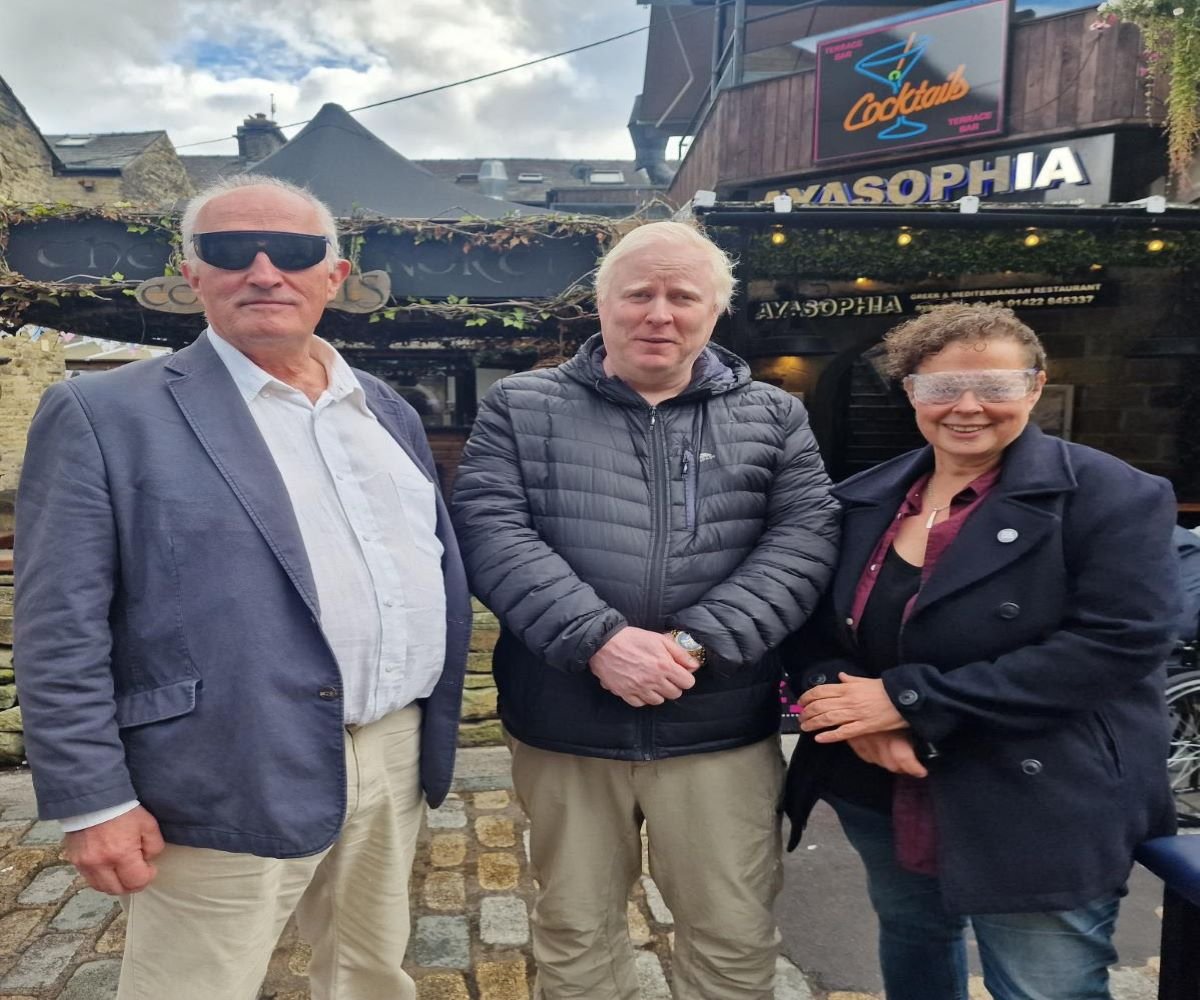
Representatives of Calderdale Council, Hebden Royd Town Council and Business Forum got first-hand experience of what it’s like to be blind walking through Hebden Bridge. Organised by West Yorkshire Sight Loss Council (WYSLC), the walk aimed to highlight the ongoing issue of pavement obstacles which cause obstructions for blind and partially sighted pedestrians, as well as the wider community.
The Royal National Institute of Blind People (RNIB) estimates that around 2 million people in the UK are living with sight loss, and within that, 340,000 are registered blind or partially sighted. Last year, the RNIB conducted research and subsequently published their ‘See Streets Differently’ report, which found that there were a number of issues limiting blind peoples’ ability to make walking journeys confidently.
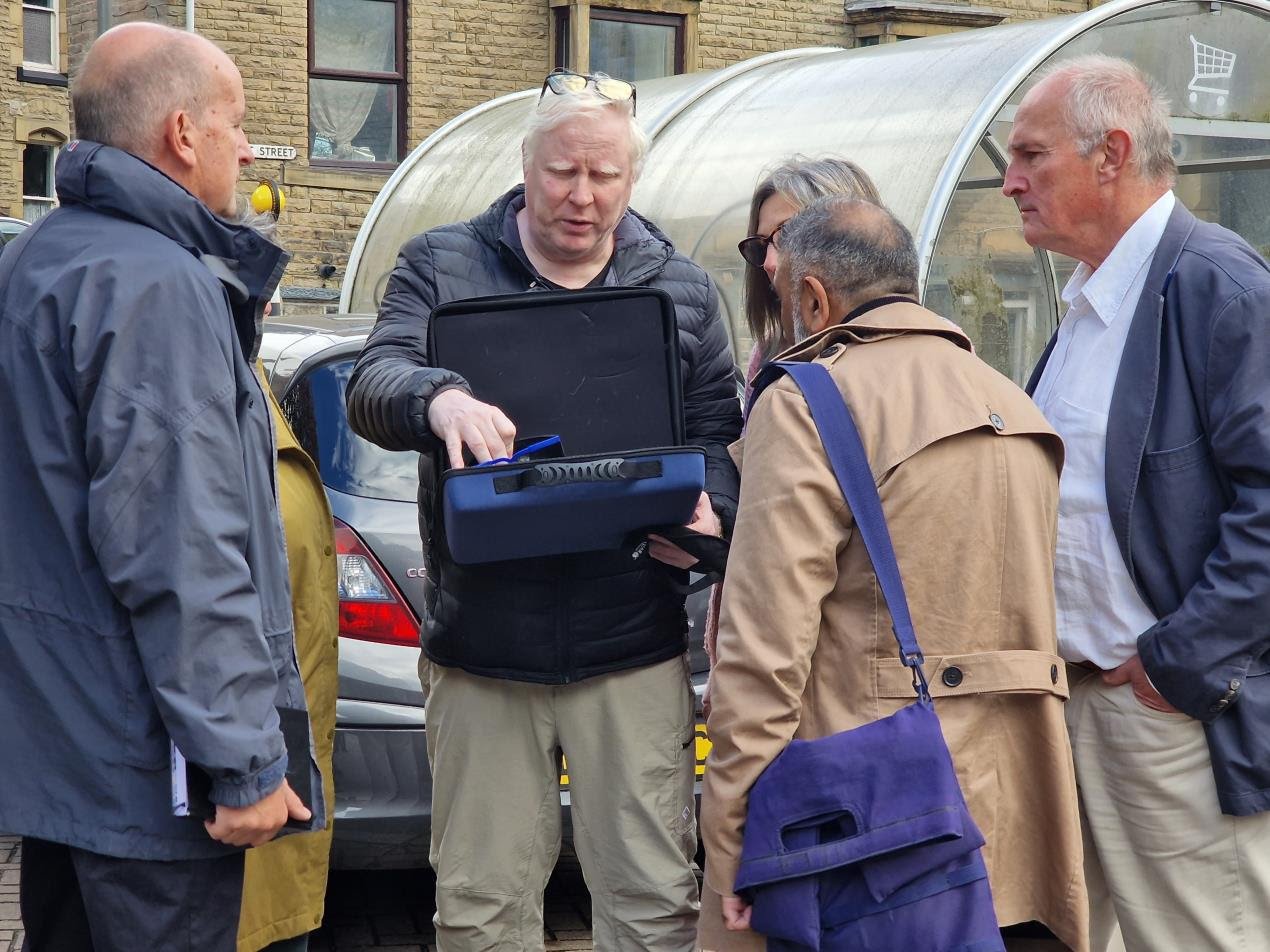
Sim specs: a window to an alternate world
To enable them to empathise with those who are blind and partially sighted, people taking part in the guided walk wore simulation spectacles, designed to mimic the effects of various sight conditions.
The guided walk was led by WYSLC and supported by RNIB and Halifax Society for the Blind. WYSLC is funded by Thomas Pocklington Trust which is led by blind and partially sighted members. Together, they tackle local issues and work with businesses and service providers to improve the accessibility of their services.
The main issue the walk aimed to highlight was the number of obstacles which blind and partially sighted people have to navigate such as street furniture, advertising boards, bins, pavement parking and new street designs.
The experiment will further inform Calderdale Council’s launch of a new advertising boards (A-boards) licensing policy to help make streets more accessible. Current proposals include a trial ban of A-boards being put out onto the streets in the centre of Hebden Bridge.

An eye-opening experience
Those who took part were quick to praise the exercise. Colin Hutchinson, councillor for Skircoat in Halifax said:
“The experience of trying to navigate using the simulation spectacles makes you realise just how much harder it is to do something we can so easily take for granted. You have to look around for hazards and obstacles to negotiate them. It is particularly challenging when there is a combination of hazards like kerbs, other people and crowded pavements with obstacles such as A-boards.”
Alison Bartram, owner of Heart Gallery and member of the Business Forum, added:
“I wore the macular degeneration glasses. This helped me to understand what my dad has been experiencing for many years. It was quite scary and quite moving. It also made me realise how difficult it must be for anybody who is blind or partially sighted, or who has mobility problems, to navigate the streets.”
It’s hoped this exercise will raise awareness of the obstacles faced every day by those who are blind and partially sighted and will help the push towards more accessible pavements across the country, but particularly in West Yorkshire.
If you are blind or partially sighted and want to get involved in tackling local issues, or know somebody who is, West Yorkshire Sight Loss Council is currently recruiting new members. Learn more or come join and us at www.sightlosscouncils.org.uk/west-yorkshire-sight-loss-council.