At every general election, we choose who we want to represent us at a national level. The party with the most seats in parliament since 2010 – and therefore the party of government – has been the Conservatives. A good government should make every effort to make the country better and improve the lives of everyone who lives there. With all the negative headlines recently, it’s worth taking a detailed look to see exactly what’s improved and what still needs to change.
Let’s examine some key areas of national life that any government needs to get right if it’s going to provide a decent life for its citizens. Where possible we’ll measure the UK against other comparable nations.
The economy
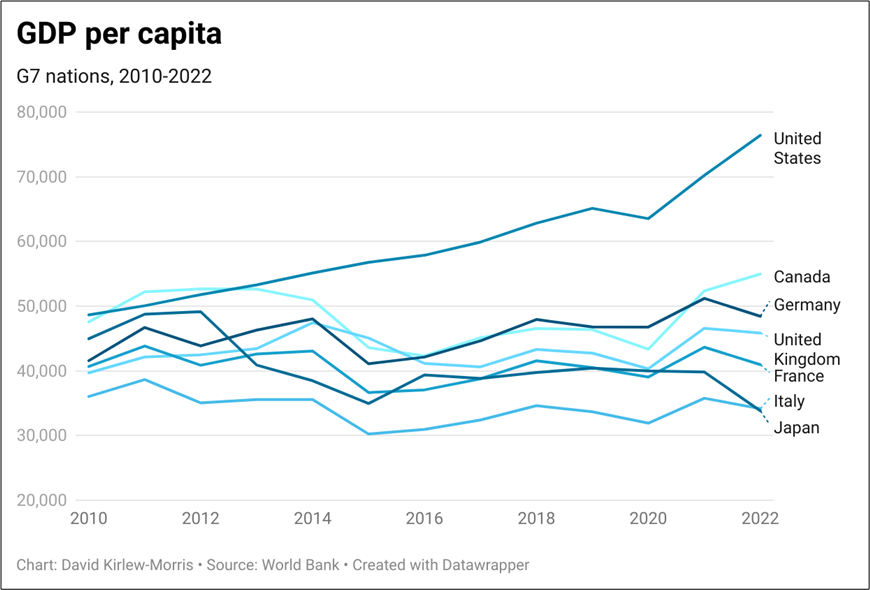
Some reports suggest that, since the start of the pandemic, Britain has had one of the poorest performing economies in the G7. The pandemic took a toll on everyone and it’s true that the UK saw a significant drop in economic activity. World Bank figures show that Canada was the only G7 nation to see a bigger economic contraction than the UK from 2019 to 2020. But that isn’t the whole story. Comparing 2020 and 2022, you can see that the UK had the third best recovery. In 2010 we had the sixth best GDP (gross domestic product) per capita amongst this group of nations, but 2022 saw us in fourth.
What about poverty levels? ‘Extreme poverty’ is currently defined as living on less than $2.15 per day (£1.65). Comparing our performance against other nations is difficult given that fewer nations disclose this information to the World Bank (‘Blanks’ in the chart below). However, there are fewer nations worse than us and more who are better. Some 0.2% of the UK population were in extreme poverty when the Conservatives came to power in 2010. The figure rocketed to 0.5% between 2018 and 2020 (leaving us in the company of countries like Malta and Armenia). Although the World Bank hasn’t had information since then, the UN Special Rapporteur on poverty has repeatedly condemned the UK government’s approach.

There’s also relative poverty to consider. Assuming housing costs are taken into account, 20% of people in the UK are currently in relative poverty. Since the Conservatives came to power, the number of children in relative poverty has gone from 27-28% to 35%. This is absolutely unacceptable and sets future generations up to fail.
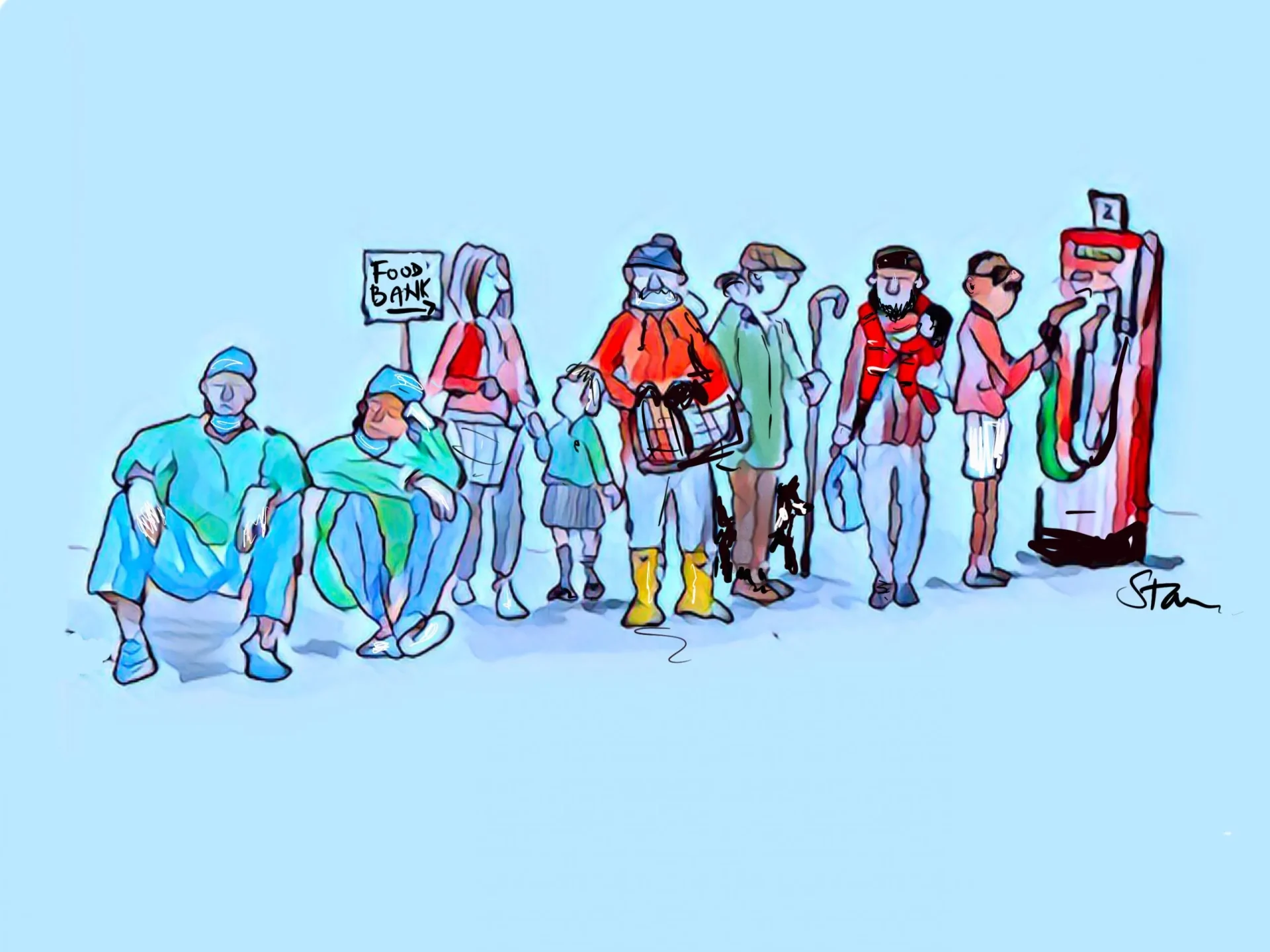
Food poverty deserves a look. Around 2010, The Trussell Trust had 35 food banks and delivered 61,000 food parcels in. Recent figures show deliveries from 1585 locations and around three million parcels. There are also (at least) 1,172 independent food banks, making a total of at least 2,700 across the country.
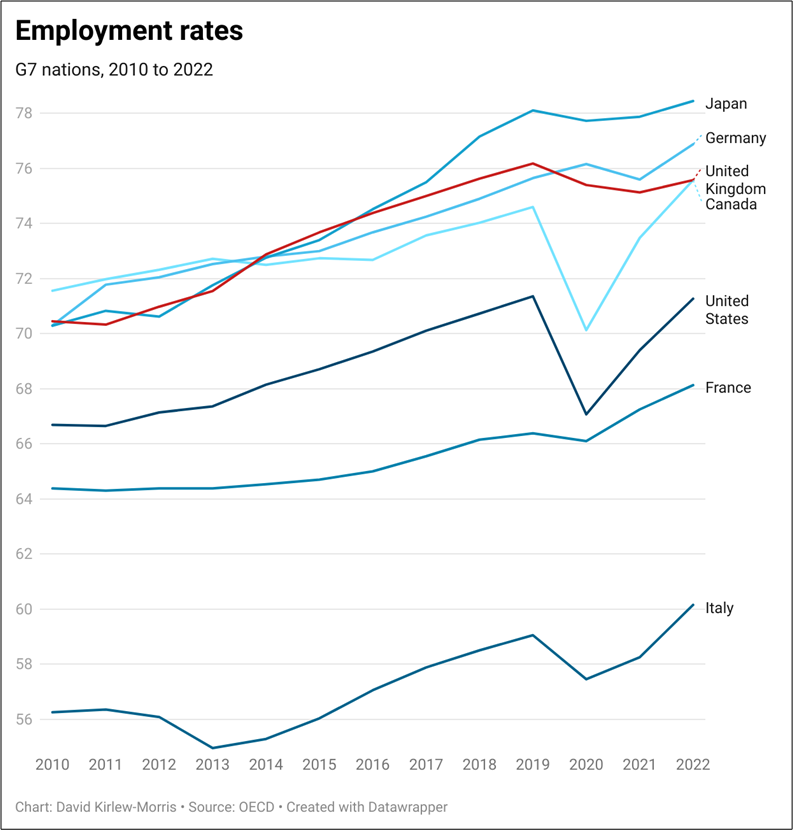
What about employment? As we can see from the graph below, employment rates have been increasing since the pandemic and have improved significantly since 2010. Amongst the G7 nations Britain has seen the third biggest percentage increase in employment in the period. Low Pay Commission (an independent government advisor) data shows the percentage of people in low paying occupations has gone down by 6.2% since 2014.
Unfortunately, in the same period the cost of many things has increased vastly. According to the Bank of England, goods and services that would have cost £100 in 2010 now cost £147.62. As we all know, utility bills are significantly higher, with the price cap consistently being changed. Mortgages are also going up – particularly since the era of Trussonomics (in my day job in local government I have heard of monthly payments of between £2,000 and £3,500). A job alone – even one that doesn’t fit the current definition of low-paid – doesn’t necessarily solve the problem of spiralling costs.
Crime
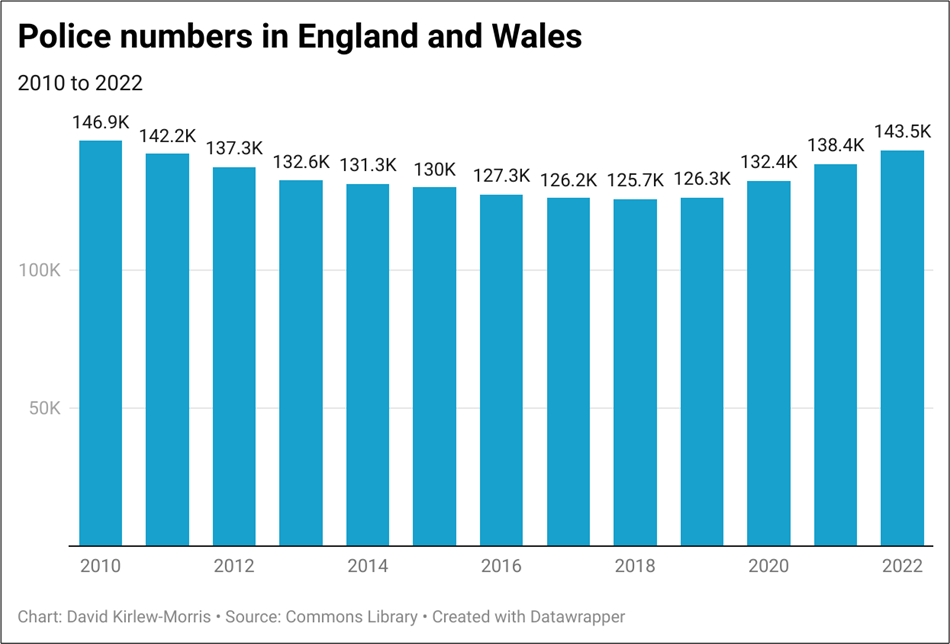
It’s often said that there aren’t enough ‘bobbies on the beat’. 2018 was the lowest point for police numbers, with just 126,300 serving officers. After eight years of initial cuts, the Conservatives have just about brought the officer numbers back to where they were under Labour 13 years ago.
The prisons numbers are woeful. A staggering 73 prisons are over capacity, with the overall figure for the system at 110%. In other words, the system cannot cope with the number of prisoners, which stands at some 849 more than in 2010 (and that number has been higher). The proportion of prisoners reoffending has actually gone down from 31.3% in 2010 to 25.4% in 2021, but the reoffenders commit more crimes.
Courts spending is £0.6bn lower compared to 2010, but the number of cases received by magistrates courts is at similar levels to 2012 and has been on the increase since the start of the pandemic. Case backlogs are far higher for the crown court than they ever were up to 2010.
Disability
The way disabled citizens are treated is a key measure of the overall health of a nation. Parliamentary briefings show the number of disabled people in the UK has steadily risen since 2010. There are currently around 16 million (over two million more than the total vote for the Conservatives at the last general election). On a number of measures, the Conservative government has failed this section of our community.
The building of adapted and accessible homes has not kept pace with need. The severe lack of occupational therapists has led to numerous delays in awarding vital grants for adaptations. I’ve previously reported on the lack of funding for the 12 million in this country with hearing loss. There are numerous stories of targets for rejecting PIP claims, even if disabled people were eligible for that important money.
People like my own wife (whose condition isn’t going to improve) are still subject to regular stress-inducing reviews to check for eligibility. The DWP – a department meant to help the most vulnerable in society – has been reported as having toxic environment. On top of that, Conservative MPs routinely vote for reductions in welfare benefits. The government’s own National Disability Strategy was also declared unlawful.
Benefit spending has gone up over the years and there has been periodic investment in some schemes, but evidence shows that still nowhere near enough is done to support a huge section of the population and not enough action to combat negative attitudes disabled people face on a daily basis.
Other things to consider
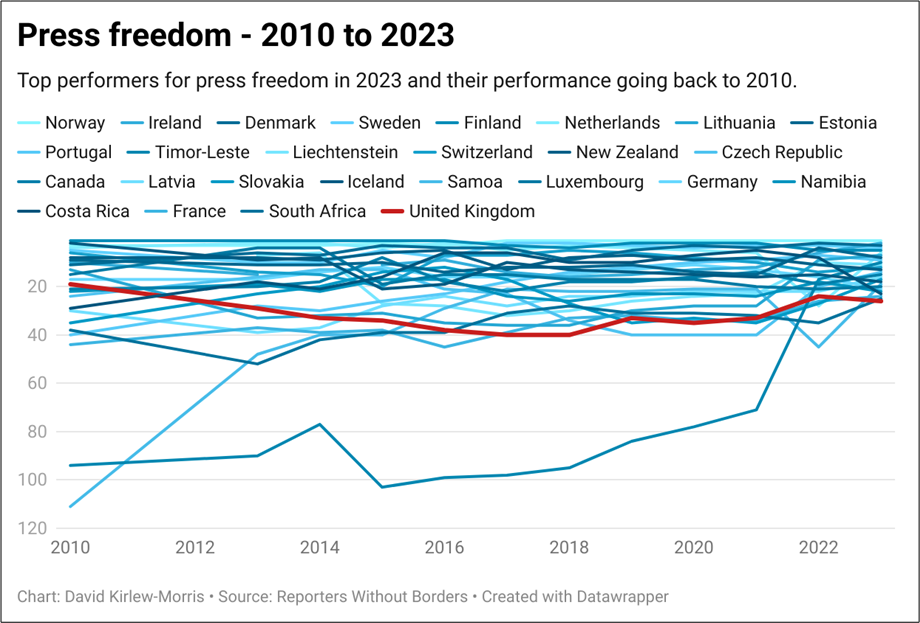
There are other areas of government responsibility which add to this generally gloomy picture of the current state of the UK. Take the freedom of the press, a fundamental aspect of any healthy society. The chart shows the highest performers for press freedom from 2010 onwards. The UK (red line) experienced a consistent decline from 2010 to 2018. Although there was a brief improvement, we are declining again. Nations such as Costa Rica, Samoa (111 in 2010!), Timor-Leste, and Namibia are ahead of us.
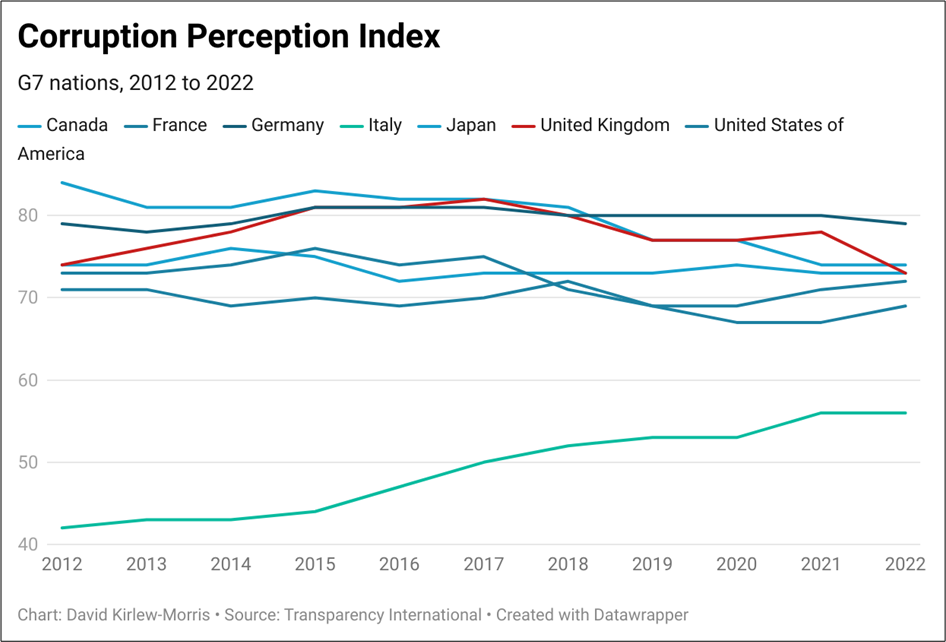
And how about outright graft? Scandals with PPE, the Owen Paterson affair, and so much more have led to accusations of government corruption. It’s worth mentioning that we are far from the worst. However, our score (and rank) is lower now than it was in 2012. The likes of Hong Kong, Iceland and Uruguay are currently ahead of us, but we are joint third amongst the G7 nations.
Add to that:
• A housing crisis that saw a net loss of 165,000 social homes between 2012/13 and 2021/22, with 1.2 million people currently on the waiting list for social housing and £1.6bn spent on temporary accommodation in 21/22 alone
• The amount of council tax received has increased, but overall funding for local authorities has decreased, leading to reduced staffing and restricted services
• Brexit
• More working days were lost to strikes under the last Labour government, but the Tories saw the two highest peaks in strike action. January to October this year saw only slightly fewer days lost than in Labour’s first five years
• NHS spending has been noticeably lower than under Labour
• From 2010 to 2019, almost 800 libraries were closed
• A drop of 4% in funding per pupil from 2010/11 to 2022/23, despite very high, sustained inflation
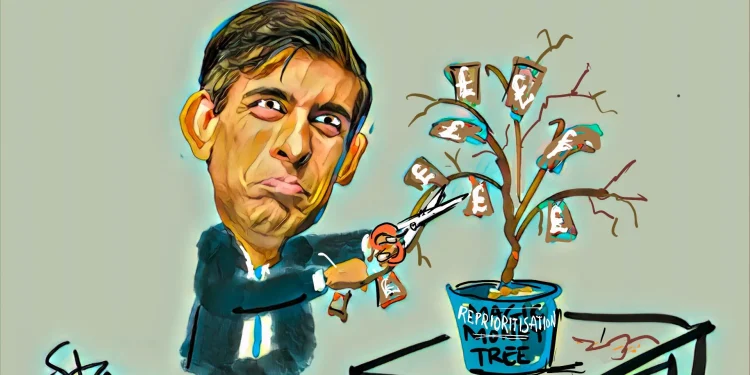
• Environment expenditure went up significantly since 2010, but only by 0.1% as a proportion of GDP, and Rishi Sunak has been accused of watering down measures to combat climate change.
So, are we better off?
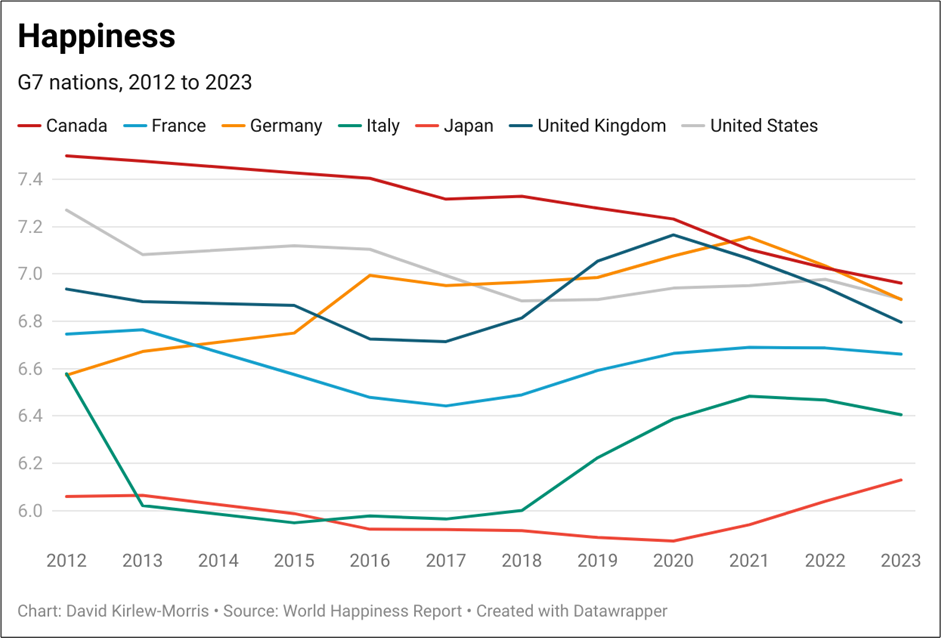
The people of the UK aren’t the unhappiest in the G7, but it’s undeniable that we are worse off in many areas. Economic performance may be better than some critics say, but in areas such as crime, disabilities, and local government things are distinctly worse. Austerity has taken its toll and people are suffering. 2024 will see another general election. It will be interesting to see if this decline will have an effect on the outcome. The polling suggests it will.