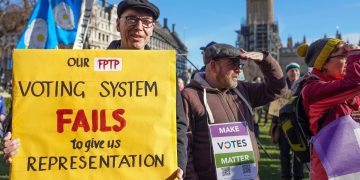
During the party conference season, the campaign group Make Votes Matter (MVM) distributed postcards for people to send to their MPs, asking them to support a change to the voting system. As they say on their website: “Our broken voting system cheats most voters and Parliament doesn’t reflect the way we voted. The UK is in crisis – to address this we urgently need to make seats match votes, with a good voting system, chosen by the people. Most people and parties agree.”
So I sent one to our new MP for Wakefield, Simon Lightwood. I believe from a social media post he made some years ago that he supports the principle of fair votes. In 2011 he posted on Twitter that he had voted for AV, or Alternative Vote, saying it was “Not perfect but step in the right direction”:
Granted that was over ten years ago, but one can hope that a belief in fair votes doesn’t simply disappear the day you take office.
Fair votes via proportional representation
The importance of electoral reform is widely acknowledged. The UK is one of very few countries in the world to still use a ‘first past the post’ (FPTP) winner-takes-all electoral system to elect MPs. Using this system, MPs often get elected despite the majority of their constituents preferring one of the other candidates. As MVM say:
“For about 90% of the time since 1935 we’ve had single-party ‘majority’ governments, but not one of them had the support of a majority of voters. The Conservatives currently hold a majority of seats with just 43.6% of the votes. In the 2019 election they gained an extra 48 seats despite an increase of only 1.2% of the vote share.
“Almost since the first general election, politicians who most of us didn’t vote for and don’t agree with have had the power to govern the UK however they like.”
A more democratic way of electing MPs would be a form of proportional representation whereby each of our votes is worth the same, so that our parliament can be representative of those votes. At the last election, a Scottish National Party MP was elected for every 26,000 votes, whereas over 800,000 people voted Green, resulting in just one MP, Caroline Lucas.
Response from Simon Lightwood
This is the response I received from Simon Lightwood:
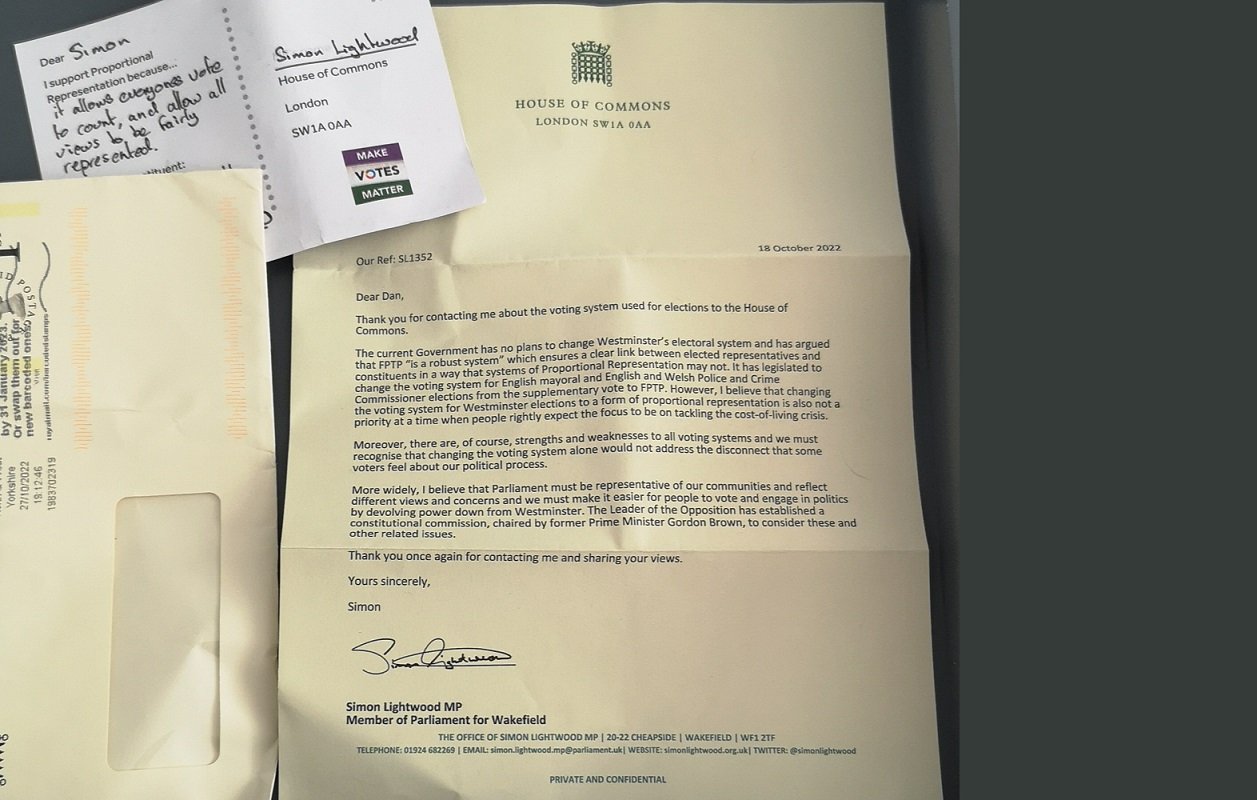
His letter is full of oxymoronic reasons for not supporting a change to the voting system. Is this genuinely his belief, or is he simply toeing the party line?
It is a shame that Labour cannot see the benefit of moving away from FPTP, a system that will always benefit the Conservative Party as the major right-wing party over the slightly more fractured left-wing parties.
Analysis by the Electoral Reform Society shows that in the 2019 general election, of the 32 million votes cast, 14.5 million (45.3%) were for candidates that didn’t win, and 8.1 million (25.5%) were for winning candidates in ‘safe’ seats, where these additional votes weren’t needed. “All in all, over 22.6 million votes (70.8%) did not contribute to electing an MP.”
Over 22.6 MILLION. How can that be a ‘robust system’ that Lightwood seems to support? When only three in ten votes are reflected in the lower house, surely anyone – regardless of their political colours – can see that our democracy is broken.
Moreover, Lightwood also states that the “voting system alone would not address the disconnect that some voters feel about our political process”. Surely he must have written this with a huge dose of irony!

Weak and unstable system
Lightwood points to the fact that people “rightly expect the focus to be on tackling the cost-of-living crisis” and I agree; who wouldn’t? But anyone who has witnessed British politics over at least the last six months (six years even) can see that FPTP has hardly delivered the ‘strong and stable’ leadership that would be needed to solve it. Nor can it be argued that a Conservative Party with a majority of seats on a minority of votes is ever likely to take the action needed to help those most at need in this crisis.
If we had a system that relied on making agreements across a wider section of the political spectrum, as most of the rest of the world is capable of managing, then we would probably have avoided crashing the economy.
What Simon needs to say to Sir Keir Starmer is this:
Support a move towards PR when the Labour Party gains power at the next general election, and it will prevent the country from ever having to suffer at the hands of the Tories in this way again. Work with parties that are close and encompass a wider range of views, because that is truer, fairer democracy.