You could probably list many things that significant numbers of English children are missing out on. You might start with healthy food, with ultra processed pap comprising up to two-thirds of children’s diets, from infants to adolescents, with fruit and vegetables on average making up a tiny fraction of the levels needed for optimal health.
Then you might add in clean air, with air pollution in almost all UK schools above what the World Health Organisation regards as safe limits.
Certainly on my list too would be a broad and rich education, trapped, as so many schools are, in the exam factory treadmill that crowds out any space for creative education and preparation for life.
Crucially, lack of play might not be something that immediately springs to mind, but there is overwhelming evidence that this activity – essential for physical and mental health, vital for the development of mind and body, offering important steps to the flowering of social skills and independence – is being squeezed out of children’s lives and living environments.
The hidden erosion of safe and accessible play areas in England
The sell-off of playing fields and closure of swimming pools is well-documented, but less noticed is the way in which informal play spaces and child-friendly public spaces are often overlooked or treated as expendable; many communities just don’t have accessible, safe places for play.
In some areas they too have been sold off or packed with “in-fill” homes. Some places – scattered with drug paraphernalia, choked with litter – are far from safe. And, of course, the streets which not so long ago were one big playground for children have been taken over by cars.
The government has acknowledged the issue. In the House of Commons, the relevant minister said: “The Government agree that access to play space is vital”. But then he added “which is why strong protections are already in place”. Which is demonstrably incorrect.
As Eugene Minogue from Play England puts it: “Seventeen years without a national commitment to play is nothing short of a generational failure. Millions of children have grown up without the opportunities, experiences and support they should have had.”
Learning from Wales and Scotland: why England needs a national play strategy
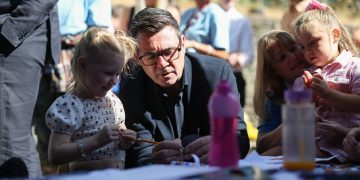
The Labour Party actually has decent form on this. In 2008, Ed Balls and Andy Burnham, then secretaries of state, got into the swing (yes it is a very awkward picture from the early days of social media) at an adventure playground in south London. That was to launch a national play strategy in England. But then two years later the coalition government came in and threw it out.
Wales and Scotland – stepping ahead of England on this issue as they do in so many matters of public and environmental health – have enacted play sufficiency legislation. In Wales, local authorities are legally required to assess and improve play opportunities, while Scotland’s law integrates play issues into local development plans, with a focus on child-friendly neighbourhoods.
And today, I’ll be putting forward an amendment to the planning and infrastructure bill that would introduce a play sufficiency duty for local planning authorities, re-tabling an amendment positively debated, but not voted on, in the Commons.

How a play sufficiency duty could transform local communities
If this becomes law, local authorities will have to regularly assess and report on the sufficiency of play opportunities in their area, adjust local plans and infrastructure strategies, consult with children, families and communities about what provisions they need and want. Most crucially of all, authorities will be required to protect existing play spaces and mandate that new developments have quality play areas.
This is not of course a panacea. Play England is also calling too for a play strategy: they’d be a need to make sure those spaces were truly accessible to all.
And the Green Party could add in lots of ideas, like starting formal schooling later (as most of Continental Europe does), allowing more time for the youngest children to learn through play, demonstrably more effective than corralling them into regimented behaviour too young. And making the four-day working week as standard for their parents and carers, so they would have more time and energy to play with their children themselves, and ensure they have the time to play and interact with others.
Play as a child’s right: addressing inequality and missed opportunities
A final thought: Article 31 of the UN Convention on the Rights of the Child guarantees every child’s right to play. Yet on this provision – as on far too many others (see lack of protection from assault, the so-called smacking ban as one prominent example), we’re failing to meet this international commitment.
Think of a child trapped in temporary accommodation – some 165,510 of them – frequently bed and breakfast accommodation, without any kind of provision for play. Or the young carer, forced to put play aside and grow up too fast to support a relative not receiving the social care they need – some 120,000 of them. Or the 4.5 million children in poverty, to whom the many privatised spaces where spending money is an explicit or implicit requirement for entry, are denied.

Subscribe to our newsletters
Each of our Bylines sends a newsletter every month and we also send out a ‘Best of Bylines, featuring a selection of the best articles from across the network