As COP15 quietly comes to a close over the next few days, you might be forgiven into thinking that this biodiversity conference was a meaningless one. With no government leaders flying in for a quick photo-shoot, the amount of media attention has been poor.
What is COP15?
Since 7 December, delegates from around the world have gathered in Montreal to agree on targets to stem the horrific decline of biodiversity and loss of nature. The conference aims to ensure protection for 30% of the planet by 2030 – the ‘30×30’ pledge – as well as the redirection of subsidies which actively continue to destroy nature. While COP27 focused on climate change and global targets, COP15 is focused on biological diversity.
This conference was originally scheduled for 2020 but was delayed owing to the global pandemic. The last time the Conference of the Parties (COP) met was in 2015 in Japan. Since then, many of the pledges and targets have been missed, meaning that the importance of COP15 has been heightened. It has now become a once-in-a-decade opportunity to halt the destruction of the natural world.
A mass extinction event
The ‘Living Planet Report’ for 2022 announced shocking statistics on species decline. It revealed that “global wildlife populations have plummeted by 69% on average since 1970”. And that “The staggering rate of decline is a severe warning that the rich biodiversity that sustains all life on our planet is in crisis, putting every species at risk – including us”. Although this report’s findings, rightly captured the public’s attention, it was sadly too easily accepted with a resigned shrug by the public, with a dismissive ‘Oh, that’s terrible’.
The importance of COP15 has been emphasised in the last few days by Tony Juniper, chair of Natural England, who stated that:
“The next few days couldn’t be more significant in laying the foundations to avoid what is potentially a mass extinction event.”
Additionally, this week has seen the publication of a UK survey, produced by Kent Wildlife Trust and ‘Buglife’, which found that flying insect numbers have plunged 64% since 2004.
Dave Goulson, Professor of Biology at the University of Sussex, also highlights the complexities and complex nature of food chains in his book Silent Earth – Averting the Insect Apocalypse, 2021. He notes that:
“Their declines are a sign that the fragile web of life on our planet is beginning to tear apart.”
Goulson continues in his book to emphasise the range of species loss:
“A feature of this new era in Earth’s history is the accelerating decline of biodiversity: the loss of wild animals and plants and of whole communities of organisms.”
He makes the point that this is not just an issue for academics, scientists and insect hobbyists, but that the decline of insects and biodiversity has far-reaching implications, as humanity is reliant on healthy ecosystems.
“The decline of insects is terribly sad for those of us who love these little creatures and value them for themselves, but it also threatens human well-being, for we need insects to pollinate our crops, recycle dung, leaves and corpses, keep the soil healthy, control pests, and much, much more. Many larger animals [such] as birds, fish and frogs rely on insects for food. Wildflowers rely on them for pollination. As insects become more scarce, our world will slowly grind to a halt, for it cannot function without them.”
Dr Karen Meusemann, from the Leibniz Institute for the Analysis of Biodiversity Change in Germany, stressed to me that:
“The main threat to biodiversity is the unchecked loss of global biodiversity which threatens our basis of life, and all of humanity. Humans are using natural resources beyond their capacity limits and continue to rely on an economic order that allows us to take advantage of the diverse ecosystem services at no cost. We destroy natural resources, including biodiversity, thereby endangering our own future.“
Despite all these varied sources screaming passionately about biodiversity loss and the impact on humans, the message of necessary urgency and action is not being vigorously matched in the media.

Biodiversity or climate change?
The challenges of addressing the intertwined present challenges of climate change and the biodiversity crisis need urgent attention. It has been noticeable that the media attention for COP15 has not been anywhere near as prolific and informative as that of COP27.
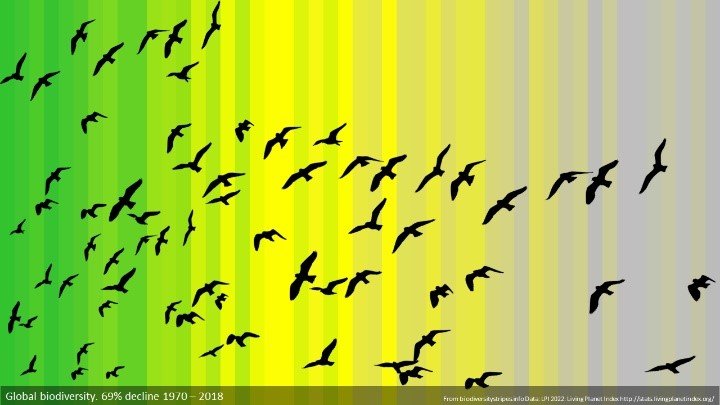
As an issue, climate change has its public champions and activists. Indeed, it is suggested that climate change has been found to get up to 8 times more coverage than biodiversity loss. This perceived imbalance has been tackled by Miles Richardson, who has created the ‘biodiversity stripes’ to emulate the success of the climate warming stripes by Ed Hawkins. The biodiversity stripes show the variety and abundance of nature over time from greater in green to less in grey.
Dr Meusemann also highlighted the disparity in media attention between the climate and biodiversity crises:
“There is a high need to pay much more attention, in the media, in politics, economy and in society on the biodiversity crisis and the aim to overcome the crisis next to the climate crisis because they are indivisibly interconnected. We need learn to think about the climate and biodiversity crisis together and need to champion solutions considering both crises.“
What happens if no progress is made?
As with COP27, political manoeuvrings may mean that the once-in-a-decade opportunity to achieve ambitious outcomes may be lacking at the summit. There are competing priority issues from countries and while the UK itself has set a ‘high priority’ for ‘Halting and reversing biodiversity loss by 2030’ and ‘Halting human-induced species extinctions by 2030’, it also opposes a ‘Global Biodiversity Fund’. Financial responsibilities, just like the ‘loss and damages’ compensation pressure at COP27, threaten to divide negotiating countries, with a group of developing countries walking out of discussions recently.
Dr Meusemann argues that prevention strategies will be financially more effective in the long-term:
“Nature-based solutions properly planned and implemented, are cost-effective and offer multiple benefits for nature, the climate, and humans and can make an important contribution to climate protection.“
The urgency for transformative change appears to be missing from the summit and it may be that with the conference closing in only a few days’ time, the issue of finance will once again be the sticking point. With Christmas on the horizon shortly after the end of the summit, any announcement on new proposals and pledges will be hard pressed to cut through to the public. Awareness and momentum will once again be lost.
An opportunity for optimism?
On the other hand, Professor Goulson, though acknowledging the scope and urgency of the biodiversity crisis, offers practical solutions in his book to help avert the worst outcomes and suggests that these solutions can happen anytime and are not wholly dependent on summits. He outlines opportunities for everyone, as well as for local and national governments.
“While time is running out, it is not yet too late to save the day. Our insects need your help. Most have not yet gone extinct, and if we just give them some space they can recover swiftly, for insects can breed fast.”
Dr Meusemann also agrees that transformative behaviours from individuals, as well as organisations and government, could help mitigate against the worst eventualities:
“We – everyone – can do a lot also in our daily lives by simply changing our way of life to a much more sustainable way, for example, by maintaining biodiversity in urban regions, on our terraces, balconies and gardens. By reducing our consumption, changing our diet by heavily reducing eating meat, changing to green public transport and ways of mobility, we allow opportunities for biodiversity to flourish. More simply, allowing much more nature in everyone’s lives will be hugely beneficial.“
The fate of the natural world lies in our hands. Sadly, we may be too selfish and immature to handle such a responsibility. Instead of demanding huge amounts of media attention and putting pressure on our political representatives, we have allowed ourselves to be distracted by ‘Harry and Meghan’, or by Elon Musk’s latest escapades. Or by which football team has lost or won a game.
At the end of Arthur C Clarke’s classic story The Nine Billion Names of God, which may be read as a metaphor of connecting with life that is larger than us, there is the poignant sentence: “Overhead, without any fuss, the stars were going out.”
With a biodiversity focus – “All around us, without any fuss, multiple species are dying out – and we are responsible.”
Alternatively, we can choose to be responsible for preserving what remains of a precariously balanced web of life. In so doing, we preserve a future for our children, grandchildren, all coming generations, and all of the vast network of life held in a fragile, diminishing natural world.
It’s an hour before dark – this choice we must make now.