
Last year, I wrote an article called ‘The dark arts of MAT management’, in which I raised a number of questions relating to the imposition of multi-academy trusts (MATs) upon England’s state school system. At this point, it seemed reasonable to ask why large numbers of MATs were introduced so quickly in England, when many questions had been asked about similarly managed charter schools over many years in the USA. Fiona Millar briefly explains this process in her 2019 Guardian article ‘Gove and Cummings honed their dark arts’.
The MAT concept is drawn from an organisational structure for administering schools in ways that reflect the management of a commercial company. MATs take executive responsibility for clusters of schools. They receive their funding directly from the Department for Education (DfE) and are managed by a chief executive officer (CEO) assisted by a board of directors or ‘trustees’. The body is called a ‘trust’ because it is allegedly not for profit.
A murky picture
There is considerable evidence that MATs created a financial revolution in England’s state education system, much of it highly questionable. BBC Panorama produced an episode about this issue in 2018 and, in Yorkshire, the now defunct Wakefield City Academies Trust (WCAT) came under fire from local media with respect to its financial practices.
The DfE awarded £500,000 to WCAT after “government officials were aware of serious concerns – including potential irregular payments and poor financial management and governance at the trust”. WCAT eventually spectacularly failed, and was accused of ‘asset stripping’ by the national press. The local press accused the CEO and his family of benefitting from this, and Schools Week reported on preposterous decisions with regard to spending on administrative expenses.
The missing money was never recovered, and a further £200,000 of public funds were paid to accountancy firm Deloitte to wind up WCAT’s affairs.
In April 2024, The Aspirations MAT dedicated £90,000 of its budget to leasing new Teslas for six of its executive management team. Schools Week reported:
“A freedom of information request showed Aspirations, which runs schools across the south of England, spent £87,000 on company cars between 2021 and 2023. Last year, the trust used a total of 12 vehicles. But six of them – four Teslas and two Volkswagen Golfs – appear to have been replaced by Tesla Model 3 saloons, with 2022 registrations. New prices for the car range between £39,990 and £49,990.”

Mighty MATs
In 2019, The Times reported that “fat cat academy bosses” had been told by the government to rein in mega‑salaries, with more than 100 MAT senior managers outstripping the prime minister in pay, and one earning £500,000 per annum.
The might of the MATs give them a power within the DfE that smaller schools do not have, highlighted here in a 2019 Schools Week article reporting that an academy leader boasted that he “flicked away safeguarding concerns” raised by a whistleblower.
There are also suggestions that some MATs engage in ‘off-rolling’ – removing children whose achievements are poor from their school rolls, to prevent them dragging down a school’s results averages, revealed by sudden drops in pupil numbers prior to exams.
Finally, there is the issue of schools perceived as ‘too difficult’ to exist within the academy/MAT model, which causes them to struggle to find a ‘home’ in a culture in which they are evaluated principally from a business model perspective.
The financial landscape uncovered
At the same time as I was researching this article, education journalist Warwick Mansell was carrying out an investigation of finances and staffing within MATs, for the Campaign for State Education (CASE). His first report, dated May 2023, claims to have uncovered data indicating that:
“A far higher proportion of public funding is being spent on the salaries of ‘school leaders’ and other administrators than is the case within the 52% of schools which are still managed by Local Authorities… [and] has not been accompanied by any noticeable rise in standards within the academy system.”
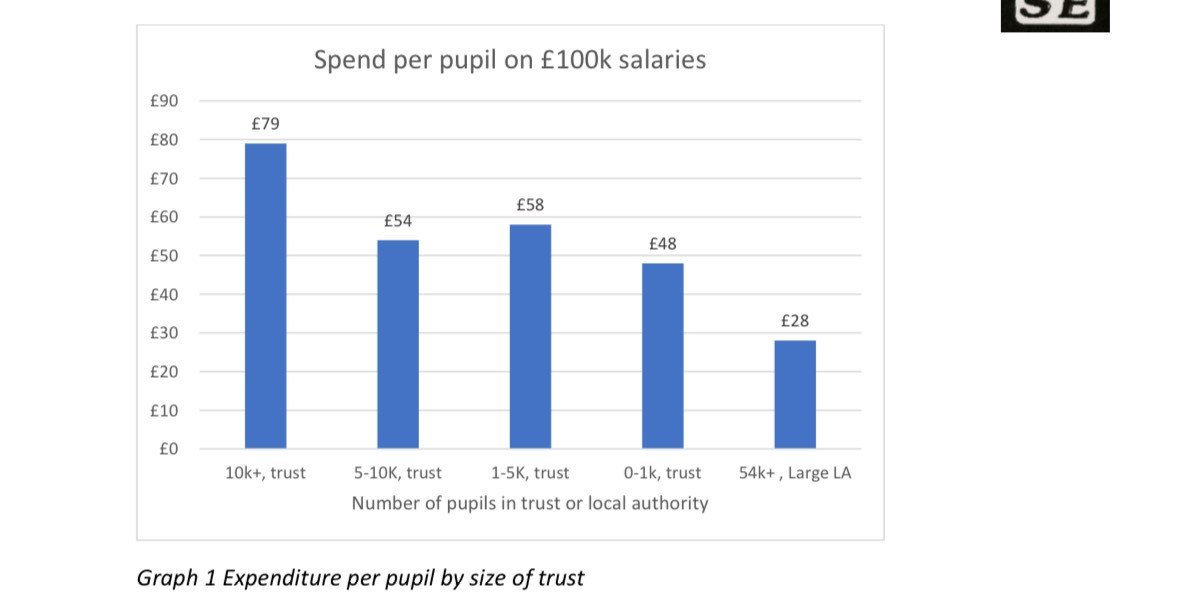
The CASE investigation found that in 2021/22 the 50 largest MATs had seven times as many staff paid at least £130,000 a year and 13 times more managers paid at least £200,000 a year than the largest Local Education Authorities (LEAs) administering non-academy schools educating approximately the same number of pupils:
“The top salary across the whole of these 10 [LEAs], paid to any headteacher or education official, was £201,616, paid to [the] corporate director for children, young people and education in Kent… [while] within the 50 largest academy trusts, 19 people were paid above [this sum] … with the highest-paid being … the chief executive of the Harris Federation, receiving £455–£460,000 in 2021–22.”
The CASE report calculates that £80 per pupil was spent in these MATs, compared to £28 per pupil in the LEAs. Running these MATs at the same cost as the LEAs would have saved the state £43.9mn.
Does academisation improve schools?
In 2018, the Department for Education permanent secretary commented that there was “no proof that forced academisation improves schools” and, in both 2019 and 2023, the Local Government Association found that Ofsted data indicated that LEA-managed schools improved faster than MATs.
Another question is raised in the CASE report about the Harris 52-school federation is the proposal that the ‘business’ will pass to the family members of the chief executive when he dies: the startling prospect of a chain of state-funded schools in England becoming part of a family business empire.
In 2019, research undertaken by Open Democracy found that 100,000 children in England were in schools controlled by wealthy business people, many of them Conservative Party donors.
The first CASE report concludes:
“England has gone from having 150 local authorities, each led by a relatively small number of people paid high salaries, to having around 2,500 academy trusts, many of the larger ones of which have a management layer with individuals on high salaries, plus the 150 local authorities.”
Teachers and pupils: first or second class citizens?
The second CASE report, published on 4October 2024, focused on teacher retention and pay in MATs as compared to LEA-administered schools.
Its headline findings were that teachers working in some large MATs were leaving their jobs at twice the rate of teachers in LEA schools. For example, the overall rate of teachers leaving LEA primary schools in 2021/22 was 16%, compared to a rate of just over 30% in three of the largest MATs. The differences between secondary schools leaned in the same direction, but more subtly: 14.8% in LEAs, 17.7% in MATs and 19.5% in the 50 largest MATs.
Overall, MATs spent less on teacher salaries than LEAs, and MAT teachers were on average younger, less likely to hold qualified teacher status and faced larger class sizes. MATs spent more money on paying top management and less on paying classroom staff.
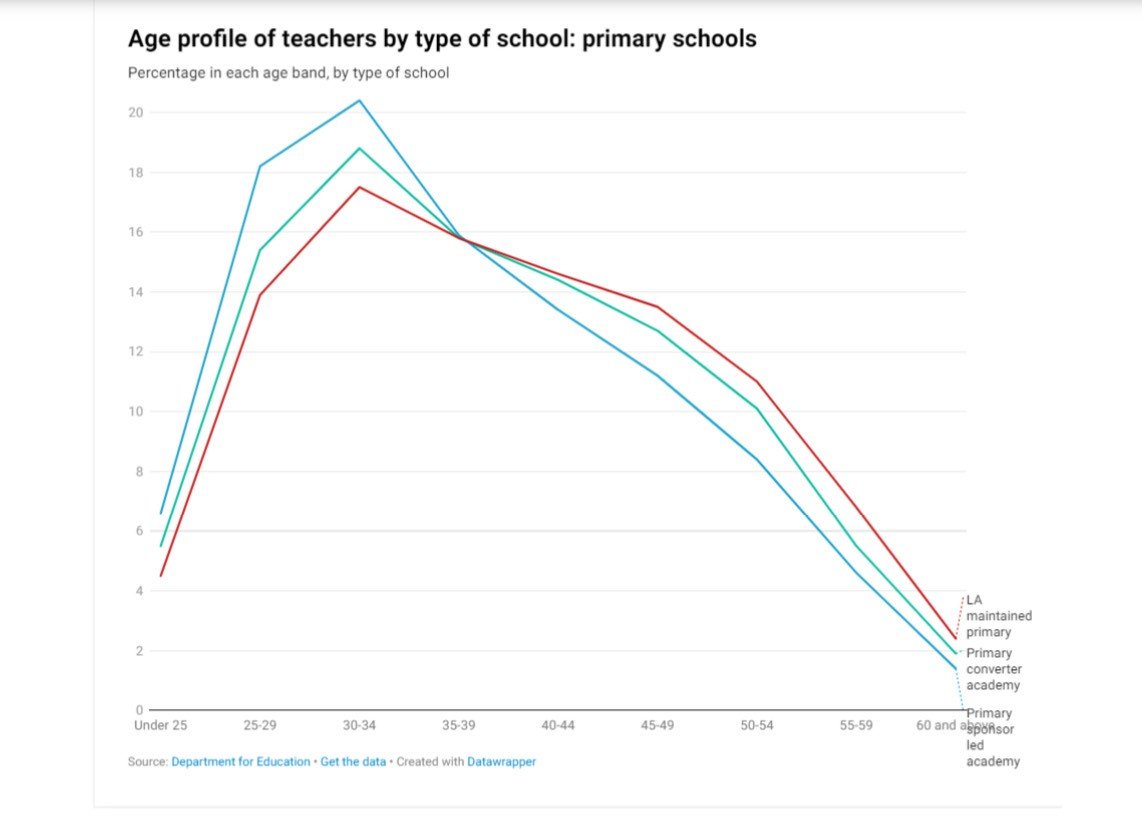
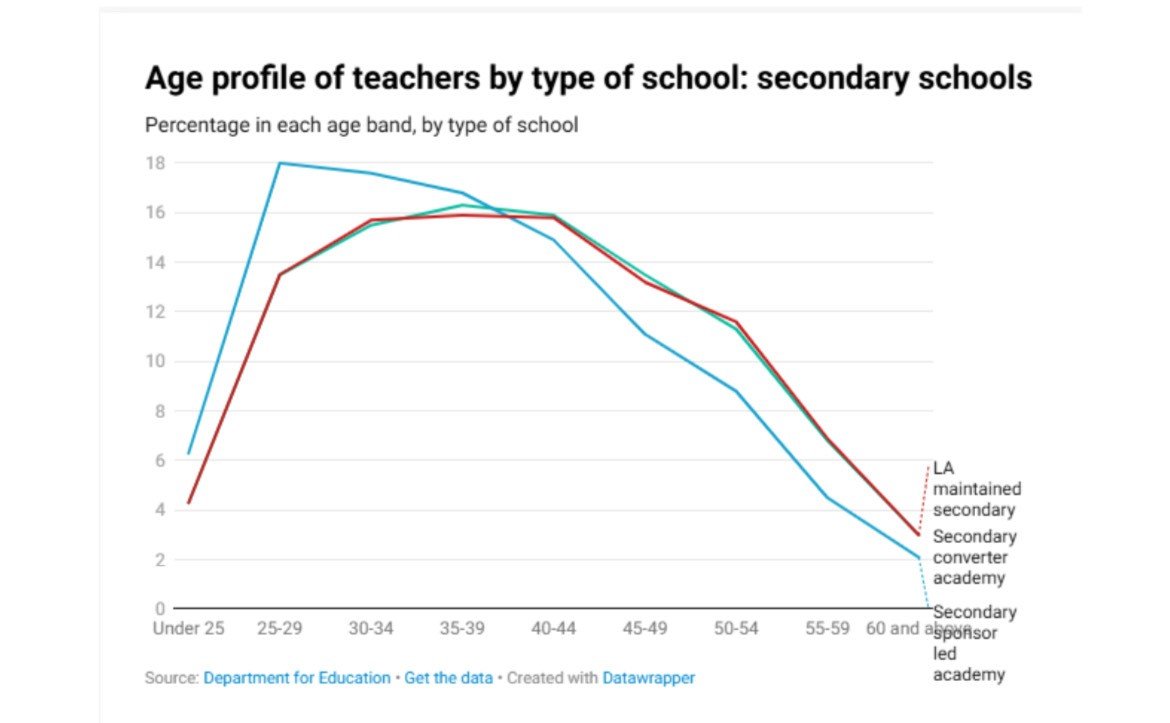
Teachers in schools that had been forcibly academised, a contentious process investigated within our region last year by Yorkshire Bylines, were paid on average £2,000 less than their counterparts in LEA schools, a statistic that may be related to the additional finding that such schools had 50% more staff under 25 than LEA schools.
The figures suggest that in ‘sponsored’ – forcibly academised – primary and secondary schools teachers are on average two years younger. This may seem a minor statistic to a non-teacher, but experienced teachers are acutely aware that, in tough secondary schools, the closer the age of the teacher to the pupils, and the less experienced they are, the more likely they are to struggle with behaviour management.
A related statistic ringing similar alarm bells is the greater likelihood that MATs will have a higher proportion of unqualified teachers. In secondary schools, the CASE report finds 2.9% in LEA-managed secondary schools versus 4.5% in ‘sponsored’ MAT schools. Younger, less qualified teachers in some of the most difficult schools in the country is clearly not a satisfactory outcome for a purportedly ‘new and improved’ way of organising education management.
Luckily, the recent King’s speech has clearly specified that all teachers in England will forthwith be required to hold, or to be working towards qualified teacher status, among a raft of other measures aimed at equalising the pupil experience between LEA-administered schools and MATs.
Please sir, I want some more
Overall, the CASE report claims that the statistics indicate that, when comparing a large MAT to a similar sized LEA area, the implication is that the MAT is likely to be spending £6.7 million less on classroom teachers and educational support staff than is typical in the LEA-maintained sector, but will be operating at a higher cost to the public purse.
Spending per pupil was 6% less in MAT primary schools than in those administered by LEAs, and 5.4% less in secondary schools. The 50 largest MATs have 28.2 pupils per primary teacher compared to 20.5 in LEA-administered schools. Secondary school differences were more subtle and varied, with the highest pupil- teacher ratios in smaller single school academies and LEA-administered schools.
The CASE report proposes:
“In 2022–23, the 50 largest trusts employed a total of 32,392 teachers to educate 568,569 pupils in their secondary schools. They would need to take on more than 2,000 teachers between them – 2,575, to be precise – to have pupil: teacher ratios at the same level as that in non-academy [LEA] secondaries. That would mean an increase of 7.9% in the number of teachers they employ.”
Are MATs worth it?
A current FFT data lab report proposes that:
“According to government figures, there were just 203 academies open in 2010, when a Labour government was last in power. The latest data shows that there are now over 10,000, amounting to 50% of all open schools … the vast majority of academies are part of a multi-academy trust, 89%, at the latest count, with the remaining 11% operating as single-academy trusts.”
In the dying days of the 2010–2024 Conservative government, their final education secretary, Gillian Keegan triumphantly tweeted her pride in their academisation achievement.
But are these ‘higher standards’ she proclaims an illusion?
The CASE reports indicate that MATs cost the nation more, but spend more of that funding on management than on pupils and teaching staff, that they have younger teachers on average, who are more likely to be unqualified, and who are more likely to leave their jobs: “in the largest academy trusts… some of the largest chains lose up to a quarter of their teachers [each year] – in one case, the figure was 30%.”
There is also evidence elsewhere that MATs are more likely to ‘lose’ the very pupils who require the most care from adults outside the family; those who are economically disadvantaged and disengaged with school – a process that has been labelled ‘ghosting’.
Overall, the evidence suggests that the jury is still out on the quality of England’s so-called ‘improved’ state schools system, and the impact of large MATs with superannuated non-teaching CEOs and directors in particular.
Bridget Phillipson, the current education secretary, therefore has an urgent task ahead, in terms of commissioning a much larger investigation and taking urgent action if her findings also indicate that too many MATs are putting copious amounts of public money into the pockets of non-teaching managers while giving the nation’s children less quality for more funding.

CLICK HERE TO DONATE TO OUR CROWDFUNDER
HELP US BECOME STRONGER SO THAT WE CAN CONTINUE TO DELIVER POWERFUL CITIZEN JOURNALISM!